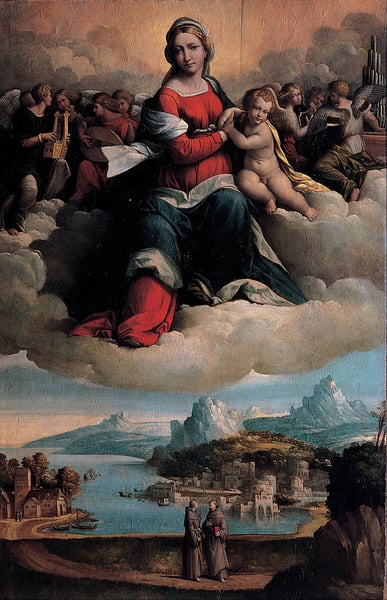
Analisi esperta di Madonna with the Child in Glory and Holy Ones di Benvenuto Tisi
Stile: Mannerism (Late Renaissance) · Genere: religious painting
Expert Analysis: Madonna with the Child in Glory and Holy Ones by Benvenuto Tisi (Il Garofalo)
Style & Period Context:
This work exemplifies Mannerism, the late Renaissance movement that emerged as a sophisticated, self-conscious reaction to the harmonious ideals of the High Renaissance. Benvenuto Tisi, known as Il Garofalo, was a leading Ferrarese painter who synthesized influences from Raphael, Leonardo, and the Venetian colorists, yet his work distinctly pushed toward Mannerist elegance.
Significance Within Mannerism:
-
Elongated, Graceful Figures: The Madonna and Child, along with the “holy ones” (saints or angels), would be rendered with exaggerated slender proportions and refined, almost serpentine poses. This elongation conveys a sense of spiritual otherworldliness, a hallmark of Mannerist religious painting that prioritizes grace over naturalism.
-
Complex, Layered Composition: The title’s “in Glory” suggests a celestial vision—likely a dynamic, crowded arrangement of figures ascending or floating in a luminous void. Mannerists often disrupted Renaissance balance with asymmetrical, crowded, or spiraling compositions to evoke divine mystery.
-
Artificial, Jewel-like Color: Tisi’s Ferrarese training (stemming from the School of Ferrara, influenced by Dosso Dossi) would yield acidic, cool greens, deep pinks, and golden highlights—colors that are heightened and non-naturalistic, intensifying the sacred drama.
-
Emotional Ambiguity: Unlike High Renaissance clarity, Mannerist figures often wear distant, melancholic expressions or engage in ambiguous glances. In this work, the Madonna might look away from the Child, directing the viewer’s attention heavenward, fostering a contemplative, unresolved spiritual tension.
Why It Matters:
“Madonna with the Child in Glory and Holy Ones” is significant as a prime example of Mannerist religious transcendence. It bridges the High Renaissance’s serene ideal and the coming Baroque dynamism. Tisi’s adaptation of Raphael’s grace into a more intricate, emotionally layered vision demonstrates how Mannerists reimagined traditional devotional subjects for a period obsessed with artifice, spirituality, and intellectual complexity. The painting’s very title—in Glory—announces its departure from earthly naturalism toward a mystical, mannered heaven.
Visivamente simili
20 opere con composizione e palette affini
The Vision of St. Augustine
Benvenuto Tisi
Madonna in Glory with Four Saints
Andrea del Sarto
Assumption of the Virgin
Andrea del Sarto
The Holy Family Appearing in a Vision to St Gaetano
Giovanni Battista Tiepolo
The Madonna of Foligno
Raphael
Mary in Glory
Albrecht Altdorfer
The Madonna and Child with Saint Martina
Lazzaro Baldi
Desposorios místicos de Santa Inés
Francisco Pacheco
La Venida De La Virgen Del Pilar a Zaragoza
José Luzán
Gazing Ball (Perugino Madonna and Child with Four Saints)
Jeff Koons
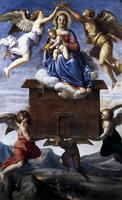
Translation of the Holy House
Annibale Carracci
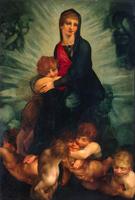
Madonna and Child with Putti
Rosso Fiorentino
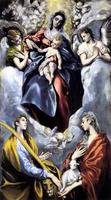
The Virgin and Child with St. Martina and St. Agnes
El Greco
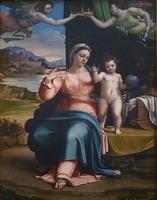
Holy Family
Sebastiano del Piombo
Holy Family with Saints Catherine of Alexandria and John the Baptist
Palma Vecchio
Madonna and Child with Angels
Correggio
Virgin and Child with Souls in Purgatory
Luca Giordano
The Virgin Mary in Glory
Jan Provoost
Holy Family with the Infant Saint John the Baptist
Orazio Gentileschi
The Holy Family with Saints
Benvenuto Tisi