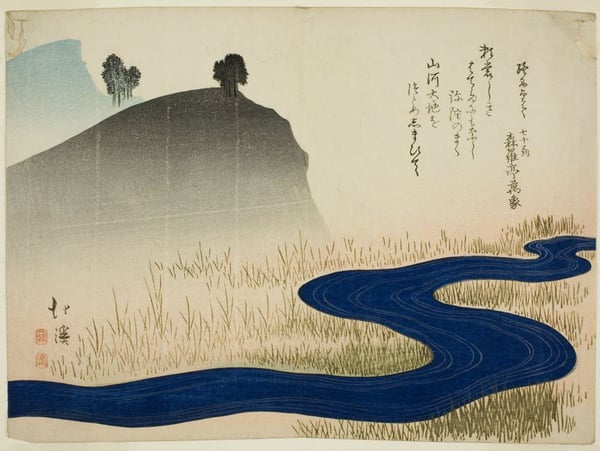
Expertenanalyse zu Toyota Hokkeis A Mountainous Landscape with a Stream
Stil: Ukiyo-e · Genre: landscape
Expert Analysis: "A Mountainous Landscape with a Stream" by Toyota Hokkei
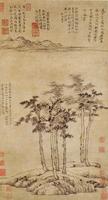
Toyota Hokkei’s A Mountainous Landscape with a Stream is a refined example of the ukiyo-e landscape tradition, a genre that flourished in Japan during the late Edo period. While Hokkei is best known for his intricate surimono (privately commissioned prints), this work demonstrates his mastery of the broader ukiyo-e ethos: capturing the sublime beauty of nature through bold composition, precise linework, and a harmonious color palette.
Significance within Ukiyo-e Landscape Painting
- Integration of Western Perspective: Hokkei, a pupil of the iconic Katsushika Hokusai, skillfully incorporates Western linear perspective—a hallmark of ukiyo-e landscape innovation—to create depth in the receding stream and layered mountain forms. This synthesis of Japanese flatness with European spatial illusion marks the work as a product of the period’s cross-cultural exchange.
- Dynamic Naturalism: The composition directs the viewer’s eye from the rocky foreground, through the meandering stream, to the distant peaks shrouded in atmospheric mist. Hokkei’s use of varying line weights—subtle for clouds, assertive for mountain ridges—imbues the scene with both tranquillity and tectonic energy, a balance characteristic of the ukiyo-e landscape genre.
- Material and Technique: Executed as a woodblock print (or possibly a hanging scroll, depending on the specific medium), the work likely employs the bokashi (gradation) technique to soften the sky and water, enhancing the ephemeral quality of light. This technical sophistication elevates the piece beyond mere topography, aligning it with the ukiyo-e ideal of fūkei-ga (landscape pictures) as meditations on nature’s permanence and impermanence.
Art-Historical Position
While Hokkei is often overshadowed by his teacher Hokusai and contemporaries like Hiroshige, A Mountainous Landscape with a Stream reveals his distinct voice: a quieter, more intimate approach to the monumental landscape. The work’s significance lies in its demonstration of how ukiyo-e artists of the second generation continued to refine the genre, blending native traditions of seasonal motif with borrowed techniques, yet retaining a distinctly Japanese sensitivity to line, space, and the sublime power of the natural world.
Visuell ähnlich
20 Werke mit ähnlicher Komposition und Farbpalette
Autumn on the outskirts of Yangzhou
Shitao
Island Enoshima. The Fuji can be seen far away
Utagawa Kuniyoshi
Blind Men Crossing a Bridge
Hakuin Ekaku
View of Mt. Fuji
Utagawa Kuniyoshi
Mount Fuji from the Sumida River embankment
Utagawa Kuniyoshi
Water and Bamboo Dwelling
Ni Zan
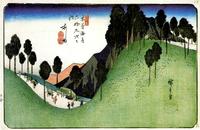
Ashida
Hiroshige
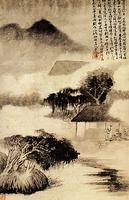
Sound of thunder in the distance
Shitao
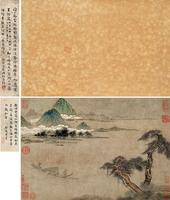
青山白云图
Qian Xuan
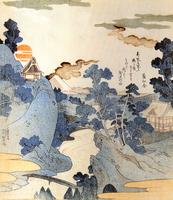
View of Mt. Fuji
Utagawa Kuniyoshi
Poem and Falling Cherry Petals
Shibata Zeshin
23. Chiyogaike Pond in Meguro
Hiroshige
Evening Snow on Mount Hira
Hiroshige
Three Friends of Winter
Bada Shanren
Cypresses
Qi Baishi
楼台殿阁图
Qian Xuan

Landscape (Dong Yuan and Juran Style)
Bada Shanren
Sakanoshita: the Throwing Away the Brush Peak
Hiroshige
Ochanomizu
Utagawa Kuniyoshi
Six Gentlemen
Ni Zan