
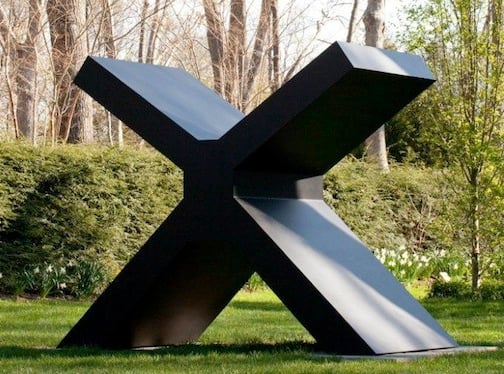
Экспертный разбор работы «The X» художника Ronald Bladen
Стиль: Minimalism · Жанр: sculpture
Expert Analysis: "The X" by Ronald Bladen
As a seminal work of Minimalist sculpture, Ronald Bladen’s “The X” stands as a powerful distillation of the movement’s core principles. Created in the mid-1960s, this piece epitomizes Minimalism’s radical shift away from expressionistic or narrative content toward pure, reductive form. Bladen, a key figure in the development of Minimalist sculpture, achieved significance by transforming the simple geometry of an “X” into a monumental, physically assertive object.
Significance within Minimalism
-
Geometric Purity & Scale: True to Minimalist ideals, “The X” strips form to its most elemental shape—two intersecting diagonal beams. Bladen eschews any ornamentation or representational reference, letting the stark geometry dictate the viewer’s experience. However, he amplifies this simplicity through massive scale (often towering over the viewer), a tactic that forces a direct physical encounter rather than a purely optical one. This aligns with Minimalism’s goal of creating “specific objects” that occupy real space with undeniable presence.
-
Materiality & Color: In typical Minimalist fashion, Bladen usually painted his sculptures in matte black or white, eliminating surface texture or expressive brushwork. This treatment makes the form read as a unified, monolithic whole, emphasizing volume and mass over detail. The monochrome finish also heightens the interplay of light and shadow, making the “X” seem to slice through the gallery or landscape.
-
Gestalt & Perception: The “X” is a classic example of Minimalism’s reliance on gestalt—the viewer grasps the entire shape instantly. Yet Bladen complicates this: from frontal view, the arms appear flat; from oblique angles, they reveal depth and cantilevered weight. This tension between immediate recognition and spatial ambiguity is a hallmark of Minimalist sculpture, demanding active perceptual engagement.
-
Context in the Minimalist Canon: While contemporaries like Donald Judd and Robert Morris favored boxy, serialized forms, Bladen’s “The X” introduced a dynamic, almost vector-like thrust into Minimalism. Its angled lines create a sense of energy and directional force—almost a frozen “explosion”—that distinguishes it from the static, gridded works of his peers. This made the piece a touchstone for the movement’s exploration of how minimal shapes can generate psychological and environmental impact.
In summary, “The X” is significant because it achieves Minimalism’s ambition of a purely abstract, tangible form that asserts its own existence, while injecting a rare dynamism and spatial drama that pushes the boundaries of the style. It remains a benchmark for how reduction can amplify presence.
Визуально похожие
20 работ с близкой композицией и палитрой
Caephae-Aekyad #2
Douglas Abdell
For Roebling
Mark di Suvero
V (Garden)
Ronald Bladen

Einheit aus drei gleichen zylindern
Max Bill
Fısıltı
Fusun Onur
Monumento
Eduardo Chillida
Arbre
Eduardo Chillida

Source
Tony Smith
Untitled
Thomas Downing
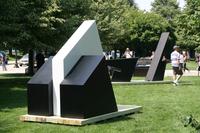
Black Lightining (Garden)
Ronald Bladen
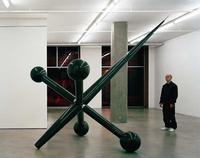
Black Jack
Inigo Manglano-Ovalle
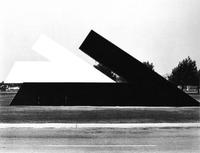
Raiko I
Ronald Bladen
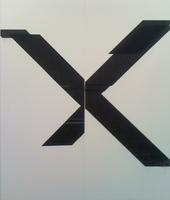
Untitled
Wade Guyton
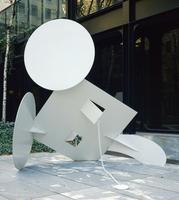
Geometric Mouse, Scale A
Claes Oldenburg
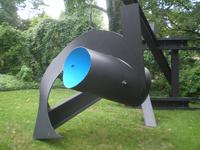
Sister Lu
Mark di Suvero
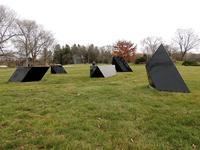
Wandering Rocks
Tony Smith
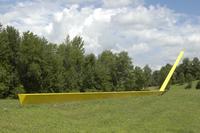
Untitled
Robert Grosvenor
Kryeti-Aekyad #3
Douglas Abdell
Orinoco
David Annesley
Sculpture in front of Burgo Empreendimento
Angelo de Sousa