Expertenanalyse zu Fernand Leducs Triptyque ocre-violet-rouge
Stil: Color Field Painting · Genre: abstract
Expert Analysis of "Triptyque ocre-violet-rouge" by Fernand Leduc
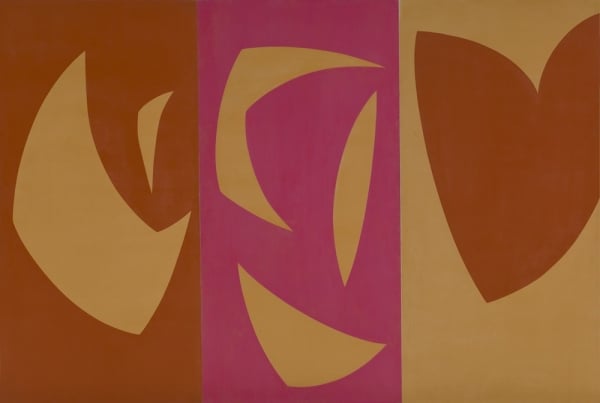
This work stands as a compelling example of Color Field Painting, a movement that emerged in the mid‑20th century as a radical exploration of pure, autonomous color. Fernand Leduc, a Canadian modernist who evolved from the gestural automatism of the Refus global group toward a more disciplined, luminous abstraction, here employs a triptych format—a structure traditionally associated with religious altarpieces—to orchestrate a meditative dialogue among three chromatic zones: ocher, violet, and red.
The title itself announces the work’s essence: color is both subject and substance. Leduc avoids narrative, figuration, or overt symbolism, instead allowing large, unmodulated fields of hue to activate the viewer’s optical and emotional response. The significance within the Color Field canon lies in Leduc’s subtle modulation of intensity and temperature: ocher (earthy, warm) yields to violet (cool, introspective) and red (urgent, passionate). By arranging these in sequence, he creates a rhythm akin to a visual chord, where each panel both contrasts and harmonizes with its neighbors.
The triptych structure further distinguishes the work. Rather than a single vast canvas (common in Color Field giants like Rothko or Newman), Leduc’s tripartite division invites a temporal, almost musical reading—left to right, color unfolds as a journey. This choice reflects his desire to infuse abstract form with a contemplative, almost spiritual quality, echoing the movement’s broader ambition to make color a direct vehicle for transcendent experience.
In the context of Leduc’s own development, this painting marks a mature synthesis: the spontaneity of his earlier automatist period is disciplined into flat, serene expanses, yet the visceral impact of color remains untamed. “Triptyque ocre-violet-rouge” thus exemplifies how Color Field painting could retain expressive power while shedding all reference beyond the painted surface—a testament to the movement’s core belief that color itself is enough.
Visuell ähnlich
20 Werke mit ähnlicher Komposition und Farbpalette
Untitled - Abstract
Will Barnet
Berlin Blues 6
William Scott
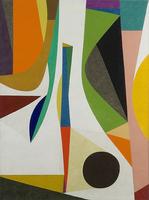
Up Within
Frederick Hammersley
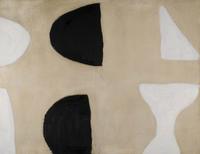
Angle
William Scott
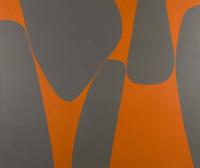
Magical Space Forms
Lorser Feitelson
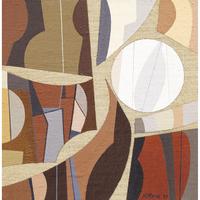
Sentiers
Jean-Paul Jerome
M-yellow
Ray Parker
Can be joined any way
Harriet Korman
Composition 16
Stefan Sevastre
Dal di fuori
Atanasio Soldati
Doppio
Atanasio Soldati
La Magnanerie de la Ferrage
Alberto Magnelli
Serie 4x4
Sofia Areal
The Growth of Trees
Constantin Flondor
Untitled
Sophie Taeuber-Arp
Abstract Composition
Jean Helion
Untitled
Pedro Coronel
Untitled
Karl Benjamin
Hélène
Richard Mortensen
Magical Space Forms
Lorser Feitelson