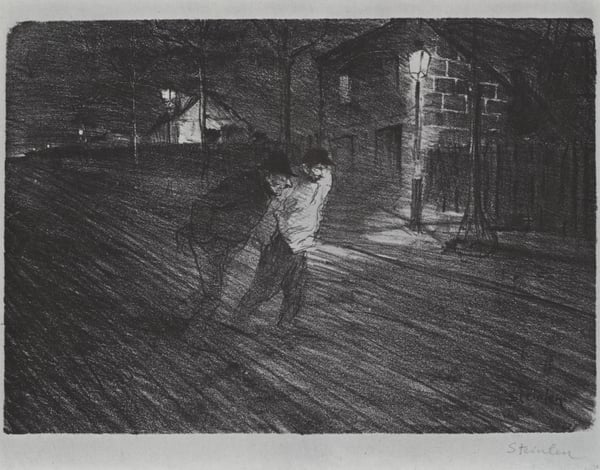
Expert analysis of Theophile Steinlen’s La Rue Caulaincourt
Style: Realism · Genre: illustration
Expert Analysis of “La Rue Caulaincourt” by Théophile Steinlen
Théophile Steinlen’s “La Rue Caulaincourt” stands as a compelling exemplar of Realism fused with the narrative urgency of illustration. Executed in the late 19th or early 20th century, the work captures a quotidian street scene in the Montmartre district of Paris—a locale Steinlen knew intimately and chronicled with unsentimental fidelity.
Significance within Realism
As a Realist work, the print or drawing eschews idealization, focusing instead on the unvarnished textures of working-class urban life. Steinlen’s careful observation of light, shadow, and architecture on the sloping street—famous for its bridge crossing the Montmartre cemetery—anchors the composition in a specific, recognizable place. The artist’s choice of humble subjects—pedestrians, shopfronts, perhaps a weary laborer or a mother with a child—reflects Realism’s core mission: to elevate ordinary existence to the level of serious art. By rendering the grit and grace of daily routine without melodrama, Steinlen reinforces the movement’s rejection of Romantic idealization in favor of empirical truth.
Significance within Illustration
Steinlen was a master of illustration, a genre often dismissed as lesser art but which he elevated through technical skill and social consciousness. “La Rue Caulaincourt” was likely created for a periodical or poster, functioning not merely as decoration but as a visual document meant to inform, engage, or comment. The illustration’s strong linear dynamics and expressive economy of detail—hallmarks of Steinlen’s poster work—make the street’s character instantly legible. In this context, the artwork becomes a historical record of Montmartre’s transformation from a village-like enclave to a bustling urban district, capturing the tension between old Paris and modernity.
Why It Matters
Steinlen’s “La Rue Caulaincourt” is significant precisely because it blurs the boundary between fine art and popular media. It demonstrates how Realist principles could thrive outside the academy, reaching a broad audience through illustrated journals and advertisements. The work’s empathetic gaze toward the city’s marginal figures—beggars, workers, children—aligns it with social realist currents, prefiguring later 20th-century documentary photography. In this single street scene, Steinlen encapsulates both the aesthetic rigor of Realism and the communicative power of illustration, proving that commercial art can be as perceptive and enduring as gallery painting.
Visually similar
20 works with related composition and palette
Amants de Village
Theophile Steinlen
Rue Ravignan, Paris
Maximilien Luce
Paris at night
Arturo Souto
Group of figures in front of a house and some trees
Georges Seurat
Soliloque Cover
Theophile Steinlen
City View
Vincent van Gogh
Dans La Rue
Theophile Steinlen
Scullery
Arturo Souto
The Kiss
Theophile Steinlen
Amoureux Sur Un Banc
Theophile Steinlen
Nocturne in Grey and Gold: Chelsea Snow
James McNeill Whistler
Vanite d'Un Viellard
Theophile Steinlen
Paris La Nuit
Theophile Steinlen
Hornsgatan nattetid
Eugène Jansson
Chemineau Traversant Un Village Endormi
Theophile Steinlen
Stone breakers, Le-Raincy
Georges Seurat
Dawn on the Outskirts of Town (Morning)
Istvan Farkas
People Walking on a Street in the Evening
Vincent van Gogh
Vagabond Sous La Neige
Theophile Steinlen
La Derniere Bastille
Theophile Steinlen