Analisi esperta di Don Quijote di Esteban Frances
Stile: Surrealism · Genere: illustration
Expert Analysis of "Don Quijote" by Esteban Frances
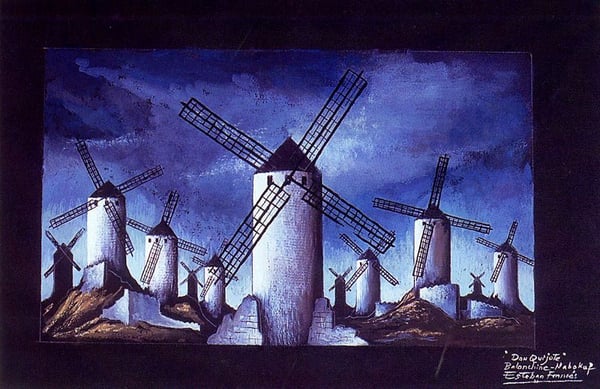
Esteban Frances, a Spanish-born surrealist who later became a key figure in the New York School, brings a distinctly dreamlike and psychologically charged lens to the iconic literary figure of Don Quijote. As an illustration, this work transcends mere visual accompaniment to the text, instead functioning as a surrealist reinterpretation that probes the deeper, subconscious layers of Cervantes’ character.
Significance within Surrealism and Illustration:
-
Surrealist Mutation of a Cultural Icon: Frances transforms the knight-errant into a symbol of the surrealist obsession with the irrational and the metamorphic. Rather than depicting Quijote as a recognizable, armored figure, Frances likely distorts his anatomy or environment—common techniques in surrealist illustration to express the collision of reality and fantasy. This aligns with the surrealist goal of liberating the imagination from rational constraints, making Quijote’s madness not a pathology but a gateway to a higher, poetic truth.
-
Fusion of High Art and Popular Illustration: By choosing the genre of illustration—often considered a commercial or secondary art form—Frances challenges the hierarchy of artistic media. Surrealists frequently embraced illustration, collage, and book arts to disseminate their ideas beyond the gallery. His "Don Quijote" would be a prime example of how surrealism infiltrated literary illustration, infusing a canonical work with the movement’s characteristic disquieting beauty and unconscious symbolism.
-
Personal and Cultural Resonance: As a Spanish artist, Frances brings a personal and national dimension to the subject. Don Quijote is a quintessentially Spanish archetype of the idealist struggling against an unyielding reality. In Frances’s surrealist hands, this struggle becomes internalized, reflecting the artist’s own experience of exile (he fled Spain for Mexico and later the U.S.). The illustration thus serves as a self-portrait of the artist as a displaced dreamer, rendered through the visual language of impossible spaces and hybrid forms.
-
Technical and Compositional Innovation: Surrealist illustration often employs precise draftsmanship combined with irrational juxtapositions. Frances’s background in design and printmaking would have allowed him to execute a technically refined image that still feels unsettling or enigmatic. The significance lies in how the illustration balances readability (as a depiction of a literary character) with surrealist dislocation, inviting viewers to see Quijote not as a static hero but as a living, shifting entity of the subconscious.
Without specific visual details, we can conclude that Frances’s "Don Quijote" is a key example of how surrealism revitalized literary illustration by transforming a beloved myth into a vehicle for exploring desire, delirium, and the fluid boundaries between madness and revelation.
Visivamente simili
20 opere con composizione e palette affini
Bretagne
David Kakabadze
Moinho do Estevão, Alcochete
António de Carvalho da Silva Porto
Moulin
Henri Matisse
Les anciens moulins de Montmartre et la ferme Debray
Maurice Utrillo
Windmills of Montmartre
Maurice Utrillo
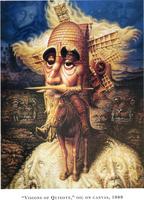
Visions of quixote
Octavio Ocampo
Untitled
Tano Festa
Mykonos at Night
Spyros Vassiliou
Andante (Sonata of the Spring)
Mikalojus Konstantinas Ciurlionis
Windmill near Guerande
Ferdinand du Puigaudeau
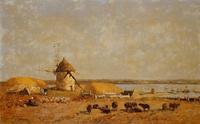
View from the Camaret Heights
Eugene Boudin
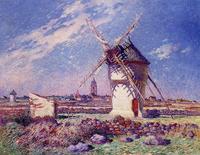
Windmills near the Town of Batz
Ferdinand du Puigaudeau
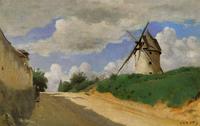
Windmill on the Cote de Picardie, near Versailles
Camille Corot
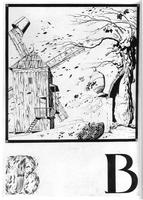
Sheet 'V' from the album 'Ukrainian alphabet'
Heorhiy Narbut
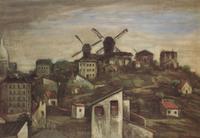
Montmartre Windmills
Theophile Steinlen
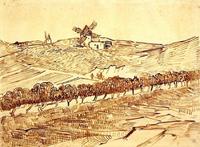
Landscape with Alphonse Daudet's Windmill
Vincent van Gogh
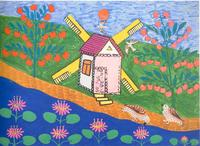
Two Pigeons Drank Water by a Windmill and Ford
Maria Primachenko
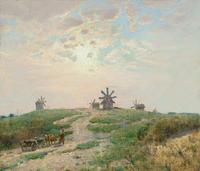
Windmills on the Hill
Васильківський
Landscape with Windmill
Georges Michel
Green autumn
Zinaida Serebriakova