
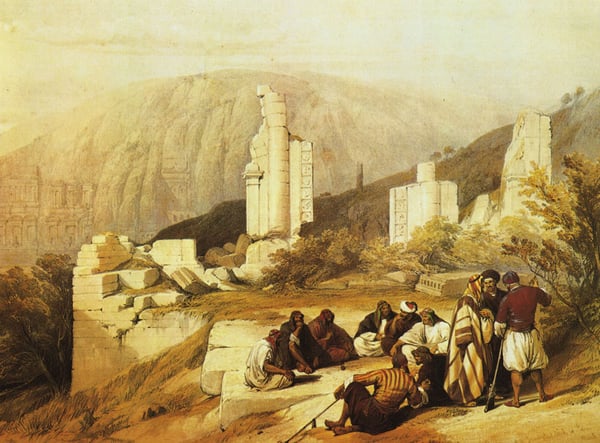
Petra. Ruins of a Triumphal Arch
Expert analysis of David Roberts’s Petra. Ruins of a Triumphal Arch
Style: Romanticism, Orientalism · Genre: genre painting
Expert Analysis: Petra. Ruins of a Triumphal Arch by David Roberts
This work is a quintessential example of how Romanticism and Orientalism converge in mid-19th-century European art. Roberts, a Scottish painter and lithographer, became celebrated for his archaeological precision and evocative storytelling during his travels through the Middle East.
Significance within Romanticism and Orientalism:
- Romanticism prized the sublime, the ancient, and the emotional power of decay. Here, the crumbling arch—once a symbol of Roman triumph—becomes a Romantic emblem of transience and human ambition swallowed by time. The dramatic scale of the ruins, set against the stark desert landscape, evokes awe and melancholy, key Romantic responses to the “sublime” in nature and history.
- Orientalism shaped Western perceptions of the East as exotic, mysterious, and frozen in a glorified past. Roberts presents Petra—a lost Nabataean city—as a theatrical spectacle: the arch’s intricate carvings, now weathered, invite viewers into a dreamlike world of antiquity. His attention to architectural detail satisfies a Western appetite for “authentic” documentation, yet the composition is inherently romanticized, framing the ruins as a stage for imagined histories.
Genre Painting and Human Presence:
Though the scene centers on a monumental ruin, Roberts categorizes this as genre painting—a depiction of everyday life. Small human figures often populate his landscapes, lending scale and narrative. Here, locals (likely Bedouins or travelers) pause near the arch, their humble presence contrasting with the colossal structure. This juxtaposition reinforces the Orientalist trope of the East as a land where ancient glory coexists with a “timeless” present. The figures are not historical reenactors but contemporary inhabitants, grounding the Romantic ruins in a lived, accessible reality.
Artistic Legacy:
Roberts’ lithographs of Petra (from his 1842–49 series The Holy Land, Syria, Idumea, Arabia, Egypt, and Nubia) were among the first widely circulated European images of the site. This work crystallizes the Romantic–Orientalist gaze: it is both a topographic record and a poetic meditation on decay, serving as a bridge between documentary travel art and the exoticizing fantasies that shaped 19th-century Western views of the Middle East.
Genre
Visually similar
20 works with related composition and palette
Baalbek, General View
David Roberts
Rovine con accampamento di arabi
Jakob Alt

Sight of Petra, South
David Roberts
Bataille d'Heliopolis
Léon Cogniet

A depiction of Jesus and the woman taken in adultery
Vasily Polenov

The Refugees of Parga
Francesco Hayez
Christ and the Sinner
Vasily Polenov
Christ and the Sinner
Vasily Polenov

Versöhnung Jakobs mit Esau
Heinrich Schonfeld
Vue d’orient
Louis-Amable Crapelet
Alexander at the Tomb of Cyrus the Great
Pierre-Henri de Valenciennes

Bonaparte in Cairo
Pierre-Narcisse Guerin

Baalbek. From the Fountain
David Roberts
Landscape with coast and ruin
Jacob van Strij

Nazareth. The Fountain of the Virgin
David Roberts
Donkey drivers at an Italian ruin
Jan Asselijn

Landscape with Saint John on Patmos
Nicolas Poussin

Landscape with St. James in Patmos
Nicolas Poussin

The captured thief
Alfred Dehodencq
The Campo Vaccino with a Gypsy Woman Reading a Palm
Paul Bril