Description
Style : Naïve Art (Primitivism), Post-Impressionism · Genre : animal painting
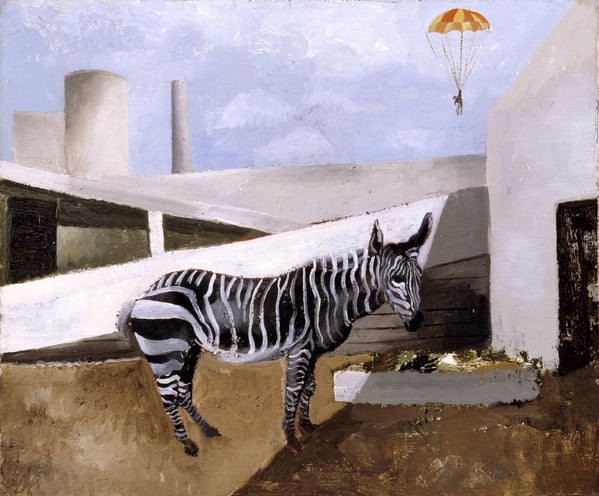
Zebra and Parachute is one of Wood’s last paintings. The image brings together an unusual collection of elements that give the work a surrealist flavour. A zebra appears against the backdrop of a modernist building. The animal stands on the building’s roof terrace near a raised flowerbed. The distinctive lines of the architecture, which include strong diagonals produced by a zig-zagging ramp and the cylindrical forms of two chimneys or towers in the background, suggest an almost abstract arrangement that contrasts with the altogether different pattern produced by the zebra’s stripes. A dark shadow falls just in front of the zebra, casting the right-hand zone of the terrace into semi-darkness and adding to the mysterious atmosphere of the image. In the sky above this scene, a parachute is descending. The tiny figure that dangles in the parachute harness appears limp and lifeless.
The distinctive architecture of the building in Zebra and Parachute identifies it as the Villa Savoye, near Paris, designed by Le Corbusier. The villa, begun in 1928, was finished in 1931, and construction was well underway at the time Wood produced this painting. In the context of this work the Villa Savoye’s modernism suggests civilization and the zebra is a signifier of the exotic.
Wood was staying in Paris when he painted in Zebra and Parachute. Along with this work, he produced at the same time the closely related painting, Tiger and Arc de Triomphe. In it, he set up a similar juxtaposition of the exotic and the man-made as that produced in Zebra and Parachute, this time placing a lazily sprawling tiger and a sitting leopard against a wooded background with a view of the Arc de Triomphe monument behind them. Both paintings are reminiscent of the work of Henri Rousseau, known particularly for the depiction of animals in jungle settings in a naïve style. The parachute is perhaps evocative of Rousseau’s late landscape painting View of the of the Bridge at Sèvres and the Hills of Clamart, St Cloud and Bellevue, which includes in the sky a biplane, a hot-air balloon and an airship. In Zebra and Parachute, the effect of strong shadow cast across a built environment resonates with the work the Italian painter Giorgio de Chirico, with whose art Wood was familiar.
The surrealist aspects of Zebra and Parachute and Tiger and Arc de Triomphe suggest that Wood was striking off in a new direction at this point in his career. However, he tragically died on his return to England. Suffering the effects of opium withdrawal, which produced feelings of being pursued, he threw himself under a train at Salisbury station.
Museum / Gallery
Visuellement similaire
20 œuvres à la composition et à la palette proches
A Zebra
George Stubbs
Zebra
George Stubbs
Sleeping Zebra
Carel Willink
Man with zebra
Mary Fedden
The Peace of Wild Things
Gregorio Undurraga
Zebra II
Dieter Asmus
Zebra
Victor Vasarely
Vinyl
Arsen Savadov
Zebra and a Boy
Jahar Dasgupta
Zebra
Luis Paret y Alcazar
Spinoza
Alexander Roitburd
Donkey Frieze
Franz Marc
Zebra in Nature
Jahar Dasgupta
Fighting Zebras
Vladimir Tretchikoff
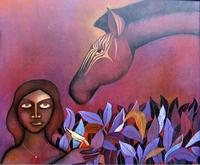
Zebra and Lady I
Jahar Dasgupta
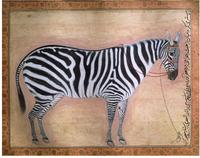
Zebra
Ustad Mansur
Study of a Donkey
David Cox
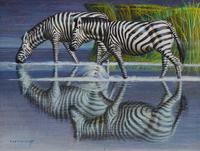
Zebras Drinking
Vladimir Tretchikoff
Zebra
Mary Fedden
Zebra
Bernadette Resha