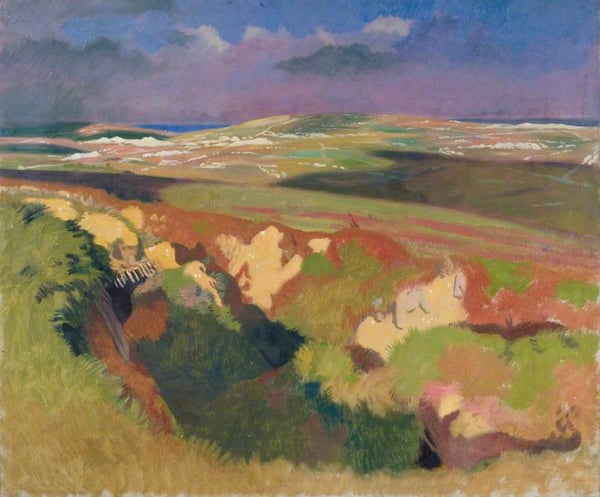
View from the Old British Trenches- Looking towards La Boisselle, Courcelette on the Left, Martinpuich on the Right
Details
Expert analysis of William Orpen’s View from the Old British Trenches- Looking towards La Boisselle, Courcelette on the Left, Martinpuich on the Right
Style: Post-Impressionism · Genre: landscape
As an expert art historian, I will analyze "View from the Old British Trenches- Looking towards La Boisselle, Courcelette on the Left, Martinpuich on the Right" by William Orpen (1878–1931), a work firmly rooted in Post-Impressionism and the landscape genre.
Significance: The Psychological Landscape of War through a Post-Impressionist Lens
This painting is significant as a rare and powerful fusion of military reportage with the subjective, emotive language of Post-Impressionism. While many war artists of the First World War focused on heroic action or documentary accuracy, Orpen uses the conventions of landscape painting—a traditionally serene genre—to depict the utter devastation of the Somme battlefield. The work’s title itself functions as a geographic coordinate, grounding the viewer in a specific, contested hellscape.
What sets this piece apart is Orpen’s deliberate stylistic choice. Post-Impressionism, with its emphasis on personal expression, arbitrary color, and structural composition, allows him to transform a barren, cratered field into a visually disorienting and psychologically charged environment. The muddy, ochre tones are not merely descriptive of the terrain; they are a fundamental part of the painting’s emotional palette—evoking the stagnation, decay, and the cloying physicality of the mud that swallowed men and machines. The flattened perspective and the way the distant villages (La Boisselle, Courcelette, Martinpuich) are reduced to indistinct smudges on the horizon create a sense of spatial and moral dislocation. The viewer is placed within the old British trenches, looking out at a landscape that offers no focal point of respite—just a barren expanse scarred by shell holes.
Orpen’s genius lies in making the landscape itself the primary subject of trauma. There are no soldiers in the foreground, only the absent presence of those who fought and died there. The painting’s significance, therefore, lies in its inversion of the pastoral tradition. It is a landscape of pure aftermath, rendered with a Post-Impressionist’s sensitivity to atmosphere and emotional weight. Orpen does not show us the battle; he shows us the memory of battle etched into the earth. The work stands as a testament to how modernist artistic language—with its break from strict naturalism—could more truthfully convey the unprecedented horror and surreal emptiness of industrialized warfare than any literal depiction could achieve.
Visually similar
20 works with related composition and palette
The Somme- A Clear Day; View from the British Trenches opposite La Boisselle, Showing the German Front Line and Mine Craters
William Orpen
Barranca del Agua Santa
Jose Maria Velasco
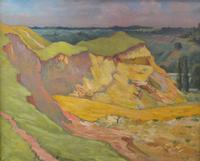
La Carrière
Léo Gausson
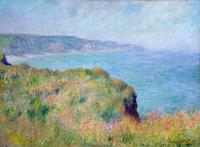
Cliff near Pourville
Claude Monet
Dunes
Vincent van Gogh
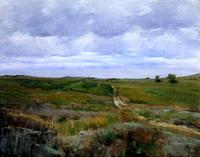
Over the Hills and Far Away
William Merritt Chase
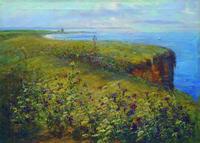
Landscape (Sea and Flowers)
Konstantin Makovsky
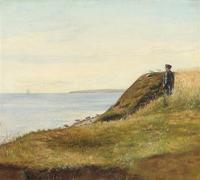
Scenery from Refsnæs on a sunday afternoon
Carl Bloch
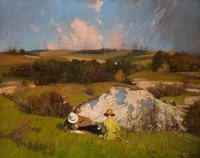
The Chalk Pit
George Henry
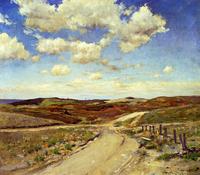
Shinnecock Hills
William Merritt Chase
Edge of the Cliff at Pourville
Claude Monet
Shinnecock Landscape
William Merritt Chase
Calvary
Nicolae Tonitza
Landscape
Kitty Lange Kielland
Road in Maine
Edward Hopper
Landscape, Shinnecock Hills
William Merritt Chase
Vertiente en el río
Jose Maria Velasco
Paysage avec une maison sur la colline
Maurice de Vlaminck
The Varangeville Church and the Cliffs
Pierre-Auguste Renoir
Torrey Pines
Maurice Braun