Daniele da Volterra sanatçısının Moses on Mount Sinai eseri hakkında uzman analizi
Tarz: Mannerism (Late Renaissance) · Tür: religious painting
Expert Analysis: "Moses on Mount Sinai" by Daniele da Volterra
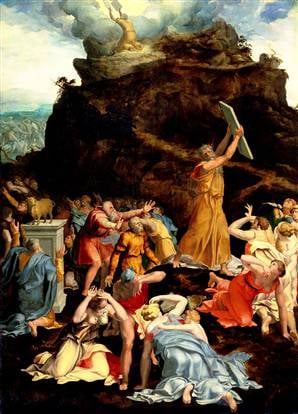
This work is a quintessential example of Mannerist religious painting, executed by Daniele da Volterra—a close follower of Michelangelo who navigated the shift from High Renaissance idealism to the more self-consciously artificial and emotional style of Mannerism. Painted during a period when artists deliberately distorted classical norms for expressive effect, the piece derives its significance from its dramatic tension and sophisticated formal complexity.
Composition and Style:
Da Volterra structures the scene around a diagonal thrust, with Moses ascending the rocky Sinai toward a divine light. The figure of Moses is elongated and contorted, a hallmark of Mannerism: his torso twists, his gesture is theatrical, and his musculature is exaggerated in a direct homage to Michelangelo’s ignudi. The landscape is not naturalistic but stylized—sharp, jagged rocks and an unnaturally dark sky heighten the supernatural moment.
Color and Light:
The palette is acid-based and non-naturalistic: cold blues, harsh yellows, and stark whites clash against deep shadows. This artificiality—typical of Mannerism—serves to spiritualize the scene, divorcing it from earthly reality. Da Volterra uses a strong chiaroscuro that carves out forms, making Moses appear as a sculptural marble figure set against a turbulent background.
Significance:
The painting’s importance lies in how it embodies Mannerism’s core concerns: a rejection of Renaissance balance in favor of spatial ambiguity, emotional intensity, and intellectual artifice. Da Volterra, known for his later role in covering Michelangelo’s nude figures in the Sistine Chapel, here demonstrates his own mastery of terribilità—the awe-inspiring, frenzied power associated with his master. Moses on Mount Sinai is not a calm narrative but a vision of divine encounter rendered through distortion and unease, capturing the spiritual anxiety of the Counter-Reformation era. It stands as a key document of late 16th-century religious art, where theological mystery is conveyed not through harmony but through expressive rupture.
Görsel olarak benzer
İlişkili kompozisyon ve renk paletine sahip 20 eser
11. The Death of Henry IV and the Proclamation of the Regency
Peter Paul Rubens
The Vision of Aeneas in the Elysian Fields
Sebastiano Conca
The Miracle of St Augustine
Tintoretto
Triumph of the Church
Andrés Amaya
Apollo (possibly Hymen) crowning a Poet and giving him a Spouse
Tintoretto
Apotheosis of Henry IV and the Proclamation of the Regency of Marie de Medici
Peter Paul Rubens
Allegory of Temperance
Luca Giordano
Dante and Virgil in the Second Circle in Hell
Joseph Anton Koch
Time Unveiling Truth
Pompeo Batoni
Minerva as Protectress of the Arts and Sciences
Luca Giordano
Neptune and Amphritrite
James Thornhill
The Baptism of Christ
Tintoretto
The Saving of the Infant Pyrrhus
Nicolas Poussin
Steinigung Des Stephanus
Karel Škréta
The adoration of the golden calf
Sebastien Bourdon
Landscape with Saint George and the Dragon
Peter Paul Rubens
The Raising of the Cross
Peter Paul Rubens
The Cave of Eternity
Luca Giordano
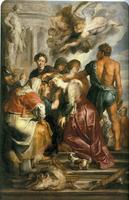
Martyrdom of St. Catherine
Peter Paul Rubens
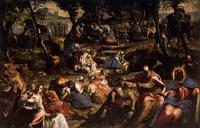
The Jews in the Desert
Tintoretto