
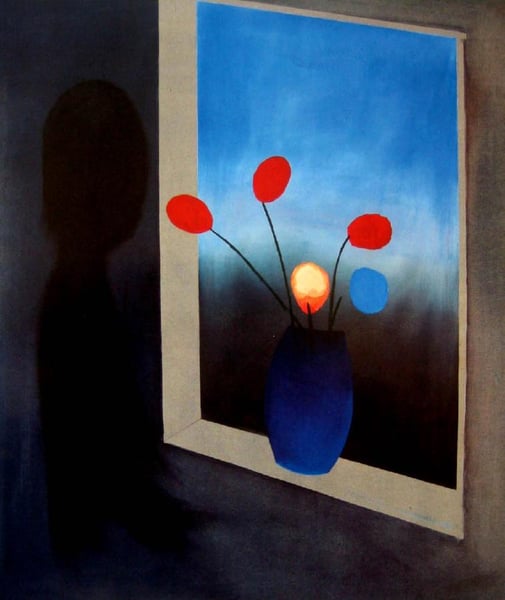
The Night Watch
Analisi esperta di The Night Watch di Charles Blackman
Stile: Expressionism · Genere: flower painting
Expert Analysis: "The Night Watch" by Charles Blackman
Charles Blackman’s The Night Watch presents a remarkable fusion of Expressionist sensibility with the traditional genre of flower painting, subverting expectations of both. While flowers often symbolize life, fragility, or transient beauty, Blackman’s treatment injects a mood of nocturnal mystery and psychological depth—the title itself alludes to a vigil or guarded presence, transforming a still-life subject into a scene of latent drama.
Significance within Expressionism
As an Expressionist work, The Night Watch prioritizes emotional intensity over naturalistic representation. Blackman distorts form, color, and scale to evoke unease or introspection. The flowers, rather than rendered with delicate precision, are likely painted with bold, agitated brushstrokes and a somber, perhaps dissonant palette dominated by deep blues, blacks, and muted greens—colors associated with night and shadow. This departure from the luminous, cheerful flower paintings of Impressionism or Realism aligns with Expressionism’s core aim: to externalize inner states. The “watch” in the title suggests that the flowers are not passive objects but sentinel-like figures, perhaps mirroring the artist’s own emotional vigilance or existential anxiety.
Innovation in the Flower Painting Genre
Flower painting has historically been a vehicle for memento mori (reminders of mortality) or decorative beauty. Blackman’s The Night Watch reimagines the genre as a site of psychological encounter. By choosing night—a time of dreams, secrets, and vulnerability—he imbues the flowers with a charged, almost anthropomorphic presence. The composition likely rejects symmetry and harmony, instead using jarring angles or cropped blooms to create tension. This challenges the viewer to consider flowers not as serene nature morte but as active participants in a dark, subjective narrative.
Placement in Blackman’s Oeuvre
While Charles Blackman is best known for his haunting images of schoolgirls and dreamlike interiors, The Night Watch extends his exploration of mundane subjects as vessels for hidden meaning. The work stands out for its radical departure from floral convention, merging the private, nocturnal mood of his figurative works with the apparent simplicity of botanical imagery. It demonstrates how Expressionism can revitalize even the most traditional genres, making the familiar strange and emotionally resonant.
Conclusion
The Night Watch is significant as a bold Expressionist reclamation of flower painting, transforming it into a vehicle for nocturnal symbolism and psychological intensity. Through distorted form and dark palette, Blackman invites us to witness nature under the shadow of the psyche—a vigil that is both beautiful and deeply unsettling.
Visivamente simili
20 opere con composizione e palette affini
Des fleurs pour le bien-aimé.
Chaldin Alex
Breakfast nook
Charles Blackman
Les Tullipes
Georges Valmier
Untitled
Dilek Demirci
The Blue Dress
Charles Blackman
Painting #3
Fernando García Ponce
Untitled
Dilek Demirci
Untitled
Dilek Demirci
Vase with flowers
Pablo Picasso
Zátiší
Josef Capek
Untitled
Dilek Demirci
Zinnias
Paul Wonner
Nothing Is What It Seems II
Paulo Tercio
Red head, blue body
Meret Oppenheim
Untitled
Dilek Demirci
Still Life (with a Portrait of a Girl)
Petros Malayan
Girl with Flowers
Charles Blackman
Vases
Charles Blackman
Woman by a Window
Charles Blackman
Variation
Alexej von Jawlensky