Description
Style : Mozarabic · Genre : miniature
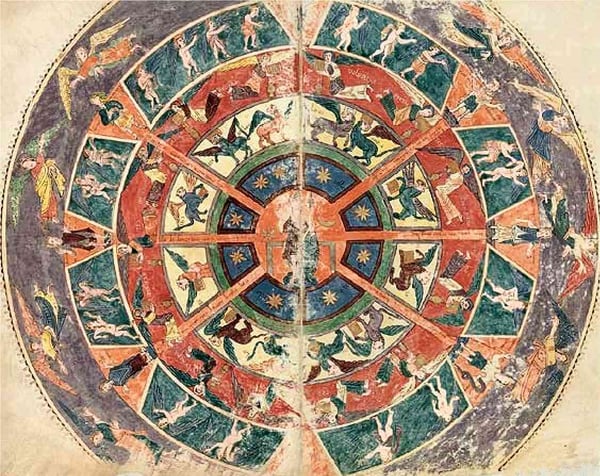
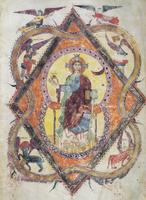
This is the first image in the Gerona Beatus that covers two full pages – a characteristic trait of stemma II. However, apart from its copy, the Turin Beatus (Biblioteca Nazionale Universitaria, Sgn. I.II.1, ff 2v-3r) it is a unique illustration amongst the extant illustrated manuscripts of the Commentary on the Apocalypse. Depicted in a completely frontal and majestic manner around a central circle and seated upon a simple, silver throne, is quite a damaged figure which does nonetheless have the appearance of a warrior. His right hand is raised with his index finger and thumb lifted up, whilst his left hand holds a gold-tipped spear and shield. His naked feet and legs are shown resting upon a bluish, wavy form. His traits are practically obliterated: only part of his eye and traces of his long hair and bearded chin can be seen. He is flanked by a starry, golden figure that can be identified with the sun and a golden, first-quarter moon. Around him are five concentric circles divided by eight radial lines into as many sectors, except for the outermost circle. In the one closest to the centre, upon a blue background, are nine golden stars each in a separate sector except for the top, left-hand one with two.
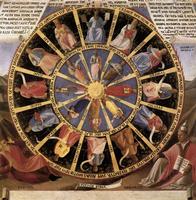
Generally speaking it is possible that the composition of the image of heaven, like other subsequent images to be seen in the Gerona Beatus, stems from many sources, including particularly images of astronomy dating from late antiquity and the early Middle Ages or, perhaps, from Gnostic sources which often used intricate diagrams with a cosmic meaning. It is difficult to trace the transmission of an image, particularly an image modified by the passage of time, originating in the early days of Christianity and possibly greatly influenced by Gnosticism – had it not been Christian Gnostic from the outset – until the last quarter of the 10th century. From the 4th century onwards, the Western Roman Empire was home to many pagan and Gnostic customs and others related to pre-Christian beliefs alongside Christianity. A work penned by Priscilianus or one of his disciples describes beings similar to those in the image of heaven that could appear in a Gnostic diagram. Despite the on-going condemnation of the Church in Hispania and elsewhere, these heterodox ideas persisted until as late as the 10th century. It is however highly likely that only this figurative aspect, albeit greatly modified, survived in the circles in which the Gerona Beatus was illustrated, having lost the heretic or having adapted an image that, whilst of a heterodox meaning, was useful for illustrating an orthodox belief. C. O. Nordström pointed out the parallel with an illustration in a manuscript of Ptolemy (Vatican, Apostolic Library, MS. Vat. gr. 1291, f. 9r), that was copied between 813 and 820 from a model dating from late Antiquity: the illustration is divided into different sections by concentric circles and twelve radii which would be the equivalent of the radial lines with inscriptions in the Gerona Beatus. The sun, Helios, is in the centre in his chariot: this would correspond to the figure of Christ enthroned. This type of images is however different from the one in the Gerona Beatus which was undoubtedly inspired by a late Antiquity model, which is now missing but that must have existed in the library of the monastery where the Gerona manuscript was copied.
Visuellement similaire
20 œuvres à la composition et à la palette proches
The Cycle of the Seasons
Hildegard of Bingen
Second vision. Adam as Mankind
Hildegard of Bingen
Mystic Wheel (The Vision of Ezekiel)
Fra Angelico
Vision of the angelic hierarchy
Hildegard of Bingen
Grande Théophanie, synthèse de l'Apocalypse IV et V, et Ezéchiel I
Facundus
Hortus deliciarum
Herrad of Landsberg
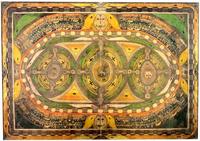
Formoosa Island in the Indian Ocean
Adolf Wölfli
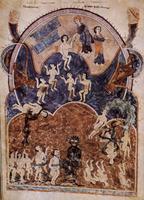
Beato de Gerona
Ende
Renaissance Ornament no. 5. Ornaments from pottery at Marlborough House
Owen Jones
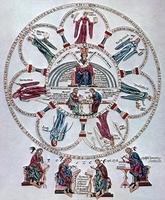
Seven Liberal Arts (folio 32r)
Herrad of Landsberg
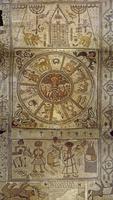
6th Century Ad Mosaic in the Beth Alpha Synagogue.
Byzantine Mosaics
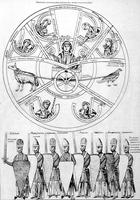
Mercy or Charity (folio 204r)
Herrad of Landsberg
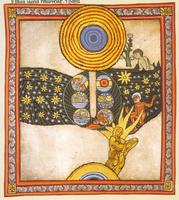
Six days of creation
Hildegard of Bingen
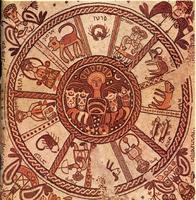
Mosaic Pavement
Byzantine Mosaics
La Jérusalem nouvelle. Apoc. XXI
Facundus
Grain of Sand
Abdul Mati Klarwein
The opening of the first four seals
Ende
Vitrage at Chichester Cathedral (David, Psalm 150)
Marc Chagall
Avarice (folio 203v)
Herrad of Landsberg
Maiestas Domini
Ende