Description
Stijl: Mozarabic · Genre: miniature
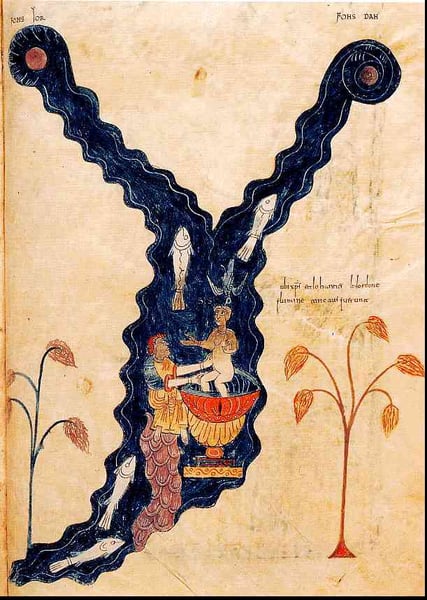
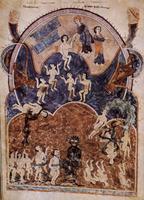
The Gerona Beatus is, apart from the Turin Beatus, the only extant Beatus to feature this illustration, which is situated at the end of the storia about the Lamb upon Mount Zion (Rev. 14: 1-5) on the page preceding the painting that illustrates this section. It has no frame, as is usual in themes not belonging to the Revelation, and covers the entire folio. Depicted in the upper part are the two sources of the Jordan, in the usual, circle form – the left-hand one reading “FONS YOR” and the right-hand one “FONS DAN”. A water course emerges from each one with wavy sides –both with a fish– which then merge into one where there is a baptismal font with Christ, possibly represented as a naked child inside. Situated above his head is the Holy Ghost, in the form of a dove, with the legend “SP[PIRITU]S”, whilst St John garbed in ankle-length, sacerdotal robes instead of his camel skin, is shown on a rock to the left grasping Christ by the body and right leg, thereby revealing that it is a baptism by immersion. Neither the Lord nor the Precursor have a nimbus, which could suggest a link with a very ancient model. Underneath and flanking the scene are another two fish and two trees that symbolise the leafy banks of the Jordan, with the words “ubi xpi et iohannes in iordone/flumine tinctus fuerunt” to the right. The meaning of the image is twofold, being both evangelical, with the representation of the two figures and the dove of the Holy Ghost in the river, and sacramental, by including liturgical elements typical of that period, such as the baptismal font and St John’s priestly robes. As regards the first aspect, the Baptism of Christ consists of two elements: the purification of the river water and the theophany. As for the sacramental nature, the place where the catechumens await their baptism by immersion is called agnile in the Mozarabic Liber Ordinum; similarly, St Gregory of Nazianzus called it the antechamber of the heavenly liturgy. Continuing with the liturgical implications of the baptismal font upon the Jordan, the Mozarabic Liber Ordinum specifies that it must be filled with river water. In addition, the baptism of children has been recorded in Hispania since the 3rd century. There are images of Christ being baptised in a font dating back to Early Christian and early medieval times. All this is possibly linked to the notion of the redemption made by the Lamb of God, hence this image may be deemed to be a gloss of “Hii emti sunt ab initjo/d[e]o et agno” (f. 188v.) in Rev. 14: 4 or, more probably, as an illustration of Tyconius’s interpretation of this passage, as can be seen in the preface by Beatus: “cantant canticu[m] nobu[m] id est/predicant xpm [...] p[er] babtism[um] et penitentja[m]/remissionem om[n]ium peccator[um]” (f. 26v).
Visueel vergelijkbaar
20 werken met verwante compositie en kleurenpalet
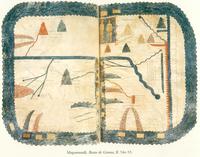
Prologue. On the Church. The map of the world
Ende
Six days of creation
Hildegard of Bingen
Beato de Gerona
Ende
Message to the Church of Ephesus
Ende
Beato de Gerona Fº 176r
Ende
Beato de Gerona Fº 176r
Ende
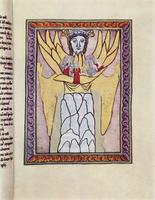
The Mystical Body
Hildegard of Bingen
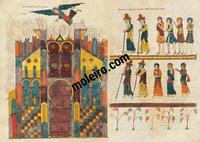
The fire of Babylon and the mourning of the kings and merchants
Ende

The Universe
Hildegard of Bingen
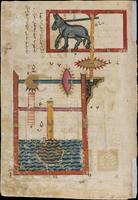
Design on Each Side for Waterwheel Worked by Donkey Power
Al-Jazari
Hymn to the Dawn
Konstantinos Parthenis
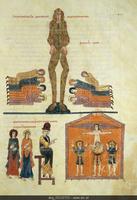
Adoración de la estatua de oro y los tres jóvenes en el horno
Ende
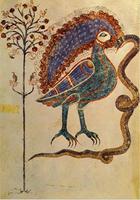
Allegorical conclusion of the Christological cycle. The bird and the snake
Ende
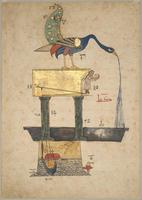
A Peacock Basin
Al-Jazari
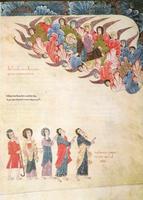
The Apparition of Christ in the clouds
Ende
Untitled
Joan Ponc
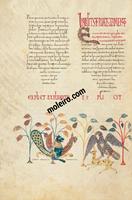
Decorative miniature. Coreus and the eagle catching the gazelle
Ende
56 At Jennie Richee. Vivian Girls caught in insane fury of crazy...
Henry Darger
Illustration for The Ancient Egyptian Book of the Dead
Anton Prinner
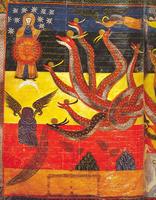
La Femme et le Dragon (détail f° 186v). Apoc. XI
Facundus