Description
Style: Mozarabic · Genre: miniature
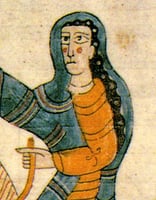
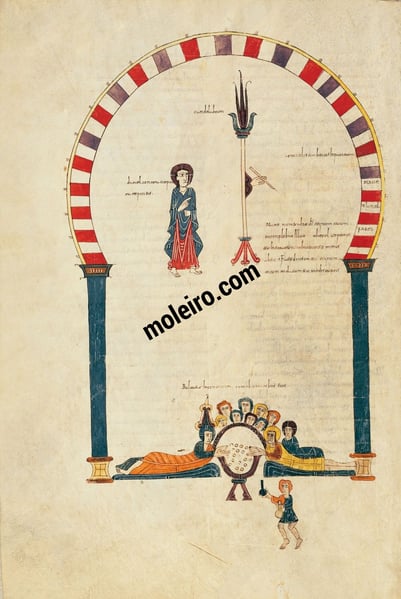
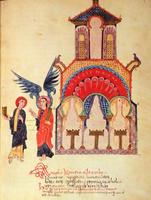
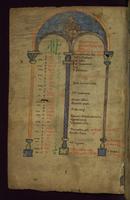
A large horseshoe arch with voussoirs in two alternating colours reminiscent of those in the caliphal art in the mosque in Cordova, which constitutes a schematic representation of the royal palace, contains the scene featuring David barefoot with a nimbus in the upper part making a gesture of dialogue, next to the words “daniel contra scriptu-/ra respiciens”. On the right, virtually along the central axis and also identified in the legend reading “candelabrum”, is a flaming candelabra upon a tripod, with a hand holding a pen emerging from it. Written opposite it, near the curved part of the arch, are the words “articulos scribentis in parietem”, which are, as can be seen on the white voussoirs further down, “MANE”, “THECEL” and “FARES”. The text next to this word towards the left and in the space left by the opening, is the prophet’s explanation of them: “Mane numerabit d[eu]s regnum tuum/et conplebit illut thecel adpensus/est in statera et inuentus es minus/abens Fares diuisum est regnum/tuum et datum est medis et fisis”. Finally, at the bottom, between the bases of the columns, Belshazzar can be seen wearing a large, coiled crown lying, as customary in Antiquity, on a side triclinium, in what Romans considered to be the place of honour, on the left, accompanied by ten courtiers. Two of them, who have nimbi, are located on the far right lying on their triclinia. Only the heads of the others, alternating to avoid an isocephalic effect, can be made out. They are all eating at a semicircular table underneath which is a recipient in the middle full of food. A cup-bearer in short garments serves them from two Muslim-type flasks. The legend above the guests reads “Baltasar in conuiuium cum obtimatibus suis”.
Both branches are highly homogeneous for most differences concern only minor details. This is yet another image inspired by illustrated, Hispanic Bibles, particularly those featuring the iconographic style of the Catalan Bibles, and especially the Roda Bible (f. 66r) which, despite having lost the classical meaning of the position of the guests, shows the scene beneath a large, semicircular opening, with a round table, the hand writing upon the curved part of the arch and Daniel watching whilst gesturing as if giving instructions to explain the meaning of the words. Furthermore, certain details make it possible to determine the approximate date of the cycle upon which the Beatus manuscripts were based. One such detail is the table, which is not round but a semicircle as can be seen in different sixth-century works such as the Rossano Gospels in the scene of the Last Supper (Rossano, Museo dell’Arcivescovado, no signature, f. 3.), the Codex Sinopensis (Paris, Bibliothèque nationale de France, ms. suppl. Gr. 1286) and the mosaics at the San Apollinare Nuovo church in Ravenna; in addition, the horseshoe arch is not ancient, therefore this cycle could have been created no earlier than the sixth century.
Visually similar
20 works with related composition and palette
The fire of Babylon and the mourning of the kings and merchants
Ende
The Castle Water Clock
Al-Jazari
Message to the Church of Smyrna
Ende
Message to the Church of Ephesus
Ende
Device for Display at a Drinking Party
Al-Jazari
Saint John with the witness
Ende
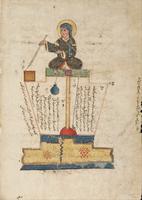
Automata
Al-Jazari
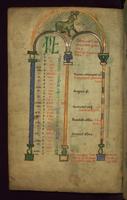
Aries
Claricia
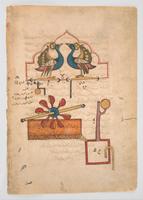
Design for the Water Clock of the Peacocks
Al-Jazari
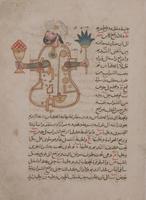
Figure for Use at Drinking Parties
Al-Jazari
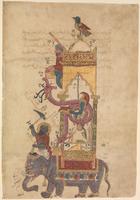
The Elephant Clock
Al-Jazari
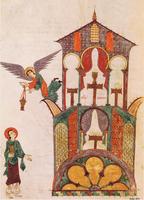
Beato de Gerona
Ende
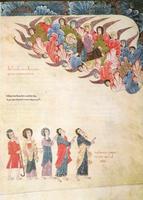
The Apparition of Christ in the clouds
Ende
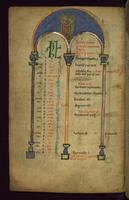
Gemini
Claricia
Libra
Claricia
Pisces
Claricia
The Castle Water Clock
Al-Jazari
Design on Each Side for Waterwheel Worked by Donkey Power
Al-Jazari
Aquarius
Claricia
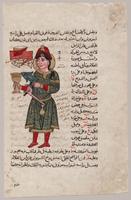
Device for a Drinking Party
Al-Jazari