Analyse experte de La Moisson et la Vendange. Apoc. XIV de Facundus
Style : Mozarabic · Genre : miniature
Expert Analysis of La Moisson et la Vendange. Apoc. XIV by Facundus
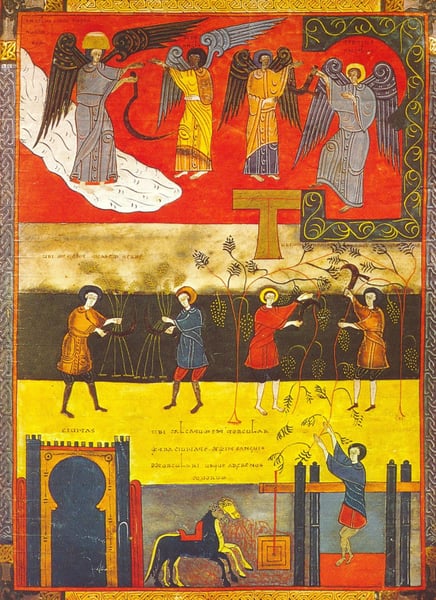
This miniature, executed in the Mozarabic style by the scribe and illuminator Facundus (active c. 1047), illustrates a passage from the Book of Revelation (Apocalypse 14: 14–20) — the harvesting of the earth and the treading of the winepress of God’s wrath. As a work of Mozarabic illumination, it stands as a vivid testament to the hybrid Christian and Islamic visual culture of medieval Iberia, and its significance lies in three key aspects: its role within the Beatus tradition, its distinctive formal language, and its theological intensity.
1. Context within the Beatus Manuscripts
Facundus is best known for illuminating the Beatus of Facundus (or Beatus of León), a richly illustrated copy of the Commentary on the Apocalypse by the 8th‑century monk Beatus of Liébana. This manuscript is one of the most celebrated in the Mozarabic canon. The miniature in question occupies a pivotal place in the Apocalypse narrative: it depicts the dual harvest — of the righteous as grain and of the wicked as grapes cast into the “great winepress of God’s fury.” Within the Beatus tradition, such images functioned not merely as decoration but as exegetical tools, guiding the viewer through the complex allegories of Revelation. The work’s significance derives from its ability to condense an entire cosmological and eschatological drama into a single, densely symbolic frame.
2. Distinctive Mozarabic Formal Language
Mozarabic art is characterized by a rejection of classical naturalism in favor of expressive abstraction. In La Moisson et la Vendange, this is immediately apparent:
- Color: The palette is bold and arbitrary — intense reds, yellows, blues, and greens are applied in flat, unmodulated washes. They do not describe local color but instead carry symbolic weight: red for blood and sacrifice, gold for divine light.
- Figure style: Human figures are rendered with large, staring eyes, angular poses, and simplified drapery folds. They lack anatomical proportion or spatial depth, placed instead against a vibrant, patterned ground (often a solid band or a simple arc) that negates any illusion of three‑dimensional space.
- Compositional structure: The scene is divided into horizontal registers or bounded by a strong architectural or abstract frame. Figures act as hieratic, iconic signs rather than participants in a narrative sequence. This non‑naturalistic approach deliberately distances the viewer from earthly realism, directing attention to the sacred, otherworldly content.
3. Syncretism of Christian and Islamic Visual Elements
Mozarabic art flourished under Muslim rule in al‑Andalus, and this miniature exemplifies the synthesis of two traditions. The intricate, repeating geometric motifs in the borders and halos recall Islamic tawriq and geometric ornamentation. Yet the subject matter is deeply Christian apocalyptic theology. The use of vibrant, non‑descriptive color and the rejection of perspective also echo contemporary Islamic manuscript illumination (e.g., from the Abbasid or Umayyad periods). This fusion makes the work a key document of convivencia — the complex cultural coexistence of Christians, Muslims, and Jews in medieval Spain.
4. Thematic and Theological Significance
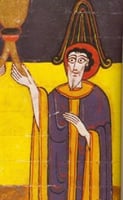
The miniature’s subject — the harvest and vintage — is an allegory of Judgment. On the left, the Son of Man (often identified with Christ) wields a sickle and reaps the “harvest of the earth” (the saved). On the right, an angel gathers grapes and casts them into the winepress, from which blood flows up to the height of a horse’s bridle — a stark reference to divine wrath. The Mozarabic rendering transforms this vision into a hieratic, iconic tableau. The figures do not emote or engage in dramatic action; they stand as timeless emblems of God’s decrees. The intensity of the color and the rigid, frontal poses gives the scene an almost hypnotic, liturgical gravity.
Art‑Historical Importance
La Moisson et la Vendange is significant not only for its place in the Beatus tradition but as a masterpiece of the Mozarabic style — one of the few surviving pre‑Romanesque painting traditions in Europe. It demonstrates how medieval Iberian artists, isolated from the mainstream of Carolingian and Romanesque art, developed a distinct vision that was at once archaic, expressive, and deeply spiritual. The miniature challenges the viewer to see beyond material representation and to engage with the apocalyptic text on a symbolic, visionary level.
Visuellement similaire
20 œuvres à la composition et à la palette proches
Beatus of Facundus
Facundus
Beato de Gerona Fº 131v
Ende
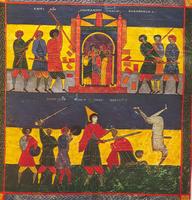
Les Nations foulent la Cité Sainte. Le meurtre des deux Témoins. La Bête Faux Prophète . Apoc. XI
Facundus
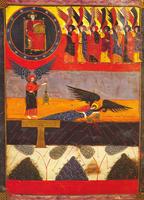
L'Ange et l'Encensoir d'or. Apoc. VIII
Facundus
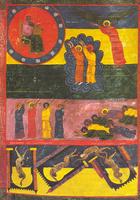
L'Ange montre le Trône de Dieu. Les deux Témoins. Apoc. XI
Facundus
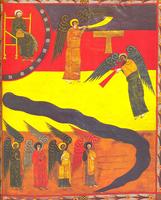
La sixième Trompette. Les Anges prisonniers au bord de l'Euphrate. Apoc. IX
Facundus
L'Ange répand la première Coupe. Apoc. XVI
Facundus
J'ean se prosterne devant l'Ange. Les sept Eglises d'Asie. La Théophanie. Apoc. XXII
Facundus
Le Christ se penche vers Jean. Jean envoie le Livre aux Sept Eglises d'Asie. Apoc. I
Facundus
Adoration de l'Agneau mystique sur le Mont Sion.. Apoc. XIV
Facundus
L'Ange remet à Jean la lettre pour l'Eglise d'Ephèse. Apoc. II
Facundus
La Bête. Le Faux Prophète. Les Nations. Gog et Magog. Apoc. XX
Facundus
La Jérusalem nouvelle. Le Fleuve de Vie. L'Arbre de Vie. Apoc. XXII
Facundus
Beatus de Facundus
Facundus
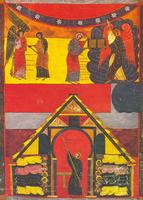
L'Ange enveloppé d'un nuage. Jean mesure le Temple de Dieu. Apoc. X et XI
Facundus
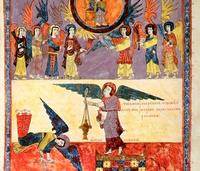
Beato de Gerona
Ende
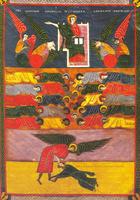
Adoration de Dieu. Les quatre Etres. Les quatre Sages. Jean. L'Ange. Apoc. XIX
Facundus
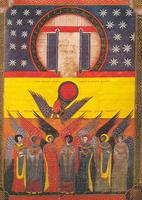
Les sept Anges et les sept derniers fléaux. Apoc. XV
Facundus
L'Ange remet à Jean la lettre pour l'Eglise de Pergame. Apoc. II
Facundus
L'Ange répand la cinquième Coupe. Apoc. XVI
Facundus