Analisi esperta di Peñascos de la Peña Encantada di Jose Maria Velasco
Stile: Realism · Genere: landscape
Expert Analysis of Peñascos de la Peña Encantada by José María Velasco
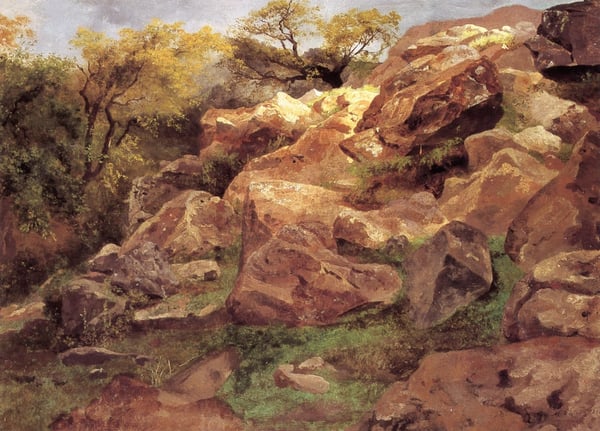
As a masterwork of 19th-century Realist landscape painting, Peñascos de la Peña Encantada (The Rocks of the Enchanted Crag) by José María Velasco stands as a defining example of how the Realist movement in Mexico was fused with a deep national and scientific appreciation of the natural world. Velasco, often called the “poet of the Mexican landscape,” is celebrated for his panoramic views of the Valley of Mexico, but this particular work—focusing on the dramatic, weathered rock formations of the Peña Encantada in the Desierto de los Leones near Mexico City—demonstrates a more intimate, geological focus within his larger oeuvre.
Significance within Realism and Period Context
-
Scientific Precision Meets Artistic Vision: Velasco trained under the Italian-born Eugenio Landesio, who emphasized precise perspective and observational drawing. In Peñascos de la Peña Encantada, this training is evident in the meticulously rendered textures of the rock faces, the subtle gradations of light and shadow across the stone, and the accurate depiction of local flora. Velasco treats the landscape with the rigor of a naturalist, capturing the specific erosive patterns and volcanic origins of the rock, yet his composition—with its diagonal thrust of the crag and framing trees—imbues the scene with a romantic sense of sublime grandeur. This synthesis of empirical exactness and emotional resonance is the hallmark of Velasco’s mature Realism.
-
A Nationalist Iconography of Landscape: In the decades following Mexico’s independence, artists like Velasco were central to constructing a visual identity for the nation. While earlier European-influenced landscapes often idealized exotic or pastoral views, Velasco’s Realism chose to depict the actual, unidealized terrain of central Mexico. Peñascos de la Peña Encantada elevates a specific, localized rock formation—once a sacred site for the indigenous Otomí people and later a retreat for naturalists—into a symbol of Mexico’s ancient, enduring geography. The work rejects generic European scenery and instead insists on the specificity of Mexican soil, making it a quietly patriotic statement.
-
Mastery of Atmospheric and Topographic Detail: Velasco’s Realism is not merely a flat transcription but a careful manipulation of atmosphere. The painting balances the rugged, tactile foreground of the boulders with a softer, hazy background that recedes into a luminous sky, a technique that anchors the viewer in the physical space while suggesting the vastness of the Mexican landscape. The contrast between the deep greens of the vegetation and the ochre-grays of the rocks demonstrates Velasco’s refined handling of the limited palette of Realist painting, achieving a sense of air and light that is both natural and deeply evocative.
Conclusion
Peñascos de la Peña Encantada is significant because it encapsulates the core achievement of José María Velasco: the elevation of the real, local landscape into a national treasure through the lens of scientific Realism. The work is not just a picture of rocks and trees; it is a careful study of Mexico’s geological heritage, a quiet assertion of cultural identity, and a testament to the power of Realism to capture both the observable world and the profound connection between a people and their land.
Visivamente simili
20 opere con composizione e palette affini
Ladera de las Montañas de Tepotzotlán
Jose Maria Velasco
4 in the Forest of Fontainebleau
Richard Parkes Bonington
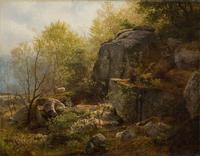
Near Conway, North Wales
Alexander Helwig Wyant
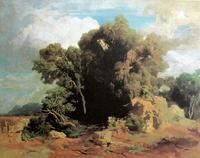
On the Pontine swamps
Arnold Böcklin
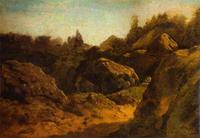
On Valaam. Rocks
Fyodor Vasilyev
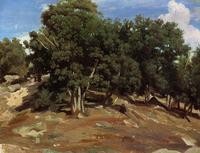
Fontainebleau Black Oaks of Bas Breau
Camille Corot
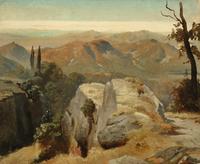
Study of the summits of northern Italy
Oswald Achenbach
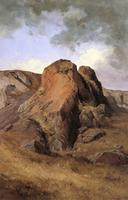
Pórfidos del Tepeyac
Jose Maria Velasco
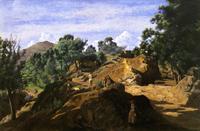
A Chestnut Wood among the Rocks
Camille Corot
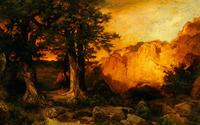
The Grand Canyon
Thomas Moran
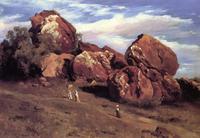
Peñascos del cerro de Atzacoalco
Jose Maria Velasco
The Dell
Thomas Moran
View in the Neighbourhood of Oranienbaum
Aleksey Savrasov
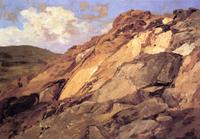
Peñascos del cerro de Atzacoalco
Jose Maria Velasco
L Arbre Tordu, Les Chenes du Mont Usey, Fontainebleau
Camille Corot
Landscape from Bortniki Upon Dniester
Henryk Rodakowski
Study of Ferns
Mary Josephine Walters
Above the Clouds
Ralph Blakelock
Arroyo de Tlaxcala
Jose Maria Velasco
Pórfidos del Tepeyac
Jose Maria Velasco