
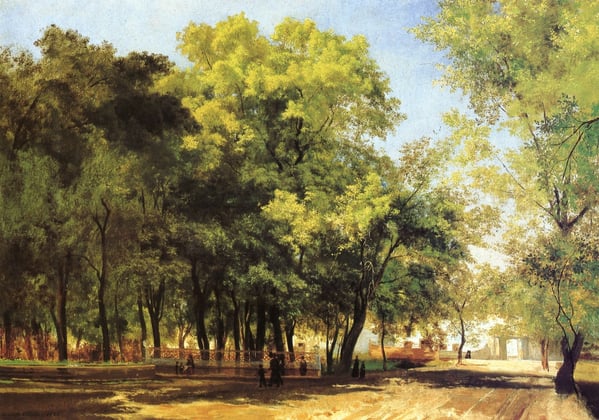
Vista tomada en la Alameda de México por el lado de San Diego
Details
Expertenanalyse zu Jose Maria Velascos Vista tomada en la Alameda de México por el lado de San Diego
Stil: Romanticism · Genre: landscape
Analysis of "Vista tomada en la Alameda de México por el lado de San Diego" (View Taken in the Alameda of Mexico from the Side of San Diego) by José María Velasco
José María Velasco’s Vista tomada en la Alameda de México por el lado de San Diego is a landmark of Mexican Romantic landscape painting. Executed within the broader Romantic tradition, the work merges a profound emotional engagement with nature with meticulous topographical accuracy, a hallmark of Velasco’s mature style.
Significance within Romanticism and Landscape Genre:
-
Sublime National Identity: Velasco transforms a familiar urban park—the Alameda Central in Mexico City—into a Romantic vision of national pride. By selecting a viewpoint from the side of the Church of San Diego, he frames the scene to emphasize the interplay between cultivated nature (the tree-lined promenade) and the distant, hazy mountains. This blending of the intimate and the vast evokes the Romantic sublime: a feeling of awe before the grandeur of the Mexican landscape, while celebrating the harmony of human presence within it.
-
Atmospheric Depth and Light: Typical of Romantic landscape painting, Velasco exploits atmospheric perspective. The soft gradation of tones—from the dark, detailed foliage in the foreground to the luminous, ethereal sky and distant sierra—creates a sense of boundless space. This technique not only demonstrates technical mastery but also infuses the scene with a contemplative, almost spiritual mood, inviting the viewer into a quiet reverie.
-
Documentary Precision as Romantic Ideal: Unlike some Romantic painters who exaggerated or idealized nature, Velasco’s work is grounded in direct observation. The specific location—the Alameda with its characteristic poplar trees and the San Diego church—is rendered with scientific accuracy. This documentary impulse, combined with emotional resonance, makes the painting significant as a record of Mexico City’s landscape during the 19th century, while elevating it to a poetic celebration of place.
-
Transition from Academic to National Romanticism: Velasco, a student of the Mexican Academy of San Carlos, fused European Romantic influences (such as the luminous skies of J.M.W. Turner and the detailed naturalism of the Barbizon school) with a distinctly Mexican subject matter. This painting exemplifies his role in forging a national visual identity, where the local landscape becomes a source of patriotic sentiment and artistic innovation.
In summary, Vista tomada en la Alameda de México por el lado de San Diego stands as a significant work within Romanticism for its synthesis of meticulous realism and emotive atmosphere, its celebration of Mexican space, and its role in defining a national landscape tradition that values both truth and beauty.
Visuell ähnlich
20 Werke mit ähnlicher Komposition und Farbpalette
Fresnos, sauces y chopos
Jose Maria Velasco
Postwick Grove, Norwich
John Crome

The Paver of the Chailly
Camille Corot
Old elms in Prater
Ferdinand Georg Waldmüller
In the forest Saint Cloud II
Paul Gauguin

Under the Trees
Thomas Moran

Under the Trees
Thomas Moran

The Forest Path
Paul Gauguin

A Shady Resting Place
Camille Corot
Road in the Wood
Narcisse-Virgilio Diaz

Fountainebleau With Georges d'Apremont
Camille Corot

Landscape
Joan Brull

Passiance, in Saint Avit
Camille Corot
A Valencian Garden
Joaquín Agrasot
Mowing in the oak grove
Ivan Shishkin
Landscape with Three Figures
Camille Corot

Horseman in the Forest
Camille Pissarro

The Beaters
John Crome
Outskirts of a Wood, with Gypsies
David Cox

Animated landscape
Gabriele Smargiassi