
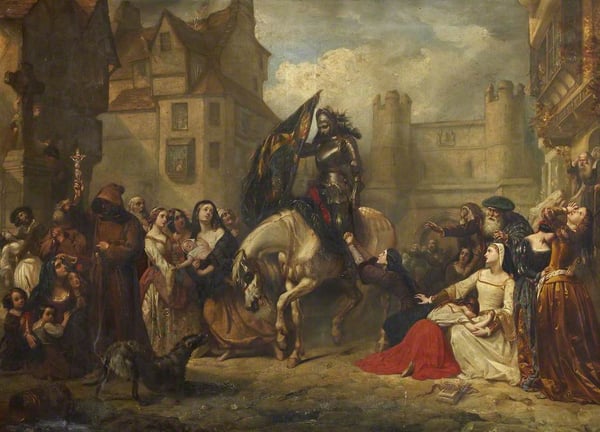
News of Battle. Edinburgh after Flodden
Analisi esperta di News of Battle. Edinburgh after Flodden di Thomas Jones Barker
Stile: Romanticism · Genere: history painting
Expert Art Historical Analysis: News of Battle: Edinburgh after Flodden by Thomas Jones Barker
Thomas Jones Barker’s News of Battle: Edinburgh after Flodden stands as a quintessential example of Romantic history painting. Executed in the mid-19th century, the work captures a moment of profound national grief: the aftermath of the 1513 Battle of Flodden, one of Scotland’s most devastating military defeats. Barker, a British painter trained in the Parisian academic tradition, here marries the Romantic fascination with historical tragedy to a deeply human, emotional narrative.
Significance within Romanticism and History Painting:
Romanticism prized intense emotion, dramatic storytelling, and the sublime power of history. Barker’s painting embodies these ideals by focusing not on the battle itself but on its psychological aftermath—the arrival of grim news in the Scottish capital. This choice marks a departure from conventional history painting, which often glorified heroic action. Instead, Barker foregrounds collective sorrow, emphasizing the Romantic belief that history’s true force lies in its impact on ordinary people.
The composition is theatrical yet somber. A central figure, perhaps a herald or messenger, delivers the fateful news to a group of townsfolk. Barker uses chiaroscuro and muted earth tones—hallmarks of Romantic chiaroscuro—to heighten the drama. The expressions of shock, despair, and resignation on the faces of the citizens reveal meticulous attention to psychological realism, a Romantic trait that sought to make historical events palpable and personal. The Edinburgh skyline, dimly lit, reinforces the city’s role as a character in the tragedy.
The painting’s significance also lies in its nationalistic undertones. By choosing a Scottish defeat, Barker taps into the Romantic obsession with lost causes and martyrdom, reflecting 19th-century Britain’s fascination with its own turbulent past. The work thus functions as a memorial, inviting viewers to contemplate the cost of war through the lens of Romantic pathos.
In summary, News of Battle: Edinburgh after Flodden is significant for its innovative focus on emotional aftermath over action, its masterful use of Romantic drama and lighting, and its contribution to the 19th-century revival of historical consciousness. It stands as a poignant testament to Romanticism’s power to transform historical fact into enduring human tragedy.
Visivamente simili
20 opere con composizione e palette affini
Halt vor dem Gasthaus
Heinrich Schonfeld
King Edgar's First Interview with Queen Elfrida (Aelfryth)
William Hamilton
Entree D Henri IV a Paris Mba Chartres Ville Entrée d'Henri IV à Paris, 22 mars 1594
François Gérard
Tancred and Clorinda
Aniello Falcone
Henri II blessé mortellement bénit le mariage de sa sœur Marguerite de Valois avec Emmanuel-Philibert de Savoie
Francesco Podesti
Cavalieri in Marcia
Salvator Rosa
Hunting with falcon
January Suchodolski
Saint Benedict receiving Totila, King of the Ostrogoths
Gaspar de Crayer
KIRKE UND ODYSSEUS
Matthijs Naiveu
De Gezanten Van Alexander De Grote Bekleden De Tuinman Abdalonymos Met De Insigniën Der Koningswaardigheid Van Sidon
Nikolaus Knüpfer
The Abduction of Rebecca
Eugene Delacroix
Scène de pillage
Theodor van Thulen
Queen Zenobia before Emperor Aurelianus
Giovanni Battista Tiepolo
The surrender of the Ancona people
Francesco Podesti
Gundaker Count Althann Handing over to the Emperor Charles VI (Charles III of Hungary) (1685-1740)
Francesco Solimena
Ancient Battle
Salvator Rosa

Scene
Charles Nahl
Guardroom
David Teniers the Younger
The Lomellini Family
Anthony van Dyck
Scène de bataille
Pieter Meulener