
Analisi esperta di The Water's Edge di William Hart
Stile: Romanticism · Genere: landscape
Expert Analysis: "The Water's Edge" by William Hart
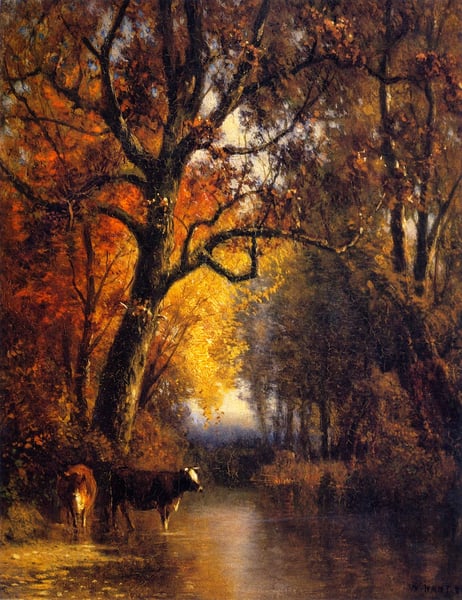
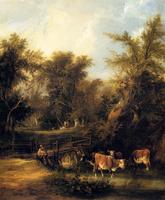
William Hart's "The Water's Edge" is a quintessential example of Romanticism in landscape painting, embodying the movement’s profound reverence for nature and its capacity to evoke emotional and spiritual reflection. As an American artist associated with the Hudson River School—a group that infused Romantic ideals with a distinctly nationalistic appreciation for the New World’s wilderness—Hart here captures a serene, pastoral moment along a shoreline.
Significance within Romanticism:
The work aligns with Romanticism’s core tenets: a focus on the sublime and the picturesque, where nature is not merely a backdrop but a protagonist. Hart’s meticulous handling of light, water, and foliage invites viewers into a contemplative state, emphasizing the harmony between humanity and the natural world—a common Romantic theme. The choice of a quiet water’s edge rather than a dramatic cliff or storm highlights the Romantic fascination with the intimate and the transient: the soft play of sunlight on ripples, the gentle curve of the shore, and the subtle gradations of atmosphere.
In the context of American Romanticism, "The Water's Edge" is significant for its role in defining the nation’s artistic identity. Unlike European Romantic landscapes that often featured ruins or mythological allusions, Hart’s scene presents an unspoiled, Edenic vista—a visual testament to the American wilderness as a source of moral and spiritual renewal. This aligns with the Hudson River School’s mission to document and celebrate the country’s natural beauty, while also encouraging viewers to find the divine in the everyday.
Landscape Genre & Technical Mastery:
Hart’s landscape is underpinned by a refined naturalism that does not sacrifice emotional resonance. The composition draws the eye across the water’s reflective surface toward a distant, atmospheric horizon, creating a sense of depth and serene infinity. The interplay of light—whether a golden sunset or a hazy midday—imbues the scene with a calm, almost reverential mood. This treatment of light and atmosphere is a hallmark of Romantic landscape painting, linking Hart to contemporaries like Thomas Cole and Asher Durand, yet his work stands out for its particular delicacy and intimacy.
In sum, "The Water's Edge" is significant as a Romantic landscape that distills the movement’s core values—emotional depth, reverence for nature, and spiritual contemplation—into a quiet, powerful meditation on the American environment. It exemplifies how Romanticism in landscape could be both deeply personal and culturally defining.
Visivamente simili
20 opere con composizione e palette affini
Summer Stream
William Hart
The Cattle Seek the Cooling Shade
James McDougal Hart
Cows in the Meadow
William Hart
Cattle Watering
Thomas Moran
Cattle Watering
Thomas Moran

Cattle, sheep and a donkey with a herdman in a rocky wooded landscape
Thomas Barker of Bath
in the Shade of the Old Oak Tree
Asher Brown Durand

Indian Summer Hudson River
Albert Bierstadt
Autumn Pasture
William Hart
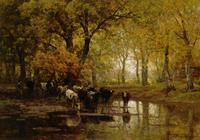
Watering Cows in a Pond
Julius van de Sande Bakhuyzen

Italian Monk Reading
Camille Corot
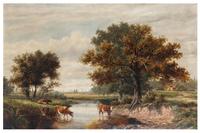
Cattle watering
William Henry Mander

Pastoral Scene of Cows at Pond
James McDougal Hart

Pastoral Scene of Cows at Pond
James McDougal Hart

Ville d'Avray, Cowherd in a Clearing near a Pond
Camille Corot

A Ford with Large Trees
Camille Corot
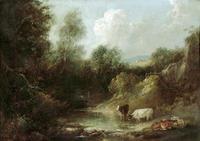
Landscape with Cattle Watering
Julius Caesar Ibbetson
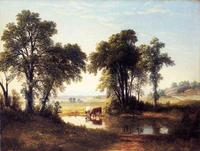
Cows in a New Hampshire Landscape
Asher Brown Durand

A Forest Glade
Adam Pynacker
Cattle By A Stream
William Shayer