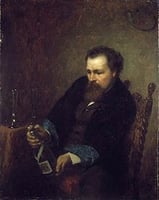
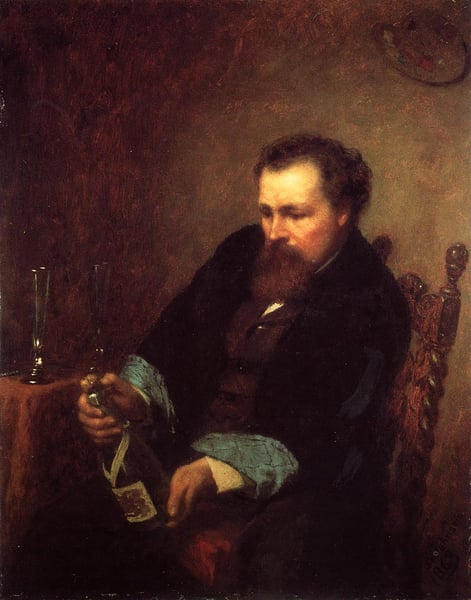
Eastman Johnson の Self Portrait の専門的な分析
スタイル:Realism · ジャンル:self-portrait
Expert Analysis: Eastman Johnson's Self Portrait (c. 1860s-1870s)
Style & Significance
As a leading American Realist, Eastman Johnson brought a quiet, unflinching honesty to portraiture. This Self Portrait is a masterclass in Realism’s core tenets: the unidealized, the intimate, and the psychologically immediate. Unlike the grand, heroic self-portraits of earlier centuries, Johnson presents himself not as a romantic genius but as a working artist—a craftsman observed in a moment of sober reflection.
The work draws its power from meticulous observation of light and texture. Johnson’s handling of flesh tones is subdued and naturalistic; the face is modeled with soft, diffused shadows that suggest a studio lit by a single window. The brushwork, while precise, is not polished into smoothness—visible strokes in the hair and coat collar anchor the portrait in the physical reality of paint, a nod to Realism’s refusal to prettify the medium.
Psychological Depth
Johnson’s gaze is direct yet reticent, avoiding the overt self-dramatization common among his contemporaries. His expression is neither proud nor humble, but contemplative and slightly reserved—the face of a man who sees clearly, without vanity. This understated intensity aligns with Realism’s mission to depict “the truth of the everyday,” even when the subject is the artist himself.
Placement in Johnson’s Career & American Realism
Johnson, a co-founder of the Metropolitan Museum of Art, was a bridge between the Hudson River School’s romanticism and the gritty urban realism of later artists like Thomas Eakins. In Self Portrait, he synthesizes Dutch Golden Age portraiture (especially Rembrandt’s psychological gravity) with a distinctly American directness. The work’s significance lies in its refusal to mythologize; it is a document of a professional observer turning his gaze inward, exploring identity through the same clear-eyed honesty he applied to his famous genre scenes (The Old Stagecoach, A Ride for Liberty – The Fugitive Slaves).
Ultimately, this self-portrait stands as a testament to Realism’s quiet revolution: the belief that an artisan’s face, painted without flattery, can command as much dignity as any king or saint.
視覚的に類似
構図やパレットが近い作品 20 件
Self Portrait with Bottle of Champagne
Eastman Johnson
Portrait of James G. Wilson
Eastman Johnson
David John Harrison (1820–1893)
William Banks Fortescue
John Passmore Edwards
George Frederick Watts
Sir Charles Wentworth Dilke, 2nd Bt
George Frederick Watts
Richard Burton painted by Frederic Leighton
Frederic Leighton
Portrait Of Don Aureliano De Beruete
Joaquín Sorolla
Auguste Rodin
John Singer Sargent
Bildnis Des Vaters Des Künstlers
Albin Egger-Lienz
David Binning Monro, Hon. DCL, Provost (1882–1905), Vice-Chancellor (1901–1904)
William Quileer Orchardson
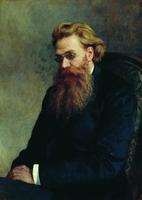
Portrait of Alexander Gerd
Mykola Yaroshenko
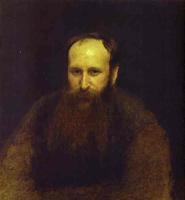
Portrait of the Artist Vasily Vereshchagin
Ivan Kramskoy
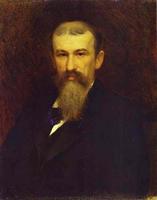
Portrait of the Artist Alexander Sokolov
Ivan Kramskoy
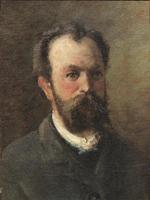
Male portrait
Noè Bordignon
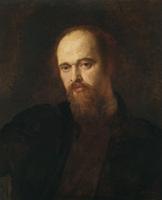
Dante Gabriel Rossetti
George Frederick Watts
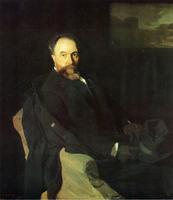
Aureliano de Beruete
Joaquín Sorolla
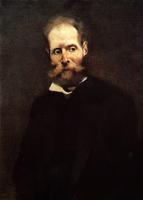
Portrait of Antero de Quintal
Columbano Bordalo Pinheiro
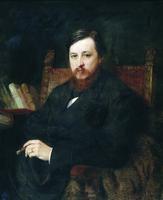
Mikhail Azanchevsky
Konstantin Makovsky
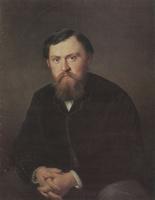
Portrait of A. A. Borisov
Vasily Perov
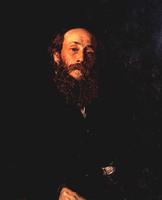
Portrait of the Artist Nikolay Gay
Ilya Repin