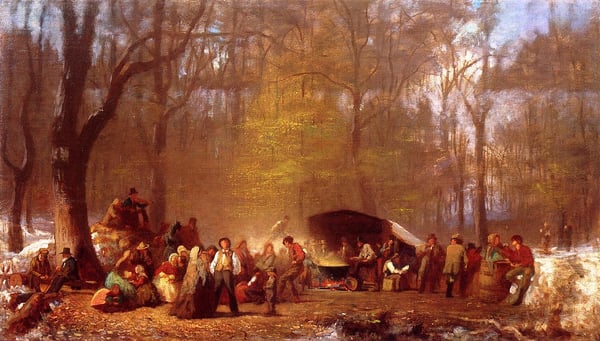
Expert analysis of Eastman Johnson’s Sugaring Off at the Camp, Fryeburg, Maine
Style: Realism · Genre: genre painting
Expert Analysis: "Sugaring Off at the Camp, Fryeburg, Maine" by Eastman Johnson
This work is a quintessential example of American Realism in the 19th century, and its significance lies in how it elevates a humble, seasonal rural tradition into a subject worthy of serious artistic attention. Painted by Eastman Johnson—often called the "American Rembrandt" for his mastery of light and character—this genre painting captures the communal process of maple sugaring in rural Maine.
What makes it significant:
-
Documentary Realism with Emotional Depth – Unlike idealized or sentimentalized pastoral scenes common at the time, Johnson renders the camp with meticulous observation: the steam rising from boiling sap, the rough-hewn wooden structures, the varied postures of workers (from children playing to men tending the fire). The realism here is not just visual accuracy but a profound respect for ordinary labor, reflecting the post-Civil War American interest in authentic, everyday life.
-
Cultural Anthropological Value – Sugaring off was a distinctively North American practice, and Johnson’s painting serves as a visual record of a vanishing way of life. By choosing a specific location (Fryeburg, Maine) and focusing on the collective activity, he preserves the rituals of rural New England communities—the gathering of families, the shared work, and the fleeting sweetness of the season.
-
Mastery of Light and Atmosphere – Johnson employs a warm, golden-toned palette that mimics the firelight and late winter sun, creating a sense of intimacy and nostalgia. The interplay of shadow and illumination across faces, tools, and the landscape emphasizes the dignity of the workers and the tactile reality of the scene. This attention to natural light aligns with the Realist movement’s departure from academic idealization.
-
Humanizing the American Frontier – At a time when American art often celebrated grand landscapes or historical allegories, Johnson’s focus on a small, communal task challenges the viewer to find beauty in the mundane. The painting’s significance also lies in its democratic impulse: every figure, from the elderly man to the barefoot child, is given distinct personality and agency, reinforcing Realism’s commitment to portraying all strata of society.
In sum, "Sugaring Off at the Camp" is a touchstone of American Realism because it transforms a local, seasonal chore into a universal meditation on community, labor, and the rhythms of nature. Johnson’s skillful blend of ethnographic detail and painterly technique ensures that this work remains a vivid, respectful snapshot of 19th-century rural life.
Visually similar
20 works with related composition and palette
Tasting the Sugar
Eastman Johnson
Measurement and Contemplation
Eastman Johnson
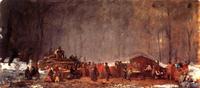
The Maple Sugar Camp. Turning Off
Eastman Johnson
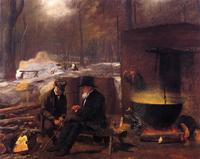
At the Camp, Spinning Yarns and Whittling
Eastman Johnson
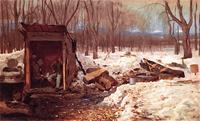
Luncheon on the Camp
Eastman Johnson
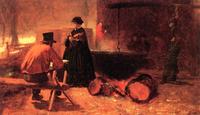
Sugar Camp
Eastman Johnson
Washing women at the river
Konstantinos Volanakis
A Veteran Recounting His Adventures
Leonardo Alenza
Potato harvest
Ludwig Knaus
The Saint Joris guild in Dongen
August Allebé
Taking out the Thorn
William Collins
Cranberry Pickers
Eastman Johnson
Peasants merrying outside an inn
David Teniers the Younger
The violets pickers (Early Spring in the Wienerwald)
Ferdinand Georg Waldmüller
The Witches Convention
William Holbrook Beard
Hearts of Oak
David Bates
The Early Lovers
Eastman Johnson
Traditional Swedish dance
August Malmstrom
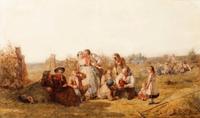
The Haymakers
John Absolon
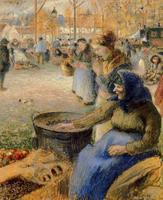
La Marchande de Marrons, Fiore de la St. Martin, Pontoise
Camille Pissarro