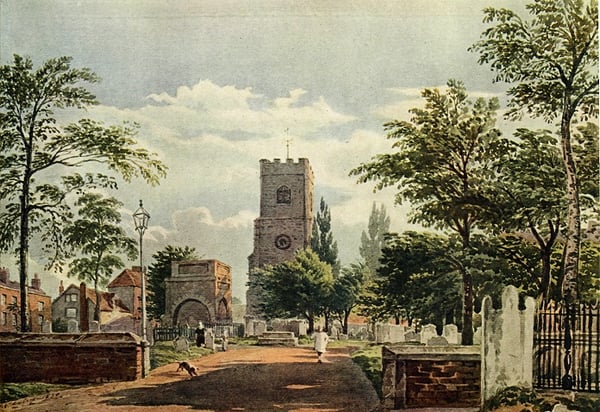
Hackney Church
Expert analysis of John Varley’s Hackney Church
Style: Romanticism · Genre: cityscape
John Varley’s Hackney Church is a quintessential example of the Romantic cityscape, a genre that flourished in early 19th‑century British art. Although the painting itself is not reproduced here, its significance within the Romantic movement lies in how Varley transforms a specific urban landmark into a vehicle for emotional and atmospheric expression.
As a cityscape, Hackney Church does not simply record the physical appearance of the building—likely St. John‑at‑Hackney, a prominent local church—but instead imbues the scene with a sense of the picturesque and the sublime. The Romantic style prioritizes feeling over faithful topography; Varley would have used soft, atmospheric light, subtle tonal gradations, and a composition that draws the viewer’s eye skyward, emphasizing the church spire as a spiritual beacon against a vast, moody sky. This approach elevates a mundane suburban church into a symbol of transcendence and human connection to the divine.
What makes the work significant within its period is Varley’s pioneering role in watercolour technique. He was a founding member of the Society of Painters in Water Colours (1804), and Hackney Church exemplifies the Romantic fascination with capturing fleeting weather effects and the emotional resonance of place. By focusing on a cityscape, Varley also reflects the Romantic interest in the interplay between human‑made structures and the natural environment—here, the church stands as a stable, quiet anchor amid the changing light and clouds. This balance of architecture and atmosphere makes the painting a subtle but powerful statement of Romantic idealism, where even a local church becomes a site for contemplation and awe.
Visually similar
20 works with related composition and palette
Handsworth Old Church, Birmingham
David Cox
Stamford
J.M.W. Turner
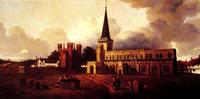
St. Mary's Church Hadleigh
Thomas Gainsborough
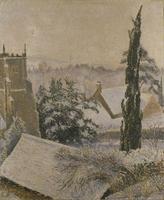
East Knoyle Church. Snow
Lucien Pissarro
January
Esaias van de Velde
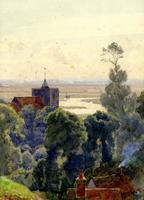
Benfleet, Mouth of the Deben
Frederick George Cotman
East Bergholt Church
John Constable
View of Linlithgow Palace
David Allan
Appleby Magna Church
John Glover
Portrait of Rachel Westropp
Stanley Spencer
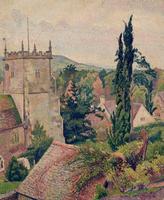
The Church, East Knoyle
Lucien Pissarro
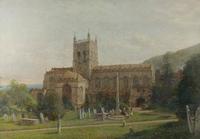
Malvern Priory, Worcestershire
David Bates
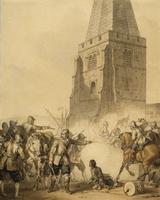
An English Civil War skirmish by a spired church
John Augustus Atkinson
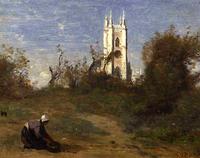
Landscape with a White Tower, Souvenir of Crecy
Camille Corot
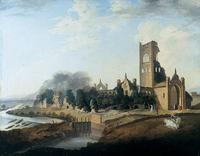
Kirkstall Abbey, Leeds
William Williams
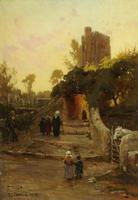
Sunday Morning
Frederick George Cotman
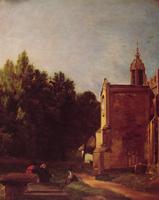
A Church Porch
John Constable
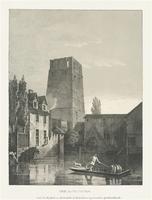
Der alte Turm
Antonio de Pian
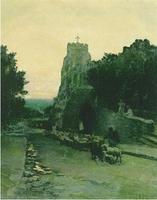
Herding Sheep in a Village Street
Frank O'Meara
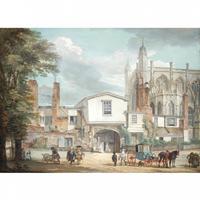
THE ENTRANCE TO THE HORSESHOE CLOISTER WITH THE WEST END OF ST. GEORGE'S CHAPEL, WINDSOR
Paul Sandby