Expert analysis of John Varley’s Holy Island Castle
Style: Romanticism · Genre: landscape
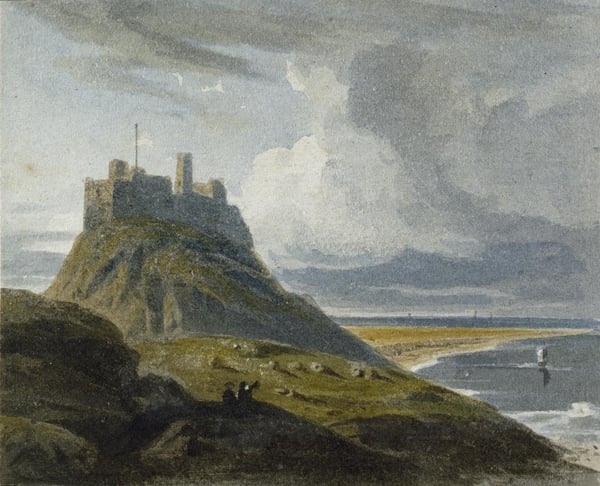
Expert Analysis: Holy Island Castle by John Varley
As a work of Romanticism in the landscape genre, Holy Island Castle exemplifies the movement’s core preoccupation with the sublime, the historical, and the emotional power of nature. Its significance lies in how it channels the Romantic reverence for wild, untamed environments and medieval ruins—both key motifs that evoke a sense of awe, transience, and spiritual connection to the past.
Holy Island (Lindisfarne) itself was a deeply resonant subject for Romantic artists: a remote tidal island off the coast of Northumberland, steeped in early Christian history and later marked by a dramatic castle. By choosing this specific locale, Varley positions the artwork within Romanticism’s fascination with the “picturesque ruin” and the confrontation between human endeavor (the castle) and the overwhelming forces of sea, sky, and weather. The castle, perched on a rocky crag, becomes a symbol of isolation and stoic endurance against the elements—a common Romantic metaphor for the individual soul.
As a landscape, the work likely employs the expressive use of light, shadow, and atmosphere that defines John Varley’s style. Varley was a key figure in the British watercolor tradition, and his landscapes often prioritized emotional mood over topographical precision. Holy Island Castle would thus be significant for capturing the Romantic ideal of Stimmung—the atmospheric mood that invites the viewer to contemplate the vastness of time and nature. The castle is not merely a landmark but a vessel for nostalgia, mystery, and the sublime terror of the natural world.
Within the broader context of Romanticism, this artwork stands out for its focus on a specifically British historical landscape—rooting the universal Romantic themes of awe and melancholy in a local, tangible ruin. It reflects the period’s interest in national heritage and the Gothic past, while also asserting the landscape itself as a primary vehicle for emotional and spiritual expression.
Visually similar
20 works with related composition and palette
View of Dover Castle
George Lambert
Conway Castle
J.M.W. Turner
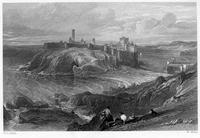
Peel Castle, Isle of Man, engraving by William Miller after Leitch
William Leighton Leitch
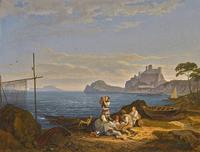
The Bay of Naples Capri Beyond
Ludwig Richter
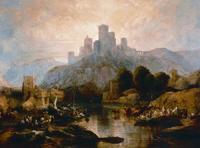
Castillo De Alcalá De Guadaira
Jenaro Pérez Villaamil
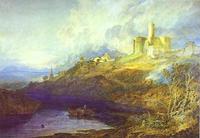
Warkworth Castle, Northumberland; Thunderstorm Approaching at Sunset
J.M.W. Turner
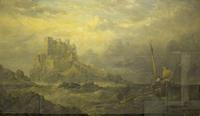
Bamburgh Castle
James Webb
Cartagena, Spain
James Webb
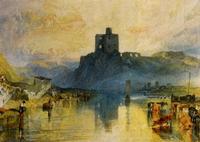
Norham Castle, on the River Tweed
J.M.W. Turner
Landscape
Thomas Girtin
Richmond Castle, Yorkshire
George Lambert
View of the Coast of Scotland
William Daniell
Odessa
Maxim Vorobiev
Lago d'Agnano with the Grotta del Cane
Richard Wilson
Northern Ireland. Dunluce Castle
Albert Julius Olsson
Prior's Haven, Tynemouth
John Wilson Carmichael
Sugdayya
Konstantin Bogaevsky
Landscape with a Castle
John Martin
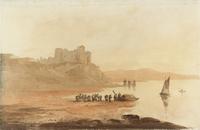
Harlech Castle, Wales
David Cox
Beach at Scheveningen
Salomon van Ruysdael