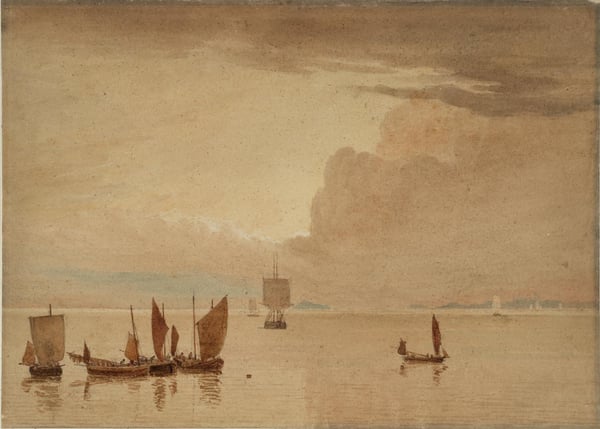
Sea-piece with Fishing Boats in a Calm None
Expert analysis of John Varley’s Sea-piece with Fishing Boats in a Calm None
Style: Romanticism · Genre: marina
Analysis of Sea-piece with Fishing Boats in a Calm None (likely "Calm Noon") by John Varley
This work belongs to the Romanticism movement and is categorized as a marina—a genre devoted to seascapes and maritime life. Its significance lies in how it exemplifies Romanticism’s shift from dramatic, storm-laden sublime to the quieter, contemplative beauty of nature.
John Varley (1778–1842) was a foundational figure in the British watercolor tradition, and this painting showcases his mastery of atmospheric tranquility. The “calm none” (likely a typo for “calm noon”) suggests a moment of hushed stillness, where the sea is flat, the light is diffuse, and fishing boats rest idly. Unlike the turbulent oceans of Turner or the dramatic shipwrecks common in Romantic marine painting, Varley focuses on the everyday, peaceful coexistence of human labor and nature.
The work is significant for its subtle play of light and reflection, a hallmark of Varley’s watercolor technique. The soft, silvery tones and delicate handling of the horizon line evoke a sense of infinite space and quiet harmony. This aligns with Romanticism’s interest in the sublime not only as awe and terror but also as serene, meditative vastness.
Moreover, Varley’s choice of a humble fishing scene elevates the ordinary to the poetic, reflecting the Romantic ideal of finding profound beauty in simple rural or coastal life. The painting’s tight composition—boats clustered near the foreground, open sky and water beyond—creates a balanced, stable world that feels both immediate and timeless.
In the context of art history, Sea-piece with Fishing Boats in a Calm None represents a critical moment in the development of British landscape and marine painting, where Nature is no longer just a backdrop but the central emotional and spiritual subject. Varley’s calm sea becomes a metaphor for introspection, making this work a quietly powerful statement of Romantic sensibility.
Visually similar
20 works with related composition and palette
Fishermen mooring in a calm
Alexandre Thomas Francia
Beach View
Abraham Storck
Beach View
Abraham Storck
The fishing fleet at dusk
William Wyld
Fischerboote Im Sturm Vor Der Holländischen Küste Bei Den Helder
Abraham Storck
Honfleur
Richard Parkes Bonington
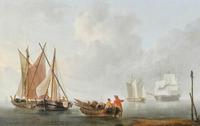
Fishermen and Boats with Two Sailing Ships Beyond
Charles Martin Powell
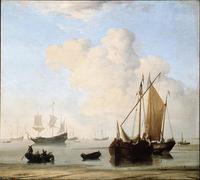
A Calm
Willem van de Velde the Younger
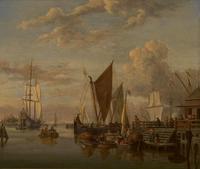
Gezicht Op Het Ij Bij Amsterdam
Abraham Storck
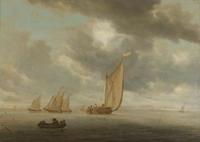
Zeilschepen Op Breed Binnenwater
Salomon van Ruysdael
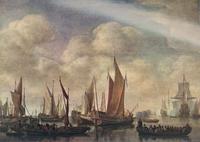
Visit of Frederick Hendriks II to Dordrecht in 1646
Simon de Vlieger
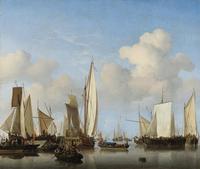
Ships in The Roads
Willem van de Velde the Younger
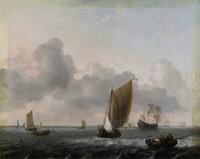
Marine, Choppy Sea
Ludolf Backhuysen I
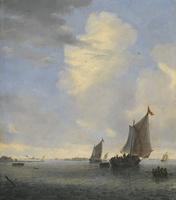
Wijdschip and Other Ships at the Mouth of An Estuary
Salomon van Ruysdael
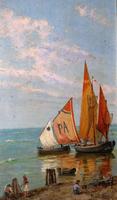
Seegelschëffer
Antonietta Brandeis
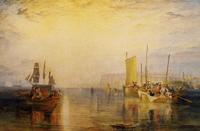
Sunrise, Whiting Fishing at Margate
J.M.W. Turner
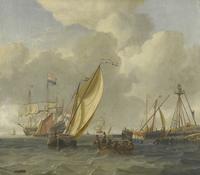
Dutch Ships on Choppy Coastal Waters by a Spit of Land with a Beacon
Abraham Storck
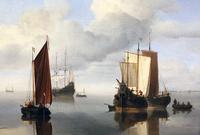
Calm: Fishing Boats Under Sail
Willem van de Velde the Younger
Coastal Scene
Simon de Vlieger
Watervlakte Met Zeilboten
Salomon van Ruysdael