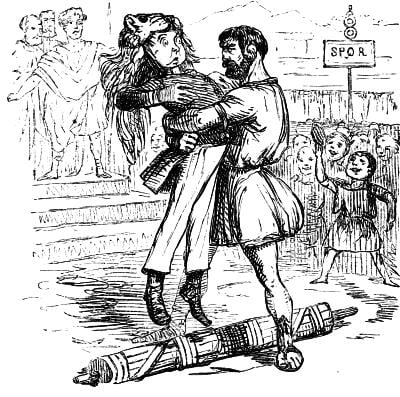
A Lictor is sent to arrest Publilius Volero
詳細
John Leech の A Lictor is sent to arrest Publilius Volero の専門的な分析
スタイル:Romanticism · ジャンル:illustration
Expert Analysis: "A Lictor is sent to arrest Publilius Volero" by John Leech
Style: Romanticism
Genre: Illustration
Significance within Romanticism and the Illustration Genre
John Leech’s "A Lictor is sent to arrest Publilius Volero" embodies the Romantic fascination with historical narrative, dramatic tension, and individual defiance—themes central to the early-to-mid-19th-century Romantic movement. While Leech is best known for his satirical and humorous illustrations for Punch magazine, this work reveals a more serious, historically charged side of his oeuvre, aligning with Romanticism’s turn toward classical and medieval subjects as vehicles for exploring emotion, heroism, and the conflict between state authority and personal liberty.
Subject and Romantic Ideals
The scene depicts a moment from Roman history (traditionally from Livy’s Ab Urbe Condita) in which a lictor—an attendant bearing the fasces, a symbol of magisterial power—is ordered to arrest the plebeian soldier Publilius Volero. Volero’s refusal to submit, which sparked a political revolt over the rights of common citizens, epitomizes the Romantic hero: a solitary individual resisting oppressive power. Leech captures this tension through gesture and implied movement—the lictor’s rigid, official posture contrasts with Volero’s likely defiant stance, heightening the drama of the impending confrontation. This alignment with Romanticism’s celebration of individual will against institutional force is a key element of the work’s significance.
Style and Emotional Impact
Though we cannot see the image directly, the Romantic style is evident in the choice of subject and the expected compositional devices: strong chiaroscuro, dynamic diagonals, and a focus on facial expression and body language to convey psychological intensity. Leech, though primarily a satirical illustrator, here adopts a more solemn, epic tone. The work’s significance lies in how it bridges the gap between high-art Romantic history painting—as practiced by Delacroix or Géricault—and the popular illustration market. By bringing such a charged historical episode into a mass-reproducible format, Leech democratized Romantic ideals, making them accessible to a broader middle-class audience.
Role as Illustration
As an illustration, this piece was likely intended for a book or periodical, reinforcing the Romantic-era trend of combining text and image to educate and inspire. Illustrations of this kind were crucial in spreading Romantic nationalism and historical awareness, particularly in Britain, where classical republicanism was invoked in debates about reform. The work’s significance, therefore, is twofold: it is a technical exemplar of Romantic history-painting principles adapted for print, and it serves as a cultural artifact reflecting the period’s fascination with ancient struggles for justice—a theme that resonated deeply in the age of revolutions and reform movements.
Conclusion
John Leech’s "A Lictor is sent to arrest Publilius Volero" is a noteworthy example of Romantic illustration because it harnesses the emotional and ideological power of a classical narrative while operating within a popular, widely disseminated genre. It demonstrates that Romanticism was not confined to monumental canvases but could thrive in smaller, narrative-driven works, reaching audiences who might never encounter official Salon paintings. In this, Leech’s work stands as a significant contribution to the Romantic movement’s mission to stir the heart and mind through history, drama, and the enduring spirit of individual resistance.
視覚的に類似
構図やパレットが近い作品 20 件
The Romans walking off with the Sabine Women
John Leech
Flaminius Restoring Liberty to Greece at the Isthmian Games
John Leech
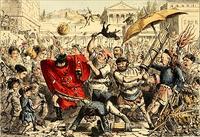
Appius Claudius Punished by the People
John Leech
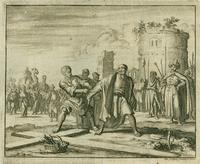
Crucifixion of Simon the Zealot, Syria, AD 70
Jan Luyken
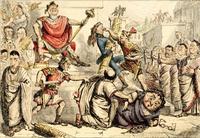
Tarquinius Superbus makes himself King
John Leech
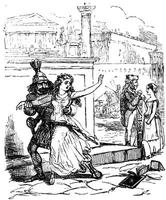
Virginia carried off by a Minion in the pay of Appius
John Leech
The Martyrdom of Eleazar the Scribe
Gustave Dore
Jullieta Killed Along with Her Daughter, Tarsus, AD 304
Jan Luyken
Crucifixion of Apostle Matthew, AD 70
Jan Luyken
The Citadel saved by the cackling of the Geese
John Leech
Felicitas Killed with Her 7 Sons, Rome, AD 104
Jan Luyken
Coriolanus parting from his Wife and Family
John Leech
Christ Taken Captive
Albrecht Durer
The Ambassadors purchasing Æsculapius
John Leech
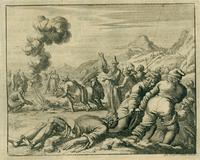
Burning of Barnabas at Salamanca, Cyprus, AD 64
Jan Luyken
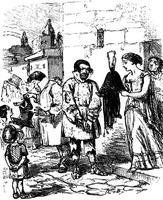
The Romans clothed by the Inhabitants of Capua
John Leech
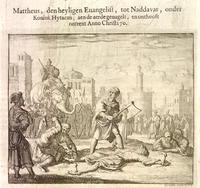
Evangelist Matthew Beheaded, Naddavar, Ethiopia, AD 70
Jan Luyken
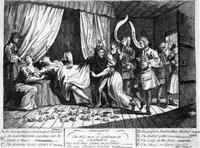
Mary Toft, apparently giving birth to rabbits
William Hogarth
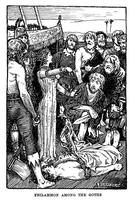
Philammon Among the Goths. Illustration from a 1914 Edition of Charles Kingsley's 1853 Novel Hypatia
Byam Shaw
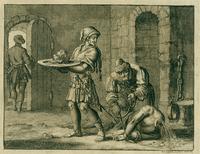
John the Baptist Beheaded, AD 23
Jan Luyken