Expert analysis of Rupert Bunny’s Chiffons
Style: Impressionism · Genre: genre painting
Expert Analysis of "Chiffons" by Rupert Bunny
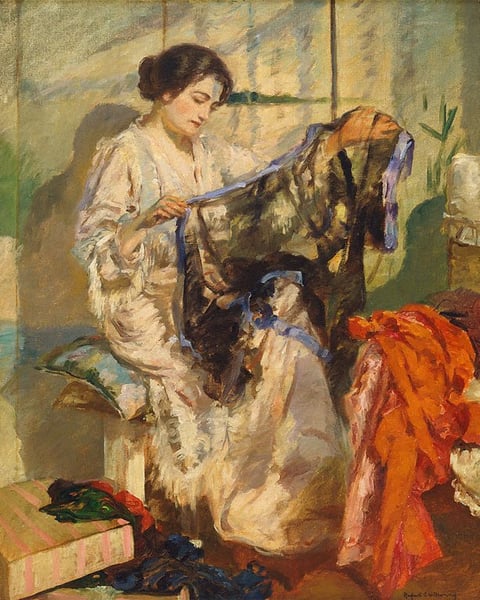
Rupert Bunny’s "Chiffons" is a compelling example of Impressionist genre painting, distinguished by its intimate focus on a scene of everyday life—likely a woman or women engaged with fabric or sewing, as suggested by the title (French for "rags" or "scraps of cloth"). The work’s significance lies in how Bunny, an Australian-born artist who thrived in the Parisian avant-garde, adapts the core tenets of Impressionism to elevate a domestic, unremarkable moment into a study of light, texture, and fleeting human activity.
Significance within Impressionism and Genre Painting:
-
Mastery of Light and Atmosphere – Like his French contemporaries, Bunny captures the play of natural light across surfaces—here, the soft folds of fabric, the gleam of a needle, or the diffused glow on a figure’s skin. The painting exemplifies the Impressionist emphasis on plein air or interior scenes where light transforms mundane objects into luminous subjects. The “chiffons” themselves become vehicles for exploring color harmonies and dappled brushwork.
-
Elevation of Domestic Labor – As genre painting, "Chiffons" celebrates the quiet dignity of women’s work, a recurring theme in Bunny’s oeuvre. It avoids sentimentality, instead presenting a studied, almost voyeuristic glimpse of a private task. This aligns with Impressionism’s broader shift toward observing modern life—not the grand narratives of history painting, but the subtle poetry of routine.
-
Cross-Cultural Innovation – Bunny’s unique position as an Australian artist in France enriches the work. While he fully absorbed French Impressionist technique, his palette sometimes carries a warmer, more intense chromatic sensibility influenced by the Australian landscape. "Chiffons" thus bridges European and antipodean sensibilities, making it a significant piece in the global diffusion of Impressionism.
-
Tactile and Psychological Depth – The title’s reference to cloth or remnants suggests a deeper metaphor: scraps of fabric as fragments of memory, identity, or economy. Bunny renders these textures with sensuous brushstrokes, inviting the viewer to feel the weight of silk or the coarseness of linen. The intimate focus on hands and materials creates a psychological tension typical of Bunny’s best works—a quiet story within a fleeting instant.
In sum, "Chiffons" is significant not only as a masterful Impressionist genre piece but as a testament to Rupert Bunny’s ability to transform the domestic into the profound, capturing a universal human experience through the lens of light, texture, and understated narrative.
Visually similar
20 works with related composition and palette
Katherine
Clarence Gagnon
The female mender
Umberto Veruda
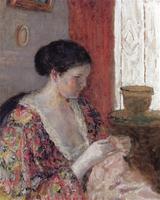
The Artist's Wife Sewing
Frederick Carl Frieseke
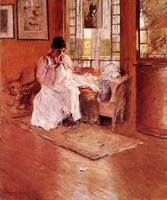
For the Little One, aka Hall at Shinnecock
William Merritt Chase
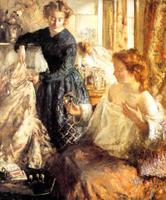
Crystal Gazers
Henry Tonks
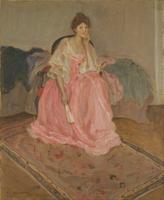
Lady in Pink
Frederick Carl Frieseke
The dead bird
Umberto Veruda
Spetssom
Anders Zorn
Interior with woman embroidering
Joaquín Agrasot
Doleful premonition
Gerolamo Induno
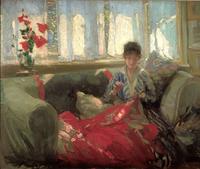
Woman Sewing
Philip Wilson Steer
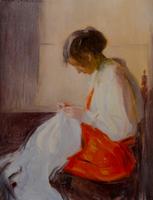
Rapariga Costurando
Antonio Carneiro
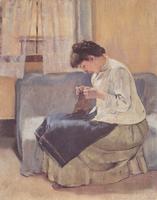
Seamstress
Ferdinand Hodler
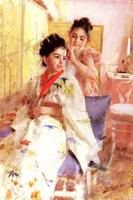
Misses Solomon
Anders Zorn
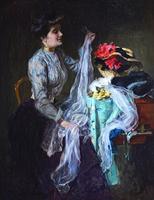
Untitled
Jules-Alexandre Grun
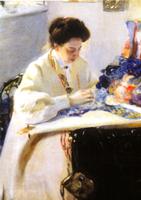
Portrait of Elena Prahova
Oleksandr Murashko
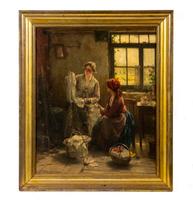
Two Women Comparing Shopping
Edward Portielje
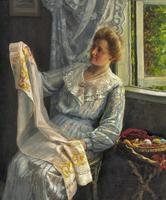
Young Girl With Her Handwork
Wenzel Tornøe
Spring
Robert Lewis Reid
Morning Reflections
Robert Lewis Reid