Expert analysis of Rupert Bunny’s Salomé
Style: Art Nouveau (Modern), Impressionism · Genre: religious painting
Expert Analysis: "Salomé" by Rupert Bunny
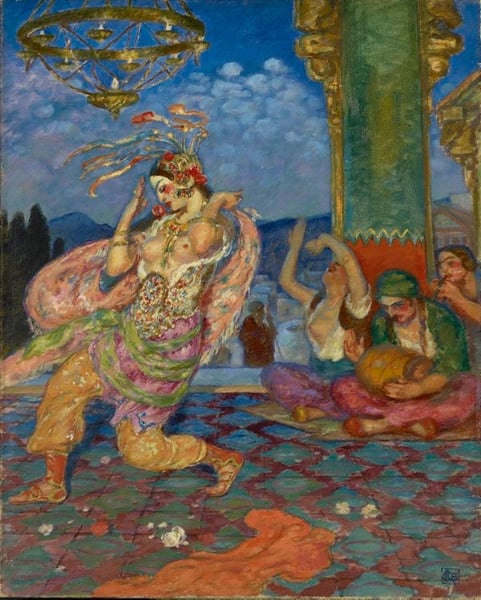
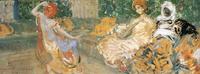
Rupert Bunny’s Salomé is a singular fusion of two distinct artistic movements—Art Nouveau and Impressionism—applied to the traditionally solemn genre of religious painting. While Art Nouveau is typically associated with decorative, secular themes and Impressionism with spontaneous, everyday scenes, Bunny boldly reimagines the biblical story of Salomé through a modern, sensual lens.
The work’s significance lies in its synthesis: the sinuous, flowing lines and ornamental elegance of Art Nouveau are married to the soft, atmospheric brushwork and luminous color palette of Impressionism. This combination transforms a religious subject into a study of mood and surface beauty, rather than a narrative of moral lesson. Bunny’s Salomé becomes less a figure of biblical condemnation and more a symbol of fin-de-siècle fascination with femme fatale and exoticism—a hallmark of modern Art Nouveau.
Furthermore, by labeling the painting as “religious,” Bunny challenges the genre’s traditional boundaries. He does not depict the dramatic moment of John the Baptist’s beheading, but instead emphasizes decorative patterning, ambient light, and a dreamlike quality. This approach distances the work from didacticism and aligns it with the aestheticist movement, where art exists for its own beauty. In this way, Salomé stands as a key example of how late-19th-century artists repurposed religious iconography to explore contemporary artistic concerns—namely, the interplay of line, color, and sensuous surface.
Visually similar
20 works with related composition and palette
Samson and Delilah
Gustave Moreau
Saltimbanques
Rupert Bunny
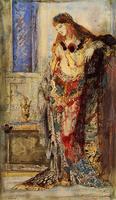
The Toilet
Gustave Moreau

Under The Pink Laurels
Nasreddine Dinet
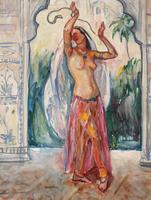
Oriental Dancer
Samuel Mutzner

Girl with Falcon
Pierre-Auguste Renoir
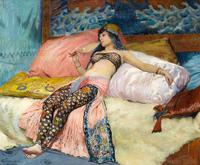
Portrait of Sarah Bernhardt
Georges Rochegrosse

Jezebel
Byam Shaw

Satan's messenger
Nasreddine Dinet
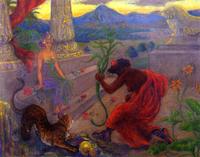
Untitled
Paul Ranson

Mademoiselle Geneviève Vix Dans Le Rôle De Salomé
Kees van Dongen
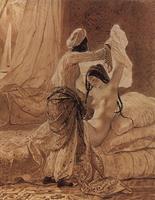
In a Harem. "By Allah's Order Underwear Should Be Changed Once a Year"
Karl Bryullov
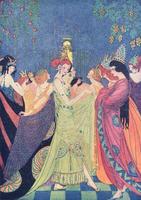
Charles Scribner's Sons
Elenore Abbott
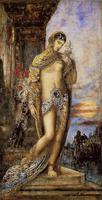
The Song of Songs
Gustave Moreau
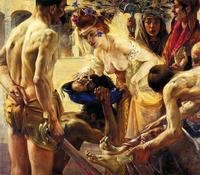
Salome
Lovis Corinth
Vision, The Rubaiyat of Omar Khayyam
Edmund Dulac
Cobra Dance
Samuel Mutzner
The Arab guard
Georges Rochegrosse
The Harem
Theodore Chasseriau
Bakhchisaray
Konstantin Korovin