
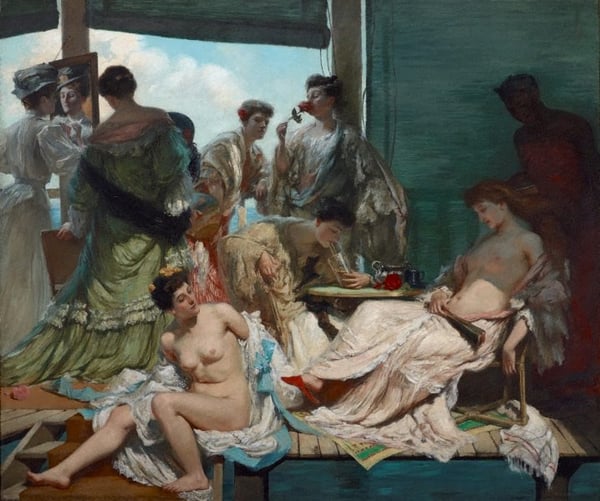
Expert analysis of Rupert Bunny’s Summer time
Style: Impressionism · Genre: nude painting (nu)
Expert Analysis: Summer time by Rupert Bunny
Rupert Bunny (1864–1947) is a pivotal figure in the history of Australian art, yet his career was largely forged in France, where he absorbed and adapted Impressionist principles. Summer time exemplifies his mature period, blending the plein-air luminosity of Impressionism with a distinctly modern treatment of the nude.
Stylistic Significance within Impressionism
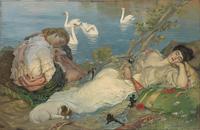
While Impressionism often favored landscapes and scenes of modern life, Bunny’s nudes stand apart for their celebration of contemporary leisure rather than mythological or exoticized figures. In Summer time, the female form is placed in a sun-drenched, outdoor setting—a hallmark of Impressionist “open-air” painting. Bunny’s brushwork is fluid and broken, capturing the dappled light filtering through foliage, and his palette emphasizes warm, hazy tones that evoke the languor of summer. This aligns with the movement’s core interest in transient effects of light and atmosphere.
Genre and Cultural Context
As a nu (nude painting), Summer time contributes to a longstanding tradition, but Bunny subverts academic conventions. Unlike the polished, staged nudes of the Salon, his figure appears natural and unposed, almost casual—a reflection of the era’s shifting attitudes toward the body and privacy. The title itself suggests a specific moment, anchoring the nude in the everyday rather than in allegory. This approach echoes the work of contemporaries like Renoir and Degas, yet Bunny’s treatment often carries a subtle Australian warmth and directness, influenced by his colonial background.
Significance in Bunny’s Oeuvre
Summer time is significant as an example of Bunny’s ability to synthesize French Impressionist technique with a personal sensibility. It showcases his mastery of light and color while offering a serene, intimate vision of femininity that was both modern and timeless. The painting is also a testament to the cross-cultural exchange in art at the turn of the 20th century, as an Australian artist engaged with—and contributed to—the most progressive currents of European painting.
In summary, Summer time is noteworthy for its Impressionist handling of natural light, its reimagining of the nude as a subject of contemporary leisure, and its place in Rupert Bunny’s career as a bridge between Australian and French artistic traditions.
Genre
Style
Visually similar
20 works with related composition and palette
Phryne at the Poseidonia in Eleusis (detail)
Henryk Siemiradzki
Private baths in Pompeii
Fyodor Bronnikov
Favorite of the Emir
Benjamin Constant
A Sleeping Girl
Albert Joseph Moore
Untitled
Henri Fantin-Latour

Mademoiselle de Clermont as a Sultana
Jean-Marc Nattier
The Bath
Henri Fantin-Latour
By a Pool. A Scene from Roman Life
Henryk Siemiradzki
Ancient grooming
Federico Faruffini
A Coign of Vantage
Sir Lawrence Alma-Tadema
Conversión de la Magdalena
Teófilo Castillo Guas
Courtship the Proposal
Sir Lawrence Alma-Tadema

Odalisque
Henri-Pierre Picou
In the studio
Paul Quinsac

Eros ferrying lovers to Cythera
Wilhelm Kray
After the Bath
Károly Lotz
Mercury and Aglauros
Carel Fabritius
Japanese Garden
Paul Quinsac
Endormies
Rupert Bunny

On the Terrace
Wilhelm Kotarbinski