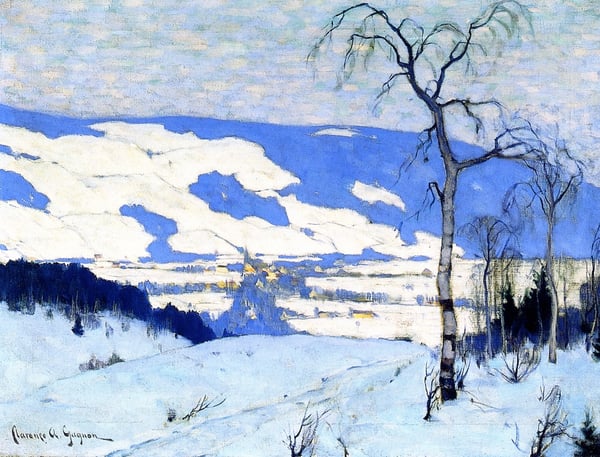
Análisis experto de Twilight, Baie-Saint-Paul de Clarence Gagnon
Estilo: Art Nouveau (Modern) · Género: landscape
Analysis of "Twilight, Baie-Saint-Paul" by Clarence Gagnon
Though Clarence Gagnon is best known for his vivid Canadian landscapes, this work is categorized within the Art Nouveau (Modern) style, offering a unique cross-pollination of that ornamental movement with the naturalist tradition of landscape painting.
Significance within Art Nouveau and the Modern Period:
-
Organic Integration of Line and Form: Art Nouveau’s hallmark is the sinuous, plant-like line—the “whiplash” curve. In Twilight, Baie-Saint-Paul, Gagnon applies this principle not to decorative motifs but to the landscape itself. The contours of hills, the flow of the river, and the silhouettes of trees are rendered with a rhythmic, undulating quality that turns the scene into a living, decorative whole. The twilight atmosphere softens edges, allowing these curves to dominate over realistic detail.
-
Emphasis on Atmosphere and Symbolism: Art Nouveau often sought to evoke mood through stylized nature. Here, the dusky light is not merely observed but transformed into a near-symbolic veil—the purples, blues, and deep greens work in harmony to create a sense of calm transcendence. This aligns with the Modern era’s shift away from strict representation toward emotional and aesthetic expression.
-
Modernist Break from Tradition: While Gagnon’s subject (a rural Quebec village) is rooted in nostalgia, his treatment is decisively modern. The flattened spatial depth, the reduction of forms to graceful silhouettes, and the unapologetic use of decorative pattern over photographic accuracy show Art Nouveau’s influence. In this context, Twilight, Baie-Saint-Paul stands as a rare example of a landscape that marries of the movement’s ornamental idealism with a specific, personal locale—making it significant as a bridge between European decorative art and Canadian modernism.
-
Local Identity in a Global Style: By applying Art Nouveau’s vocabulary to a distinctly Canadian scene, Gagnon helped adapt a cosmopolitan style to an emerging national identity. The work’s significance lies in how it proves that Art Nouveau was not limited to posters, furniture, or architecture, but could be extended to capture the quiet poetry of a rural twilight—without losing the movement’s signature grace.
Visualmente similares
20 obras con composición y paleta relacionadas
Baie-Saint-Paul
Clarence Gagnon
Overlooking the Valley of the Gouffre, Charlevoix
Clarence Gagnon
In the Laurentians, Winter
Clarence Gagnon
Winter Landscape
Pierre Daura
Rang Saint-Laurent, Baie-Saint-Paul
Clarence Gagnon
Saint-Sauves under the snow
Armand Guillaumin
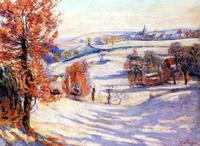
Neige à Crozant
Armand Guillaumin
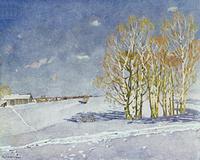
The Blue Winter Day
Konstantin Yuon
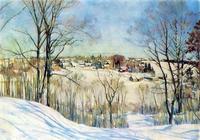
The Winter Day
Konstantin Yuon
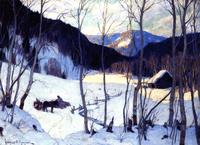
The Clearing in the Woods
Clarence Gagnon
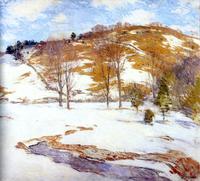
Snow in the Foothills
Willard Metcalf
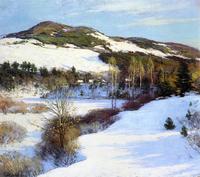
Cornish Hills
Willard Metcalf
Autumn
Mikhail Olennikov
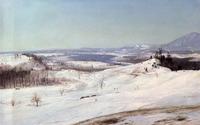
View of Olana in the Snow
Frederic Edwin Church
Untitled
Vilhelms Purvitis
Landscape in Moonlight
Henry Ossawa Tanner
WINTER LEAVES
JAROSLAV KELUC
Moonlight, Waning Winter
Homer Watson
Winter at Giverny
Claude Monet
Winter in New Hampshire
Willard Metcalf