
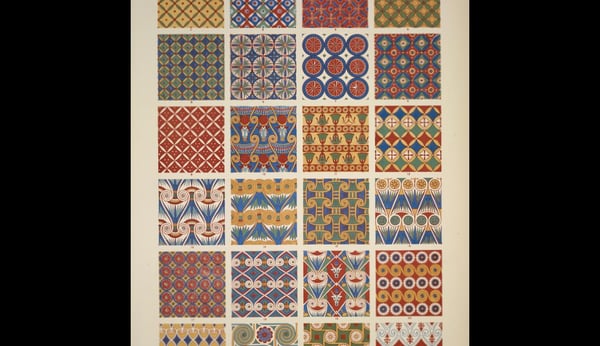
Analisi esperta di Egyptian no. 7 di Owen Jones
Stile: Art Nouveau (Modern) · Genere: design
Expert Analysis: "Egyptian no. 7" by Owen Jones
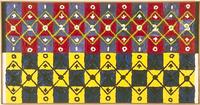
Owen Jones’s "Egyptian no. 7" is a seminal design study that bridges the historicist passions of the 19th century with the emerging visual language of Art Nouveau. Though the work is classified under the Modern style and belongs to the design genre, its significance lies in how Jones systematically abstracted ancient Egyptian ornament into a modern, decorative vocabulary—a key precursor to the organic, flat-pattern aesthetics of Art Nouveau.
Jones, best known for his encyclopedic The Grammar of Ornament (1856), championed the idea that all great ornament is rooted in geometry, balance, and the adaptation of nature. In a work like "Egyptian no. 7," he isolates and refines motifs such as the lotus, papyrus, and repetitive friezes, stripping them of literal narrative and emphasizing their rhythmic, linear flow. This reduction to pure line and pattern aligns directly with Art Nouveau’s core principle: the fusion of structure and decoration.
What makes this artwork significant is its role as a theoretical and practical bridge. Jones’s analytical approach—deconstructing historical styles into formal elements—provided later Art Nouveau designers (like Émile Gallé or Hector Guimard) a method for creating a genuinely new style that felt both ancient and modern. By presenting Egyptian motifs as part of a universal grammar of ornament, Jones argued for a global, non-hierarchical design language, challenging Eurocentric historicism. "Egyptian no. 7" is thus not merely a decorative plate; it is a manifesto for how the past could be reimagined as a source of structural clarity and refined elegance—qualities that define the best of Art Nouveau’s applied arts.
Visivamente simili
20 opere con composizione e palette affini
Egyptian no. 6
Owen Jones
Medieval Ornament no. 4. Stained glass of various periods
Owen Jones
Nineveh and Persia, no. 2
Owen Jones
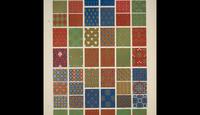
Medieval Ornament no. 3. Diapers from illuminated manuscripts and backgrounds of pictures
Owen Jones
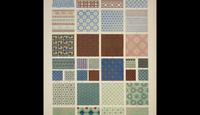
Chinese Ornament no. 1. Ornaments painted on porcelain and wood from woven fabrics
Owen Jones
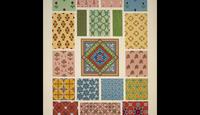
Persian Ornament no. 1. Ornaments from Persian manuscript in the British Museum
Owen Jones
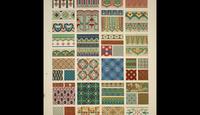
Chinese Ornament no. 2. Ornaments painted on porcelain and wood from woven fabrics
Owen Jones
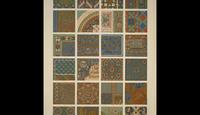
Byzantine no. 2. Painted Byzantine ornaments
Owen Jones
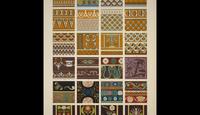
Renaissance Ornament no. 7. Ornaments from pottery at Hotel Cluny and Louvre
Owen Jones
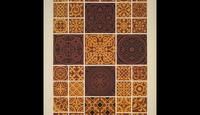
Medieval Ornament no. 4. Encaustic tiles of various periods.
Owen Jones
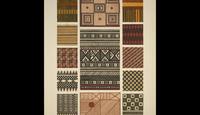
Savage tribes, no. 1
Owen Jones
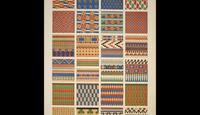
Egyptian no. 8
Owen Jones
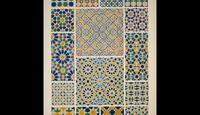
Moresque ornament from the Alhambra no. 5. Mosaics.
Owen Jones
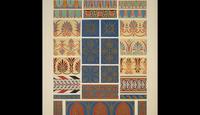
Greek no. 8. Painted Greek ornaments from the temples and tombs in Greece and Sicilty
Owen Jones
Indian Ornament no. 3. Ornaments from woven fabrics and paintings on vases exhibited in the Indian Collection, now at Marlborough House
Owen Jones
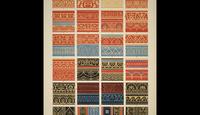
Pompeian no. 1. Collection of borders from different edifices in Pompei
Owen Jones
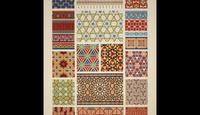
Persian Ornament no. 2. Ornaments from Persian manuscript in the British Museum
Owen Jones
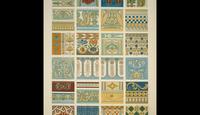
Renaissance Ornament no. 6. Ornaments from pottery at Hotel Cluny and Louvre
Owen Jones
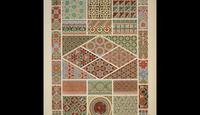
Byzantine no. 3. Mosaics
Owen Jones
Systole And Diastole
Alfred Jensen