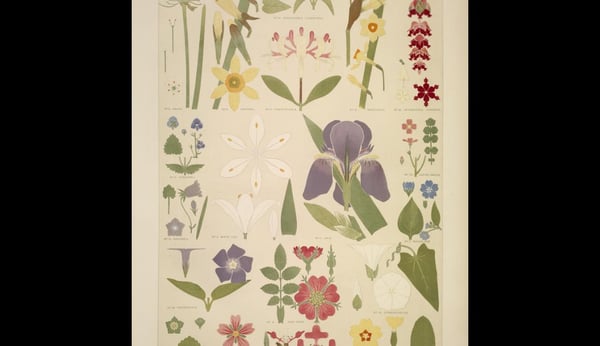
Leaves and Flowers from Nature Ornament no. 8. Various flowers in plan and elevations.
Ayrıntılar
Owen Jones sanatçısının Leaves and Flowers from Nature Ornament no. 8. Various flowers in plan and elevations. eseri hakkında uzman analizi
Tarz: Art Nouveau (Modern) · Tür: design
Expert Analysis of Owen Jones's Leaves and Flowers from Nature Ornament no. 8 (c. 1856)
This design by Owen Jones occupies a pivotal position in the evolution of modern ornament, serving as a direct bridge between the disciplined naturalism of the mid-Victorian era and the flowing, organic forms of Art Nouveau. Although the work predates the Art Nouveau movement proper by several decades, it is retrospectively understood as a foundational precursor—a systematic exploration of nature as pure graphic pattern, stripped of illusionistic depth.
Significance within the Art Nouveau (Modern) Context:
Jones’s approach here anticipates Art Nouveau’s core tenet: that ornament should be derived from nature but stylized into rhythmic, two-dimensional motifs. The title—Leaves and Flowers from Nature Ornament no. 8. Various flowers in plan and elevations—reveals his method: he dissects botanical forms into diagrammatic orthographic views (plan and elevation), transforming them into repeatable, abstract units. This analytical reduction of nature into flat, decorative schema directly prefigures the sinuous, whiplash curves and entwined plant forms that define high Art Nouveau (e.g., the work of Victor Horta, Hector Guimard, or Charles Rennie Mackintosh). Jones’s insistence on “plan and elevation” (architectural drawing conventions applied to botany) also underscores his modern, almost scientific approach—a hallmark of the rationalist design reform movement he championed.
Genre as Design: The Rational Grammar of Ornament
As a work of design rather than fine art, this piece is inseparable from Jones’s monumental publication The Grammar of Ornament (1856), where it likely appeared. Its significance lies in Jones’s revolutionary belief that ornament must be governed by universal principles—chiefly, that decoration should be flat, geometric, and derived from stylized natural forms. Here, leaves and flowers are not rendered naturalistically but are arranged in symmetrical compositions that emphasize pattern over representation. The “no. 8” indicates a serial study, reinforcing Jones’s systematic taxonomy of ornament. This design is thus not merely decorative but didactic: it teaches how to synthesize nature into modern, repeatable motifs suitable for wallpaper, textiles, or architectural friezes.
Stylistic and Historical Importance:
Jones’s work directly challenged the overloaded, illusionistic historicism of Victorian design, advocating for clarity, structure, and the primacy of the flat surface. In this sense, Leaves and Flowers from Nature Ornament no. 8 is proto-modern: it looks ahead to the abstraction of the 20th century (Cubist faceting, Art Deco geometry) while still rooted in the nineteenth-century fascination with nature. Its influence radiated through the Arts and Crafts movement, the Vienna Secession, and ultimately Art Nouveau, where the stylized botanical motif became the signature visual language. Jones’s principle—“Proportion is the most essential element of ornament, and without it no consistency can be obtained”—is vividly enacted in this plate, where each leaf and petal locks into a coherent, rhythmic whole.
Conclusion:
Owen Jones’s Leaves and Flowers from Nature Ornament no. 8 is significant because it crystallizes the transition from historic revivalism to a modern, nature-based aesthetic. It stands as a theoretical blueprint for Art Nouveau, demonstrating how organic forms can be distilled into disciplined, flat patterns that are both decorative and structurally rational. In this sense, it is not just a design of its time but a key document in the genesis of modern ornamental thinking.
Tür
Görsel olarak benzer
İlişkili kompozisyon ve renk paletine sahip 20 eser
Untitled
Maria Sibylla Merian
Spanish iris, morning glory, and cherries
Georg Flegel
Untitled
Maria Sibylla Merian
Flowers and Beetles
Hans Hoffmann
Leaves and Flowers from Nature Ornament no. 9. Honeysuckle and Convolvulus, full size
Owen Jones
Do It Yourself (Flowers)
Andy Warhol
Irises
Leon Wyczółkowski
Yellow Lily
Frank Mason
Untitled
Clovis Trouille
Irises and poppies
Emil Nolde
Field flowers
Mikhail Vrubel
Nature morte à la coccinelle
Ambrosius Bosschaert the elder
A Girl Face with Gentian
Toyen
Botanica (Flowers)
Barton Lidice Benes
From the Old Garden No 2
Georgia O'Keeffe
from Der Raupen wunderbare Verwandlung und sonderbare Blumennahrung, Plate CLXIX
Maria Sibylla Merian
Irises
Stanisław Wyspiański
Irises and Tulips
John Bratby
Flowers
Paul de Longpré
Bunny Mellon
Abdul Mati Klarwein