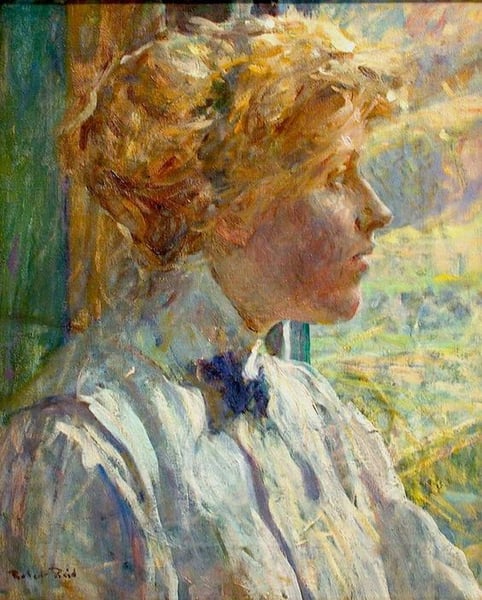
Portrait of the Artist's Wife
Analisi esperta di Portrait of the Artist's Wife di Robert Lewis Reid
Stile: Impressionism · Genere: portrait
Expert Analysis: "Portrait of the Artist’s Wife" by Robert Lewis Reid
Style: Impressionism
Genre: Portrait
Robert Lewis Reid’s Portrait of the Artist’s Wife exemplifies the American Impressionist approach to portraiture, infusing the genre with the movement’s core principles of capturing light, atmosphere, and fleeting moments. As an American Impressionist, Reid adapted the French style’s broken brushwork and vibrant color palette to intimate, domestic subjects, and this work is significant for its synthesis of personal intimacy with the broader Impressionist mission of recording sensory experience.
Significance within Impressionism:
Reid’s portrait demonstrates Impressionism’s departure from formal, static portraiture in favor of a more naturalistic, spontaneous rendering. The painting likely emphasizes the interplay of natural light on the sitter’s features and surroundings, using dappled strokes to evoke a momentary glimpse rather than a rigid likeness. This aligns with Impressionism’s rejection of academic idealization, prioritizing the artist’s immediate perception of the subject. Reid’s choice to depict his wife—a familiar, intimate presence—underscores the movement’s interest in everyday life and personal relationships as worthy artistic subjects, a radical shift from the grand historical or mythological themes of earlier eras.
Significance within the Portrait Genre:
In the context of portraiture, this work is notable for its fusion of psychological depth with sensory immediacy. Rather than a commissioned, formal portrait that projects social status, Reid’s painting explores the quiet, private bond between artist and sitter. His wife’s pose, expression, and setting would be rendered with soft, luminous colors and a palpable attention to ambient light—hallmarks of Impressionism that allow the viewer to feel the atmosphere of the moment. This reflects a broader shift in late 19th-century portraiture: the artist’s personal connection to the subject becomes as central as the subject’s identity, making the portrait both a record of a person and a meditation on seeing itself.
Art-Historical Context:
As an American Impressionist active in the late 19th and early 20th centuries, Reid brought the French Impressionist vocabulary to a distinctly American sensibility. His portraits often feature a decorative, almost mural-like quality, with lush color harmonies and a sensitivity to light that links him to both the Boston School and the broader Tonalist movement. Portrait of the Artist’s Wife thus occupies a unique position: it bridges the European Impressionist obsession with visual perception and the American emphasis on intimate, domestic realism, making it a key example of how Impressionism was adapted beyond its French origins to convey personal, emotional truths.
Genere
Stile
Visivamente simili
20 opere con composizione e palette affini
At the Window
William Merritt Chase
Profile of a seated young woman
Berthe Morisot
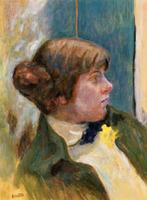
Study for Profile of a Woman in a Bow Tie
Pierre Bonnard
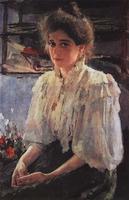
Portrait of Maria Lvova
Valentin Serov
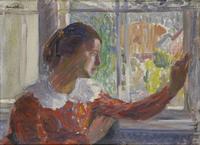
The girl at the window
Hanna Hirsch-Pauli
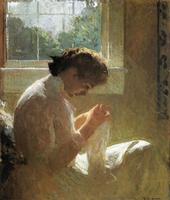
The Sunny Window
Frank W. Benson
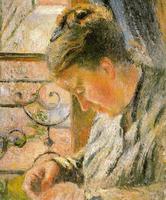
Portrait of Madame Pissarro Sewing near a Window
Camille Pissarro
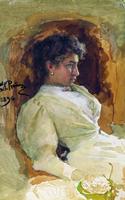
Portrait of N.I. Repina
Ilya Repin

Peasant Woman Head
Nicolae Grigorescu
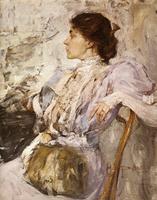
Lady in Lilac
Nicolai Fechin
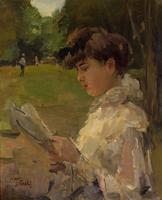
Girl Reading
Isaac Israels
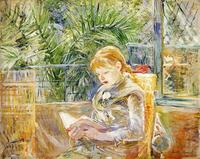
Reading
Berthe Morisot
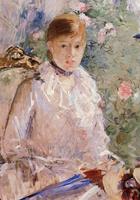
Portrait of a Young Lady
Berthe Morisot
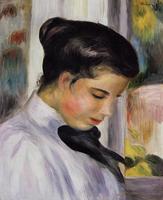
Young Woman in Profile
Pierre-Auguste Renoir
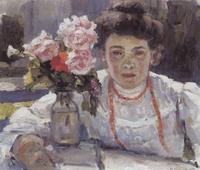
Portrait of E. V. Surikova
Vasily Surikov
Lady With Red Earring
Julian Fałat
The Little Red Haired Girl
Ethel Léontine Gabain
Young woman looking out to sea
Isaac Israels
After Luncheon
Berthe Morisot
Young Woman Sewing
Pierre-Auguste Renoir