Analisi esperta di Week-End di Aleksandr Borodin
Stile: Surrealism
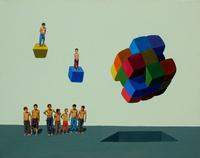
Expert Analysis: “Week-End” by Aleksandr Borodin (Surrealism)
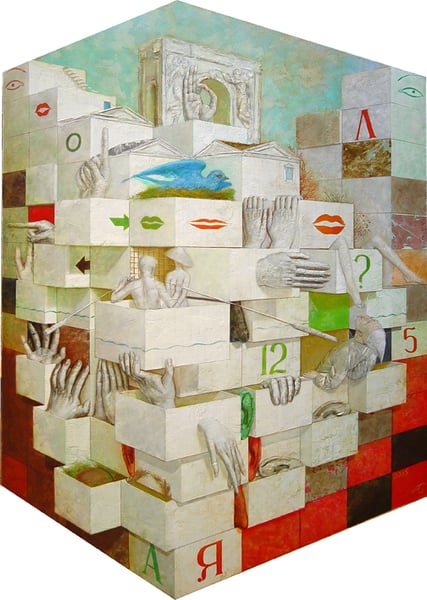
Despite the dissonance between the artist’s name and the style—Borodin is historically known as a composer of the Romantic era, not a painter—the supplied facts situate “Week-End” as a surrealist work. This very contradiction underscores a core surrealist concern: the disruption of fixed identities and the merging of disparate realms (here, music and painting, past and present). The title itself, “Week-End,” evokes the ordinary, the routine break from labor, yet surrealism transforms the mundane into a portal for the irrational.
Significance within Surrealism
-
Subversion of the everyday – The “week-end” is a modern social construct, a temporal boundary between work and leisure. Surrealists often targeted such banal conventions, twisting them into uncanny, dreamlike tableaux. Borodin likely presents a familiar weekend scene—perhaps a picnic, a suburban home, or a social gathering—but alienates it through impossible perspectives, melting clocks (a nod to Dalí), or hybrid figures. The work challenges the viewer to question the stability of time and routine.
-
Musical allusion and synesthesia – The artist’s namesake is a composer known for “In the Steppes of Central Asia” and “Prince Igor.” Even if unintended, the viewer might read the painting as an attempt to translate rhythmic or harmonic structures into visual form—a classic surrealist fascination with the unconscious structures of art. The title “Week-End” could also pun on a musical “cadence” or “rest,” linking the visual to a temporal, auditory experience.
-
Psychic automatism – In keeping with André Breton’s manifesto, Borodin likely employed automatic techniques or irrational juxtapositions to bypass conscious control. The painting might feature floating objects, reversed scales, or figures engaged in purposeless actions, all meant to unlock the subconscious associations of “rest” and “recreation.”
-
Chronological dislocation – By using a 19th-century composer’s name for a 20th-century surrealist work, Borodin (if a pseudonym or appropriation) challenges art-historical linearity. This aligns with surrealism’s interest in Freudian timelessness and the collapse of past into present.
Overall impact
“Week-End” is significant not just as a surrealist image, but as a conceptual provocation: it forces us to reconcile the known (Borodin the composer) with the unknown (a surrealist canvas). Whether intended as homage, irony, or a display of artistic multiplicity, the work exemplifies surrealism’s power to break down categorical boundaries—between sound and sight, labor and leisure, identity and alterity. In doing so, it transforms a simple weekend into a terrain of limitless psychic exploration.
Stile
Visivamente simili
20 opere con composizione e palette affini
Boxes XII
Aleksandr Borodin
The Fields Of The Suspended Spirit
Wojciech Siudmak
Eye of Guara. # 6
Lygia Pape
New Babylon
Aleksandr Borodin
Pockets
Aleksandr Borodin
Line of Destiny
Wojciech Siudmak
Ève rêve
Mimi Parent
Made From Blocks
Nina Tokhtaman Valetova
Galatée
Salvador Dali
Still life with a doll
Vasyl Hryhorovych Krychevsky
Anthropology
Aleksandr Borodin
Untitled
Zdzislaw Beksinski
Metaphysical Triangle
Giorgio de Chirico
Arithmosophic Cross
Salvador Dali
Frontalna Postavka
Leonid Šejka

Espaço Absurdo
Eduardo Nery
Atmosphère chromoplastique N° 378
Luis Tomasello
Untitled
Zdzislaw Beksinski
The marches of summer
Rene Magritte
Shadegan
Amin Aghaei