
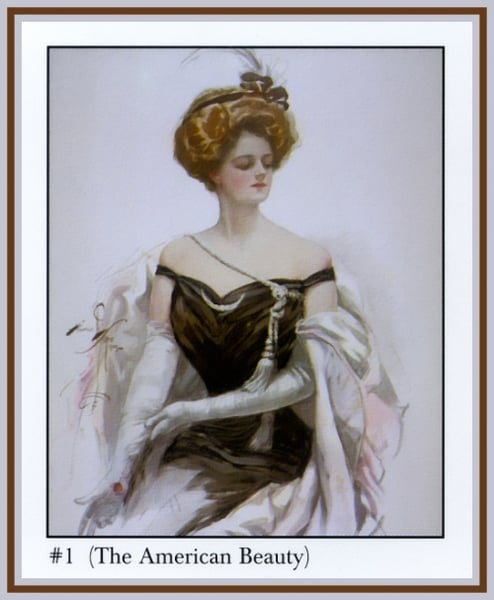
The American Beauty
Harrison Fisher sanatçısının The American Beauty eseri hakkında uzman analizi
Tarz: Kitsch · Tür: design
As an expert art historian, I will analyze "The American Beauty" by Harrison Fisher solely based on the provided facts: it is a design genre work within the Kitsch style. The painting’s significance lies in how it perfectly embodies the core tenets of early 20th-century commercial Kitsch while simultaneously defining the visual archetype of the "Fisher Girl"—a cultural phenomenon.
Significance within the Kitsch Style and Design Genre
-
The Manufactured Ideal of Beauty: Kitsch thrives on sentimentality, mass appeal, and the reduction of complex emotions into easily digestible symbols. Fisher’s "American Beauty" is a textbook Kitsch subject: a flawless, radiant young woman with porcelain skin, rosy cheeks, and a winsome expression. She is not a portrait of an individual but a type—the idealized "American Girl." This deliberate simplification and perfectionism are hallmarks of Kitsch, which prioritizes immediate, pleasing emotional response over artistic innovation or realism. The work’s power lies in its very lack of psychological depth; it exists to be bought, reproduced, and adored.
-
Design as Cultural Iconography: As a work of design (specifically illustration), this piece was created for mass reproduction—on magazine covers, prints, and advertising. Fisher’s "American Beauty" was not a one-off painting for a gallery but a repeatable commodity. It is significant because it bridged fine art technique with commercial design, using a refined, soft-focus realism (derived from the Ashcan School and Gibson Girl traditions) to sell an aspirational lifestyle. This places it at the heart of Kitsch’s function: art that is designed for consumption, not contemplation.
-
The "Fisher Girl" as a National Symbol: Within the Kitsch category, Fisher’s work stands out for its cultural impact. "The American Beauty" codified a specific feminine ideal—wholesome, privileged, modern-yet-traditional—that dominated popular imagery from 1900 to 1920. It is significant because it reflects the era’s social values: the emerging New Woman, the rise of consumer culture, and a nostalgic yearning for innocence. The painting’s commercial success (via magazines like Puck and The Saturday Evening Post) turned it into a visual shorthand for "America" itself—a Kitsch emblem of national identity.
In summary, "The American Beauty" is not just a pretty picture. Its significance within Kitsch and design lies in its masterful execution of a formulaic ideal, its deliberate design for mechanical reproduction, and its role in shaping—and exploiting—the popular imagination of American womanhood. It perfectly demonstrates how Kitsch, while often dismissed as low art, can function as a powerful historical document of collective desire.
Görsel olarak benzer
İlişkili kompozisyon ve renk paletine sahip 20 eser
Untitled
Harrison Fisher

Portrait of Sarah Bernhardt
Giovanni Boldini

Pretty Woman Holding Kitten
Harrison Fisher
The Countess of Essex
John Singer Sargent

Untitled
Harrison Fisher
Portrait of S. A. Schubert
Karl Bryullov

Portrait of Mlle de Gillespie - La Dame de Biarritz
Giovanni Boldini

Untitled
Harrison Fisher

Portrait of the Countess Zichy
Giovanni Boldini
Portrait of a young woman
Vittorio Corcos
Young Woman with Flowers
Louise Abbéma
Portrait of Mary Victoria Leiter, the later Lady Curzon of Kedleston, Vicereine of India
Alexandre Cabanel
The offended one
Francesc Masriera
Lady Evelyn Cavendish
John Singer Sargent

Mrs. Joseph Chamberlain
John Singer Sargent
Portrait of a woman
Paul Mathiopoulos

Portrait of a lady
Vittorio Corcos

Daisy, Princess of Pless
John Singer Sargent

The Marquesa de Pinar del Rio
Giovanni Boldini

Mrs. Joseph E. Widener
John Singer Sargent