Untitled
Analisi esperta di Untitled di Harrison Fisher
Stile: Kitsch · Genere: design
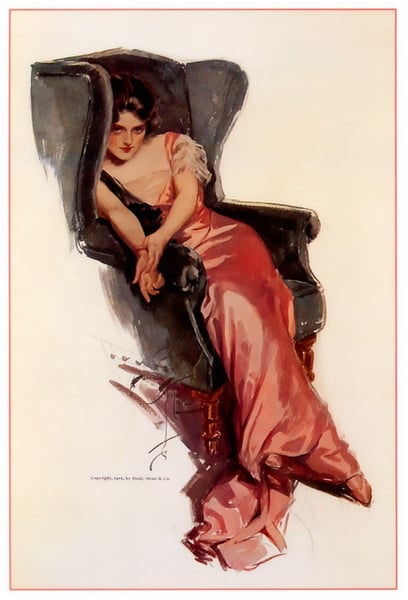
As an expert art historian, I can contextualize Harrison Fisher's Untitled within the overlapping realms of Kitsch and design—a pairing that reveals a great deal about early 20th-century visual culture and the deliberate embrace of mass appeal.
Significance within Kitsch and Design:
Harrison Fisher (1875–1934) was a dominant force in American illustration, famous for creating the idealized “Fisher Girl”—a wholesome, glamorous, and distinctly American feminine archetype that graced magazine covers, posters, and advertisements. This Untitled work exemplifies Kitsch not as a pejorative, but as a deliberate aesthetic strategy that prioritizes immediate emotional gratification, accessibility, and commercial purpose over avant-garde provocation or formal complexity.
The work is significant for three key reasons:
-
The Pinnacle of Commercial Kitsch: Fisher’s art embodies the very definition of Kitsch as a mass-produced, sentimental, and highly polished style designed to please a broad audience. His porcelain-skinned, fashionable women with sparkling eyes and perfect coiffures offered a fantasy of effortless beauty and prosperity. This Untitled piece likely functioned as a decorative design—perhaps for a magazine cover or calendar—meant to be consumed quickly and pleasurably. Its significance lies in how it transforms a genre (design) into a vehicle for collective aspiration, making idealized femininity a commodity.
-
Mastery of the Design Genre: As an illustrator working in the design field, Fisher subordinated fine-art conventions to the needs of reproduction and commercial messaging. His technique—smooth, almost photographic rendering; vibrant yet harmonious color; and a focus on elegant, streamlined composition—was perfectly suited for halftone printing and lithography. This Untitled piece showcases how Kitsch can achieve technical excellence: every brushstroke is calibrated for visual impact and readability at a distance, proving that design is not a lesser art but a distinct discipline with its own criteria for significance.
-
Historical and Cultural Barometer: Fisher’s work captures the optimism and consumer ethos of the “Gilded Age” and early 20th-century America. The women he painted—often in fashionable attire, posed with inviting smiles—were not real individuals but carefully crafted signifiers of leisure, class, and desirability. In the context of Kitsch, this piece is significant as a cultural artifact that reveals how popular taste was shaped by mass media. The Untitled design became a normative image of American womanhood, influencing fashion, beauty standards, and even social behavior.
Conclusion:
Harrison Fisher’s Untitled is a quintessential example of elevated Kitsch within the design tradition. Its significance rests in its flawless execution of a commercially driven aesthetic, its role in defining American visual culture during a period of rapid industrialization, and its demonstration that Kitsch—far from being mere “bad art”—can be a deliberate, skilled, and deeply resonant mode of visual communication. This work invites us to reconsider the boundaries between fine art and design, and to appreciate how even the most accessible images can carry profound historical and sociological weight.
Visivamente simili
20 opere con composizione e palette affini

Untitled
Harrison Fisher

Untitled
Harrison Fisher

Palmolive (Is she pretty)
Rolf Amstrong

Untitled
Harrison Fisher
Untitled
Harrison Fisher

Untitled
Harrison Fisher

Single Items
Raphael Kirchner
On the dressing table
Raphael Kirchner
Untitled
Harrison Fisher

Dark Haired Girl In Black Skirt And Turquoise Blouse On A Floral Sofa
Gerda Wegener
Woman
Rene Xavier Prinet
Untitled
Harrison Fisher

Untitled
Harrison Fisher

The Letter
Harrison Fisher
Half Act
Wilhelm Gallhof
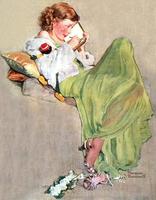
Diary
Norman Rockwell
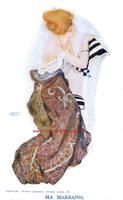
Ma Marraine
Raphael Kirchner

Miss Sylvania
Haddon Sundblom

Portrait of a Society Lady
Haddon Sundblom

On the couch
Ilya Repin