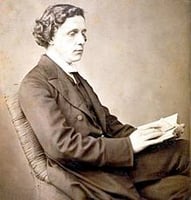
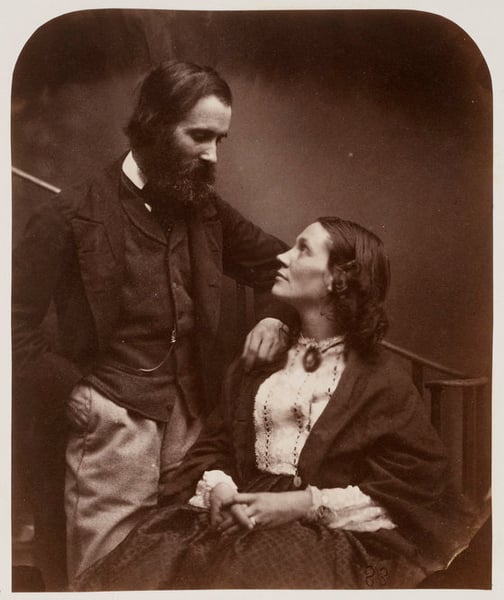
Lewis Carroll の Alexander Munro and his wife, Mary Carruthers の専門的な分析
スタイル:Pictorialism · ジャンル:photo
Expert Art Historical Analysis
"Alexander Munro and his wife, Mary Carruthers" (circa 1860s) by Lewis Carroll (Charles Lutwidge Dodgson) stands as a compelling example of early Pictorialist portraiture. The work is significant for three interconnected reasons: its place within Carroll’s photographic oeuvre, its embodiment of Pictorialist ideals, and its rare depiction of a fellow Victorian artist and his spouse.
Significance Within Pictorialism
Pictorialism (c. 1885–1915) sought to elevate photography to a fine art by prioritizing mood, composition, and soft focus over sharp documentary realism. Although Carroll was an amateur working slightly before the movement formally coalesced, his approach anticipates key Pictorialist tenets:
- Atmospheric softness: Carroll’s use of natural light and careful staging creates a gentle, painterly quality, distancing the image from mere record-keeping.
- Narrative intimacy: The couple is posed in a quiet, domestic scene—likely the sculptor’s studio—evoking a sense of private affection and artistic solidarity. This aligns with Pictorialism’s preference for evocative, often sentimental, subject matter.
- Emphasis on character over likeness: Rather than a stiff, formal portrait, the image emphasizes the subjects’ relationship and inner life, a hallmark of Pictorialist portraiture.
Carroll’s Artistic Context
Lewis Carroll is best known for his literary works and his photographs of children (e.g., Alice Liddell). This portrait of Alexander Munro (1825–1871), a notable Pre-Raphaelite sculptor, and his wife Mary Carruthers is striking because:
- It captures a fellow artist’s private world, offering insight into the social and creative network of Victorian London.
- It demonstrates Carroll’s versatility beyond child portraiture, showcasing his ability to handle adult subjects with the same sensitivity to composition and expression.
- The photograph documents Munro’s own artistic milieu—his studio, tools, or surroundings are implied, linking the medium of photography with the sculptor’s craft.
Technical & Compositional Choices
- Soft focus and restrained palette: Carroll often used collodion wet-plate processes, but this image likely employs a longer exposure and gentle light, resulting in a tonal subtlety that flatters both sitters and unifies the frame.
- Spatial arrangement: The couple is positioned in an informal yet balanced composition—perhaps Munro seated, Mary standing—creating a visual dialogue that reinforces mutual respect.
- Symbolic layering: Munro was a sculptor of idealized figures; the photograph itself, with its careful posing and controlled mood, can be read as a sculptural study in light, reflecting the sitter’s own artistic concerns.
Historical & Stylistic Significance
This photograph matters because it bridges two artistic worlds: the strictly documentary Victorian portrait tradition and the emerging Pictorialist movement that would dominate art photography decades later. As a work by a literary giant who also pursued photography as a serious art form, it challenges the boundary between amateur and professional, and between narrative and image.
In sum, “Alexander Munro and his wife, Mary Carruthers” is significant not only as a rare adult portrait by Lewis Carroll but as an early articulation of Pictorialist aesthetics—soft, intimate, and humanistic—that would later define the photographic avant-garde. Its quiet dignity and painterly quality cement its place as a seminal work in the history of art photography.
視覚的に類似
構図やパレットが近い作品 20 件
Alexandre Dumas
Felix Nadar
Stéphane Mallarmé with Méry Laurent
Felix Nadar
Camille Saint-Saëns
Felix Nadar
George Sand
Felix Nadar
Edouard Manet
Felix Nadar
Edmond (left) and Jules (right) De Goncourt
Felix Nadar
Jean-Francois Millet
Felix Nadar
Édouard Manet
Felix Nadar
Duchesse Marguerita De Madrid
Felix Nadar
Félix Nadar
Felix Nadar
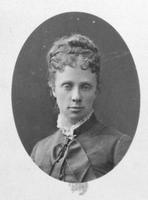
Duchesse Marguerita De Madrid
Felix Nadar
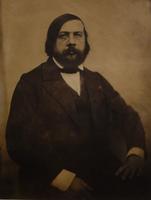
Théophile Gautier
Felix Nadar
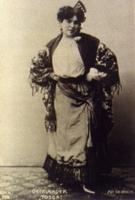
The singer Oberländer
Richard Gerstl
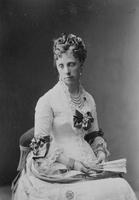
Duchesse Marguerita De Madrid
Felix Nadar
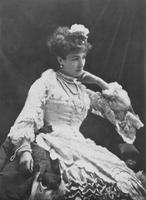
Sarah Bernhardt
Felix Nadar
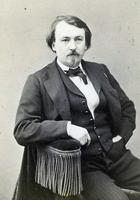
Gustave Doré
Felix Nadar
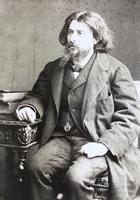
Alphonse Daudet
Felix Nadar
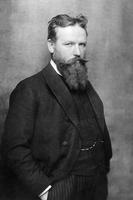
Franz Metzner
Nicola Perscheid
Family portrait
Vincenzo Cabianca
Jacques Offenbach
Felix Nadar