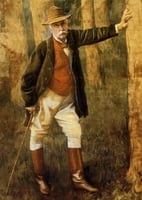
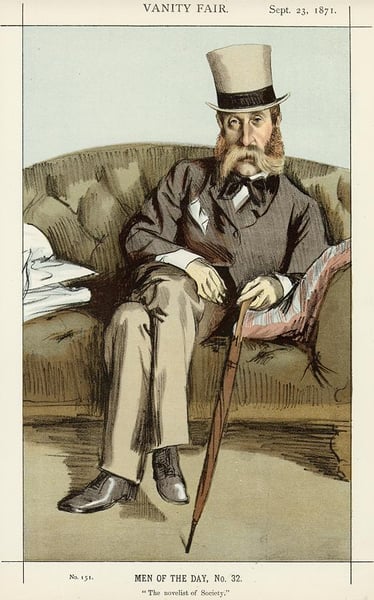
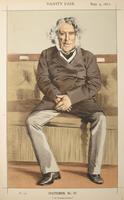
Man of the day No.32° - Caricature of George Whyte Melville
Details
Expertenanalyse zu James Tissots Man of the day No.32° - Caricature of George Whyte Melville
Stil: Realism · Genre: caricature
This work by James Tissot, Man of the day No.32° – Caricature of George Whyte Melville, is a fascinating intersection of two seemingly opposing modes: the meticulous observation of Realism and the deliberate distortion of caricature. While Tissot is primarily celebrated for his detailed, quasi-photographic scenes of modern life (a hallmark of Realism), this print demonstrates how he applied Realist precision to the service of satirical portraiture—a practice that was crucial to the popular visual culture of the late 19th century.
Significance within the style/period:
-
Realism's unlikely ally: In the hands of a lesser artist, a caricature might sacrifice anatomical correctness for ludicrous exaggeration. Tissot, however, retains a Realist's fidelity to texture, physiognomy, and social detail. The portrait of George Whyte Melville—a novelist and sportsman known for his hunting narratives—is not a grotesque lampoon but a wry, characterful exaggeration grounded in observable reality. Tissot's training in the atelier of Hippolyte Flandrin and his early success with historical painting gave him a command of form that he here channels into a kind of "documentary caricature."
-
Serial portraiture and social commentary: The title Man of the day No.32° signals that this is part of a series—a common practice in Victorian periodicals, where lithographic caricatures were released in numbered installments (e.g., Vanity Fair's "Men of the Day" or "Spy" cartoons). Tissot's contribution to this genre is notable because he elevates it beyond mere comic distraction. The "degree" symbol (°) hints at a quasi-scientific, measurable approach to celebrity typology, yet the caricature remains a humanizing study. By capturing Whyte Melville's supposed essence—perhaps his sporting enthusiasm or literary air—Tissot bridges the ephemeral world of journalistic satire and the lasting ambitions of fine art.
-
Tissot's artistic pivot: This work dates from around 1868–1870, a period when Tissot was actively contributing to the London society magazine Vanity Fair. Before his later turn to biblical and spiritual subjects, Tissot was a keen observer of fashionable life. His caricatures are significant because they reveal his ability to distill a personality into a single, sharply observed image while maintaining the elegant draftsmanship expected of a Realist. The Man of the day series thus stands as a testament to Tissot's versatility: he could be both the cool documentarian of The Ball on Shipboard and the witty satirist of the day.
Why it matters: Caricature is often dismissed as lesser art, but Tissot's example shows that Realism's core tenet—truthful representation of the observable world—can also serve the purpose of humorous critique. This work encapsulates a moment when fine art and popular illustration were not yet fully divorced, and when a master of Realist technique could apply his skills to a form that amused, flattered, and gently mocked the public figures of the day. The portrait of George Whyte Melville remains significant because it captures not only the man's physical likeness but also the social currency of celebrity in the late 19th century—all within the disciplined framework of Realist artistry.
Visuell ähnlich
20 Werke mit ähnlicher Komposition und Farbpalette
Statesman No.102° - Caricature of William Henry Gregory
James Tissot
Statesman No.096° - Caricature of Lionel Dawson Damer M.P.
James Tissot
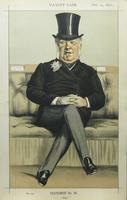
Statesman No.095° - Caricature of Henry William Eaton M.P.
James Tissot
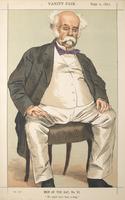
Man of the day No.31° - Caricature of The Duke of Saldanha
James Tissot
Portrait Johann Erdmann Gottlieb Prestel (1804-1885) (probably)
Leopold Pollak
Portrait of Gustave Geffroy
Marie Bracquemond
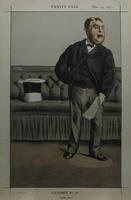
Statesman No.101° - Caricature of George Cavendish Bentinck
James Tissot
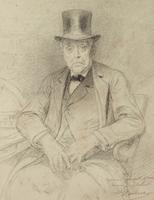
Man sitting frontally in an armchair
Diogène Maillart
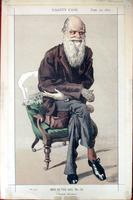
Man of the day No.33° - Caricature of Charles Darwin from Vanity Fair magazine
James Tissot
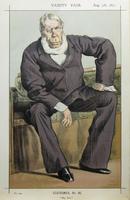
Statesman No.090° - Caricature of George William Pierrepont Bentinck M.P.
James Tissot
André Rouveyre
Antonio de La Gándara
Portrait of Emile Verhaeren
Theo van Rysselberghe
Vuk Karadžić, Serbian philologist, linguist and one of the most important reformers of the modern Serbian language
Josef Kriehuber
The Toast
Anders Zorn
Józef Mehoffer
Stanisław Wyspiański
Arthur Fouques Duparc
Henri Regnault
Man of the day No.35° - Caricature of John Pender
James Tissot
Portrait of Tomás Moragas
Marià Fortuny
Statesman No.092° - Caricature of the Rt.Hon. Russell Gurney
James Tissot
Henri Riviere
Theophile Steinlen