Expertenanalyse zu Ivan Rutkovychs Archangel Gabriel
Stil: Baroque · Genre: religious painting, icon
Expert Analysis: "Archangel Gabriel" by Ivan Rutkovych
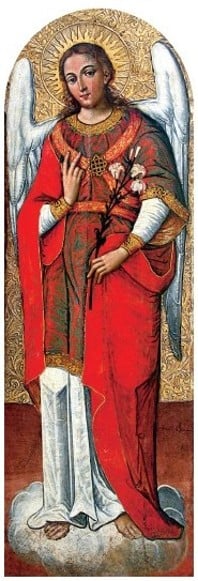
Painted during the late 17th to early 18th century, Ivan Rutkovych’s Archangel Gabriel stands as a masterful example of the Ukrainian Baroque—a hybrid style that synthesizes the theatrical dynamism of Western European Baroque with the hieratic, sacramental traditions of Eastern Orthodox iconography. This work is significant precisely because it bridges two visual cultures, transforming a static icon type into a vivid, emotionally charged devotional image.
Composition & Gesture
Rutkovych presents Gabriel not as a remote, stiff messenger of Byzantine convention, but as a heavenly actor caught mid-motion. The archangel’s figure is elongated and slightly swaying, his right arm raised in a gesture of annunciation or blessing, while his left holds a lily—a symbol of the Virgin’s purity. The drapery of his white and gold vestments cascades in sharp, broken folds, reminiscent of Bernini’s sculpted drapery but translated into the flat, gilded plane of an icon. This dynamic linework and contrapposto-like stance inject Baroque energy into a traditionally frontal format.
Color & Light
Rutkovych employs a luminous, high-contrast palette typical of the Baroque chiaroscuro: deep blues and crimson are set against a glowing gold background (the assist), which reflects heavenly light. The gold is not merely decorative but functions as a metaphysical light source, illuminating Gabriel’s face and hands from within. This fusion of Western tenebrism with the Byzantine gold ground creates a unique spiritual tension—the divine realm is both remote and palpably near.
Iconographic Innovation
While the subject is a traditional archangel, Rutkovych humanizes Gabriel with soft, individuated facial features—a slightly tilted head, almond eyes, and a gentle smile—that invite personal devotion. This aligns with the Post-Tridentine Catholic emphasis on emotional engagement, yet it never compromises the icon’s liturgical purpose. The halo, rendered as a delicate, tooled pattern in the gesso, remains unmistakably Eastern.
Cultural & Historical Significance
As an artist active in the Ukrainian lands of the Polish-Lithuanian Commonwealth, Rutkovych exemplifies the regional Baroque that emerged where Orthodox, Catholic, and Uniate traditions intersected. Archangel Gabriel is not a mere hybrid but a coherent new vocabulary: it proves that Baroque dynamism could serve Eastern spirituality, and that the icon could absorb Western naturalism without losing its contemplative power. This work is a testament to the creative resilience of Ukrainian sacred art—a bridge between East and West, tradition and modernity, that prefigured later movements in Slavic Baroque.
Visuell ähnlich
20 Werke mit ähnlicher Komposition und Farbpalette
Pala di Sant Agostino (Arcangel Gabriel)
Pietro Perugino
Archangel Michael
Nicholas Roerich
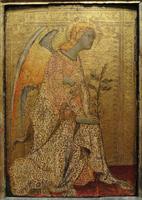
The Angel of the Annunciation
Simone Martini
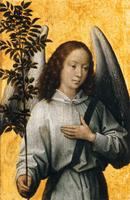
Angel Holding an Olive Branch
Hans Memling
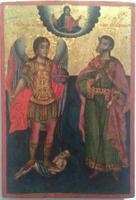
Archangel Michael and Saint Christopher
Orthodox Icons
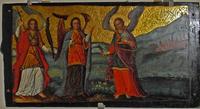
Three Angels
Ivan Rutkovych
St. Michael
Luca di Tommé
Archangel Michael
Ivan Rutkovych
Christ in Glory
Ivan Rutkovych
Saint Lucy
Álvaro Pires de Évora
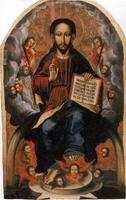
Icon of the Savior from the village of Horodyshche in Volhynia (late 17th century)
Yov Kondzelevych
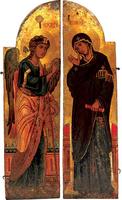
Annunciation
Orthodox Icons
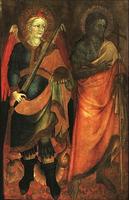
St. Michael and St. John
Álvaro Pires de Évora
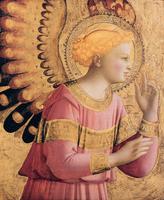
Archangel Gabriel Annunciate
Fra Angelico
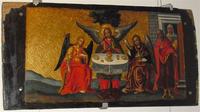
The Old Testament Trinity
Ivan Rutkovych
Madonna and Child on a throne (Front side fragment)
Duccio
Depiction of Saint Saintephen
Carlo Crivelli
St. Mark
Fra Angelico
St. Nicholas of Bari
Fra Angelico
Madonna and Child on a throne (Front side fragment)
Duccio