Analyse experte de The First Steps de Edouard Vuillard
Style : Cloisonnism · Genre : genre painting
Expert Art Historical Analysis: The First Steps by Édouard Vuillard
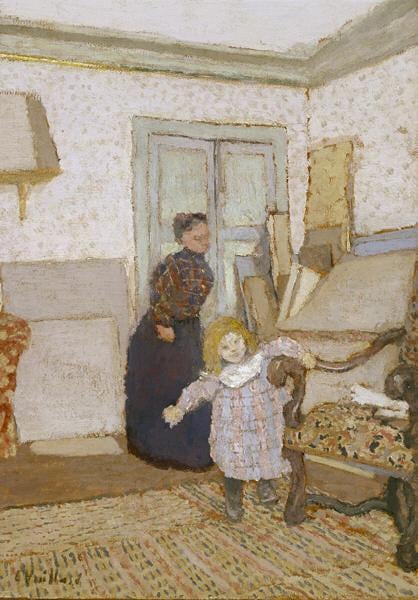
Although Édouard Vuillard is most closely associated with the Nabi movement and intimate interior scenes, The First Steps is here considered through the lens of Cloisonnism—a style defined by bold, flat areas of color separated by dark contours, reminiscent of medieval cloisonné enamel or stained glass. The work exemplifies how Vuillard adapted cloisonnist principles to the genre painting tradition, elevating a domestic, everyday moment into a formally radical composition.
Significance within Cloisonnism and Genre Painting:
-
Synthesis of Decorative Flatness and Narrative Intimacy
Vuillard applies the cloisonnist technique—broad zones of unmodulated color bounded by emphatic outlines—not to exotic or symbolic subjects (as Gauguin or Bernard did), but to the quiet drama of a child’s first steps. This domestic focus is a hallmark of genre painting, yet Vuillard’s treatment strips away naturalistic depth. Walls, floor, and figures merge into a mosaic of warm ochres, muted greens, and soft pinks, with the dark outlines tying the scene together like lead in a stained-glass window. The result is both decorative and psychologically charged, making the ordinary feel monumental. -
Blurring of Figure and Ground
A key cloisonnist strategy is to reduce spatial hierarchy. Vuillard pushes this further by embedding the mother and child into the pattern of the room—their forms echo the wallpaper, the rug, and the furniture. The baby’s outstretched arms and the mother’s bent silhouette become part of an overall surface design. This flattening of space invites the viewer to read the painting as an integrated pattern, yet the title anchors us in the tender narrative of a developmental milestone. The tension between abstraction and storytelling is central to its significance. -
Interiority as Modern Subject
Vuillard’s work helped redefine genre painting for the modern era. Where earlier genre painters (Vermeer, Chardin) used tight realism to capture domestic life, Vuillard uses cloisonnist simplification to express the emotional texture of home—the blur of memory, the warmth of enclosure, the quiet spotlight on a child’s achievement. The First Steps thus stands as a bridge between the decorative radicalism of fin‑de‑siècle art and the introspective, pattern‑obsessed interiors of the early 20th century.
In sum, the painting’s significance lies in its fusion of a stylistically avant‑garde method (cloisonnism) with a deeply human, accessible subject—showing that even the most ordinary family moment can be transformed into a bold, decorative statement about color, line, and the rhythm of daily life.
Museum / Gallery
Visuellement similaire
20 œuvres à la composition et à la palette proches
Seated Woman Dressed in Black
Edouard Vuillard
In a Room
Konstantin Korovin
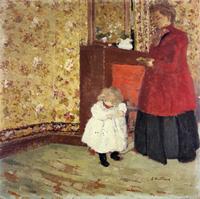
Mother and Child
Edouard Vuillard
Interior of the work-table
Edouard Vuillard
Sewing Woman
Harriet Backer
Interior
Edouard Vuillard
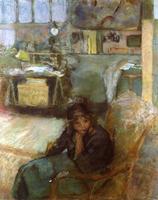
The Studio
Edouard Vuillard
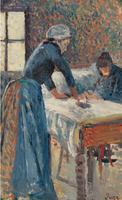
La Repasseuse
Maximilien Luce
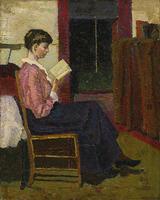
The Reader
Grace Cossington Smith
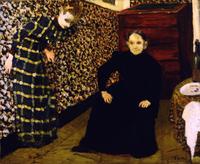
Interior with mother and sister of the artist
Edouard Vuillard
Not expected
Ilya Repin
Sketch for a Mural
Frank W. Benson
Mrs. Holley of Cos Cob, Connecticut
Childe Hassam
Noele's First Steps
Maurice Denis
Open Window
Grace Cossington Smith
Madame Vuillard Cousant
Edouard Vuillard
The brood
Alessandro Milesi
Two in a chair
Konstantin Korovin
Interior at Saint Étienne
Émilie Charmy
A Young Maid
Camille Pissarro