Notes
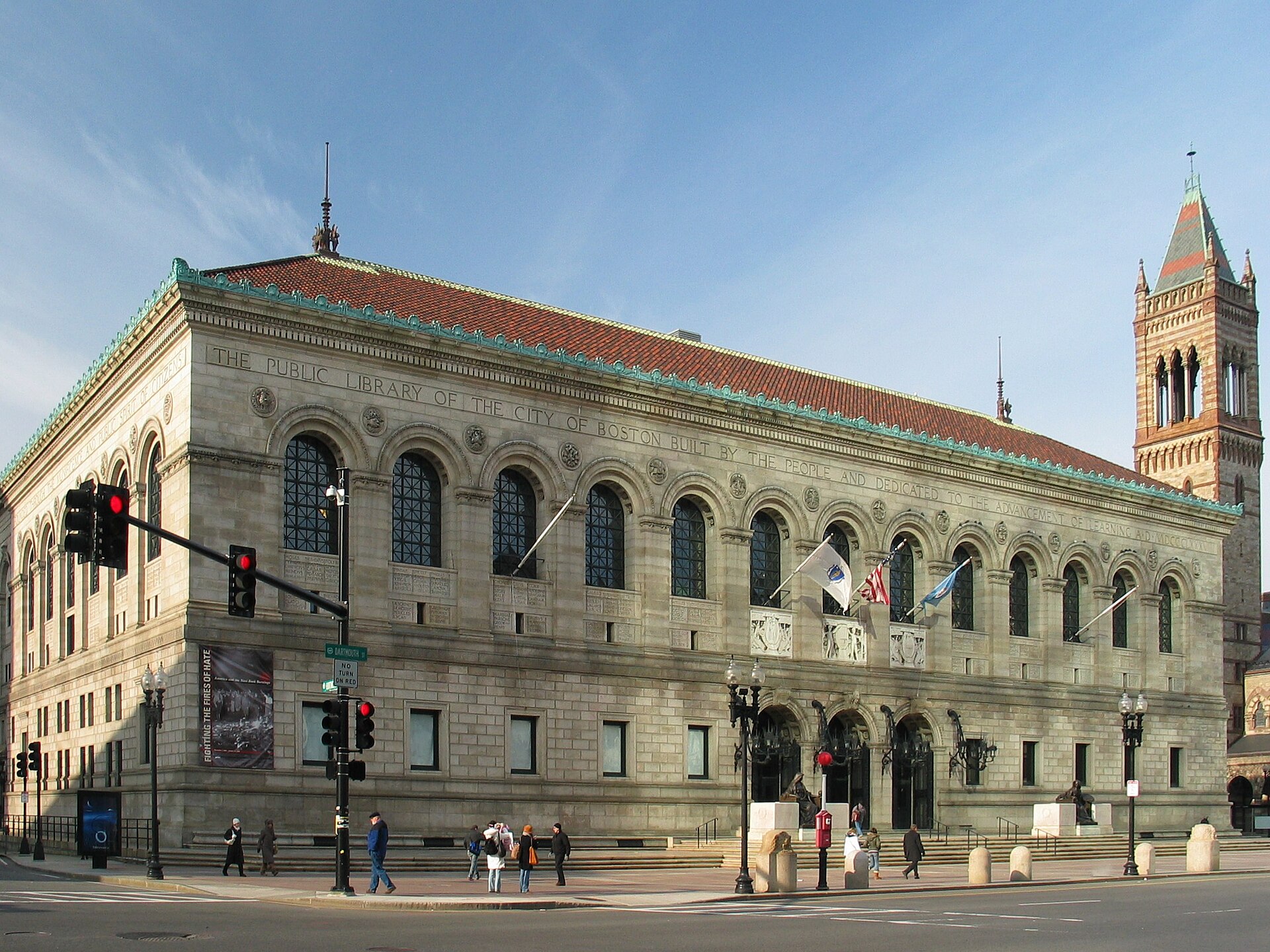
Boston Public Library is a public library founded in 1848 by an act of the Massachusetts legislature, making it the first large free municipal library in the United States; it opened in 1854 and moved to its present Copley Square site at 700 Boylston St in 1895. That building, known as the McKim Building, was designed by Charles Follen McKim of McKim, Mead & White in Renaissance Beaux-Arts Classicism and was designated a National Historic Landmark in 1986 as the style's first outstanding American example. Its interior houses three major mural cycles: Pierre Puvis de Chavannes painted his eight-panel allegorical cycle on the grand staircase and second-floor gallery — depicting Philosophy, Astronomy, History, Chemistry, Physics, and Pastoral, Dramatic, and Epic Poetry, crowned by the Muses of Inspiration greeting the Spirit of Enlightenment — his only work outside France, executed in his Paris studio on canvas and shipped to Boston. Edwin Austin Abbey contributed the fifteen-panel, 150-figure Quest of the Holy Grail cycle in the Abbey Room, based on Tennyson's telling of the Arthurian legend. John Singer Sargent worked for more than thirty years, from 1890 until his death in 1925, on his Triumph of Religion murals on the third floor, a cycle tracing the history of Christianity, Judaism, and other ancient Near Eastern religions that remained unfinished at his death.
Visitors to the McKim Building move through a Beaux-Arts architectural set piece as much as a library: the grand staircase leading up through the Puvis de Chavannes panels, the Abbey Room with Abbey's Arthurian frieze, and the third-floor Sargent murals, all free to view. For anyone interested in large-scale American mural painting of the late nineteenth and early twentieth centuries, the building offers three distinct bodies of work by three major artists under one roof — a scale and concentration of monumental mural art that is unusual to find outside a dedicated museum.
Détails
Lieu
700 Boylston St, 02116 Boston, US