Notes
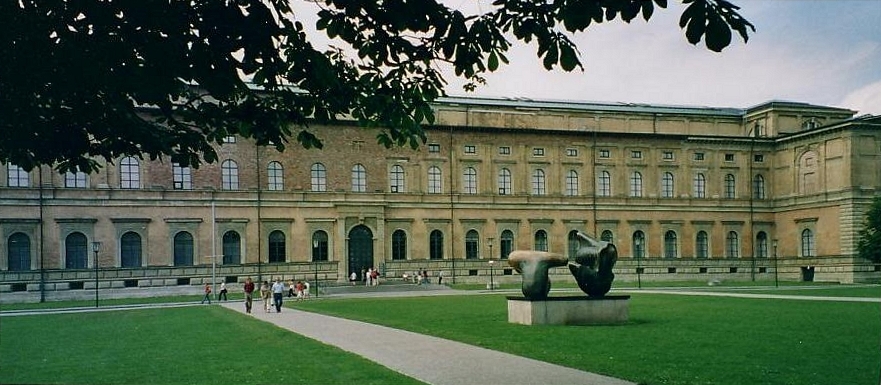
The Alte Pinakothek is a museum in Munich, Germany, housing the Wittelsbach dynasty's collection of European Old Master paintings from the 14th to 18th centuries. The collection traces back to the 1500s, when the Wittelsbach family began privately assembling works, and grew over the 16th to 18th centuries to include pieces by Dürer, Rembrandt, Rubens, and van Dyck. King Ludwig I commissioned architect Leo von Klenze to design a purpose-built gallery for the expanding royal holdings; construction ran from 1826 to 1836, and the building opened to the public in 1836 in the Kunstareal district at what is now Barer Str. 27. Klenze's neo-renaissance design, stretched along an east-west axis, introduced skylight-illuminated exhibition halls — a first for museum architecture — and the building became a reference model for later galleries, including the Hermitage in Saint Petersburg and museums in Rome, Brussels, and Kassel. Severely damaged in the Second World War, it was reconstructed by architect Hans Döllgast.
Visitors move through galleries organized around Dutch, Flemish, German, Italian, French, and Spanish schools, encountering named masters such as Michael Pacher, Albrecht Altdorfer, Raphael, Diego Velázquez, and Peter Paul Rubens alongside the Dürer, Rembrandt, and van Dyck works central to the founding collection. For art enthusiasts, the draw is twofold: the depth of pre-19th-century European painting under one roof, and the building itself, whose skylit halls and neo-renaissance architecture mark a turning point in how museums were designed to display and illuminate art.
Detalles
Ubicación
Barer Straße 27, 80333 München, DE