Notes
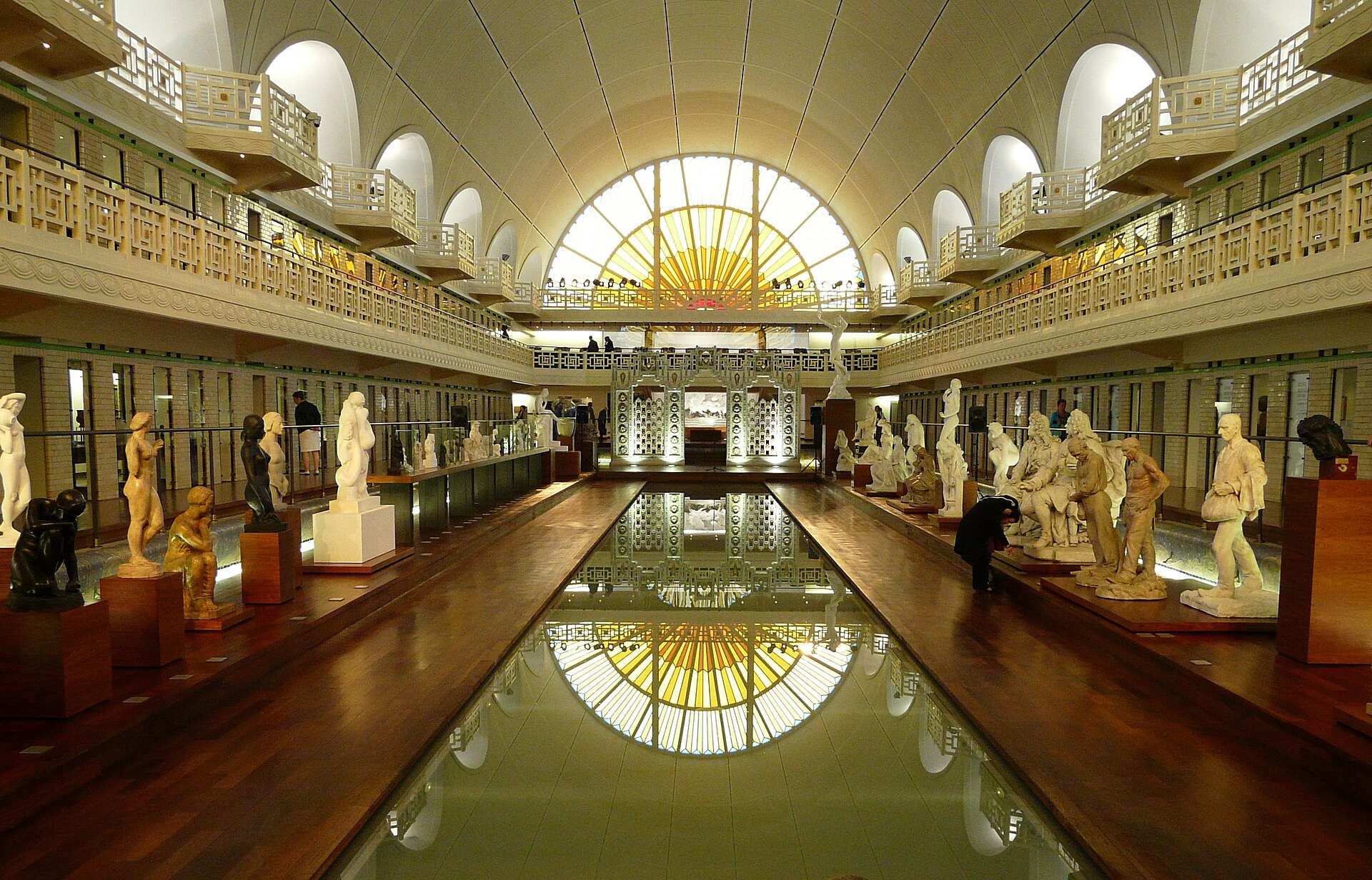
La Piscine Museum is a museum of art and industry in Roubaix, France, housed in a former Art Deco public swimming pool designed by Lille architect Albert Baert and built between 1927 and 1932 at the instigation of Roubaix mayor Jean-Baptiste Lebas. Baert modeled the complex on the layout of Cistercian abbeys, arranging a courtyard around a cloistered garden with a main wing built as a vast nave enclosing an Olympic-size pool lit by polychrome stained-glass windows depicting the rising and setting sun; human-sized statues still line the pool, which remains filled with water, alongside the former changing rooms, bathrooms, and shower cubicles. Structural weakness in the vaulted roof forced the building's closure in 1985, and after a public campaign to save it, architect Jean-Paul Philippon converted the site into a museum that opened in 2001, followed by a 2018 extension that added 2,000 square meters of exhibition space; the museum now spans roughly 11,000 square meters in total.
The collection traces back to 1835, when Roubaix's textile producers began assembling samples of fabrics manufactured in the town, and it has grown into holdings spanning fine art from the end of the 19th century through the late 20th century alongside decorative arts, sculpture, ceramics, design objects, textiles, and drawings — a range that reflects Roubaix's identity as a textile-manufacturing center as directly as it does a conventional fine-arts program. For visitors, the setting itself is inseparable from the collection: walking among sculptures and paintings arranged around a still-functioning Art Deco pool under stained glass gives the museum a character distinct from a standard white-cube gallery, making it a destination for those interested in industrial heritage and decorative arts as much as for those seeking fine-art holdings in the conventional sense.
Dettagli
Luogo
24 Rue des Champs, 59100 Roubaix, FR