Notes
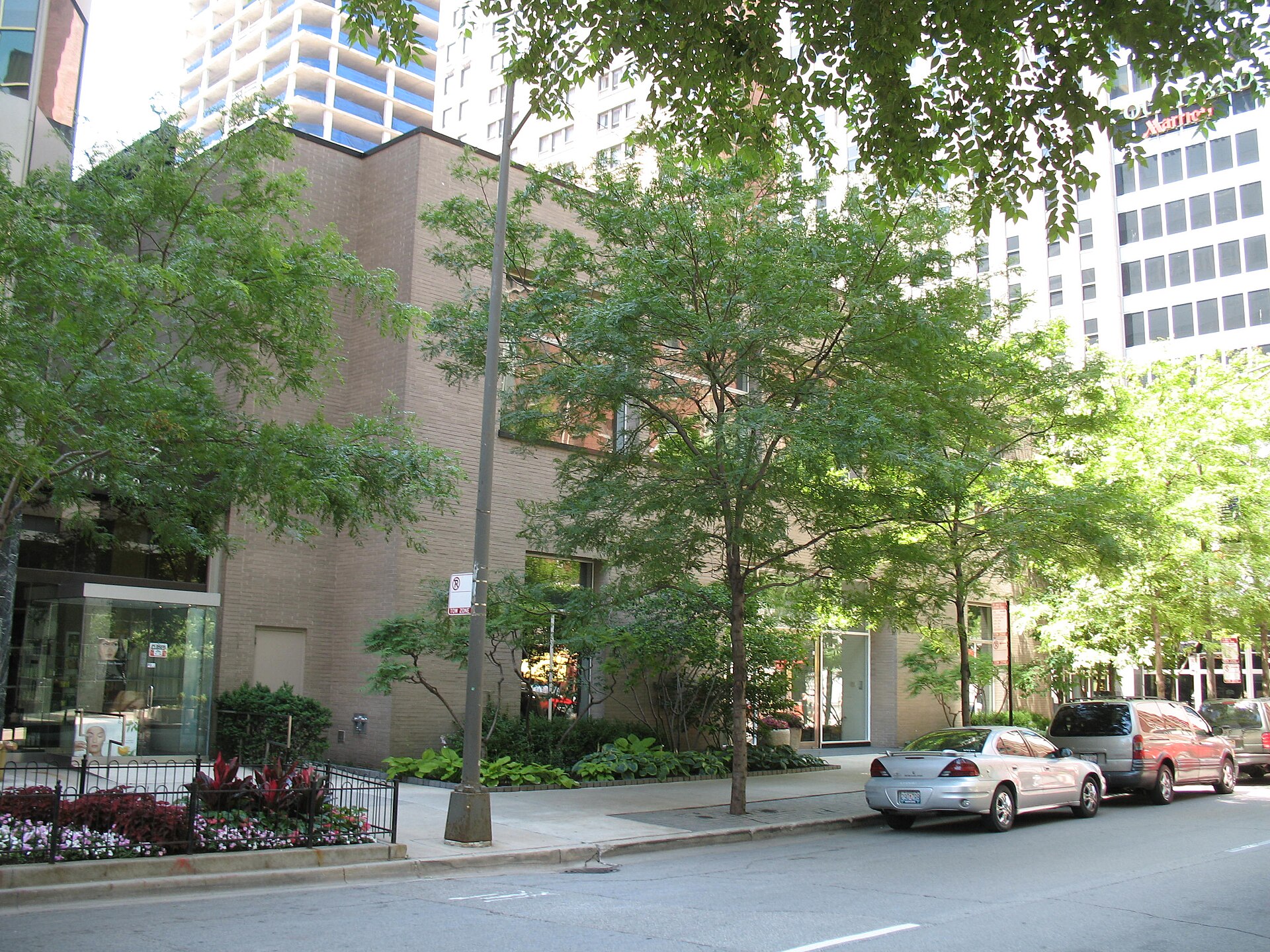
The Arts Club of Chicago is a members-only cultural association at 201 E. Ontario Street in Chicago, founded in 1916 in the wake of the controversial 1913 Armory Show to give the city "a home for challenging art, music, and ideas." Its ground-floor galleries are open to the public and have carried an outsized art-historical weight relative to their size: in March–April 1923 the Arts Club staged Pablo Picasso's first solo exhibition in the United States, in 1927 it presented a Constantin Brâncuși exhibition organized by Marcel Duchamp, and it went on to give Midwest or U.S. debuts to Alexander Calder's mobiles (1935), Jackson Pollock (1945), and later Marc Chagall, Salvador Dalí, and Louise Nevelson. Leadership by figures such as Rue Winterbotham Carpenter, Elizabeth "Bobsy" Goodspeed, and exhibition-committee head Alice Roullier steered this programming from 1918 through the 1940s, and the club operated as Chicago's leading venue for avant-garde art before the Museum of Modern Art was even founded in 1929.
The institution's building history is itself part of its identity: after moving through the Fine Arts Building, 610 S. Michigan Avenue, and the Wrigley Building, the club occupied a space at 109 E. Ontario Street from 1942 to 1997 designed by Ludwig Mies van der Rohe, centered on his celebrated floating staircase. When the club relocated to its current 19,000-square-foot building at 201 E. Ontario Street in 1997, architect John Vinci designed the new $9 million space while preserving that Mies staircase as its centerpiece. The Arts Club continues to organize original exhibitions rather than host traveling shows — its post-1998 program has included Marcel Broodthaers, Yayoi Kusama, Paul Thek, Lawrence Weiner, and Maya Lin — alongside artist conversations and performances, making it a destination for visitors drawn to seeing new curatorial work made specifically for this space rather than a fixed permanent collection.
Dettagli
Luogo
201 E Ontario St, 60611 Chicago, US