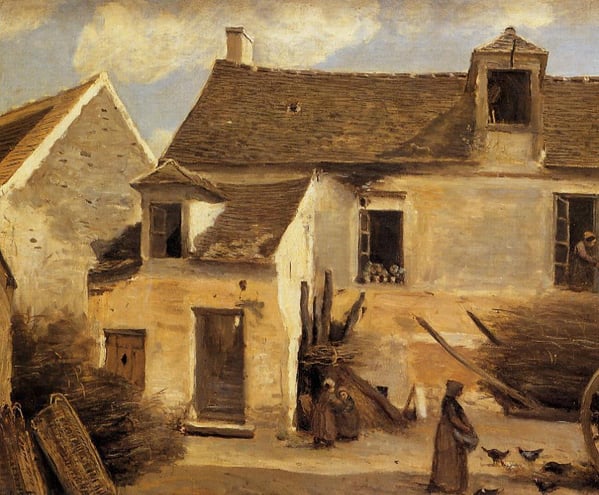
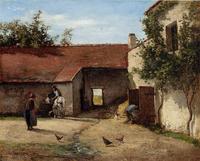
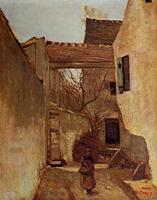
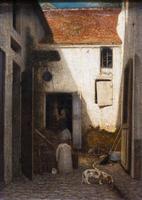
Camille Corot’s Courtyard of a Bakery near Paris (also known as Courtyard of a House near Paris) is a quintessential Realist cityscape that elevates an ordinary, functional space into a study of light, texture, and quiet dignity. Painted during the mid-19th century, the work exemplifies Realism’s departure from romanticized or historical subjects, focusing instead on the unglamorous corners of modern urban life. Here, a modest courtyard—likely behind a bakery—becomes the stage for Corot’s meticulous observation: weathered walls, a patch of gravel, a few figures going about their daily tasks. The careful modulation of natural light, filtering through the enclosed space, softens the stone and renders the scene with a palpable sense of atmosphere. This attention to the mundane, treated with both technical precision and lyrical sensitivity, marks Corot as a pivotal bridge between the classical landscape tradition and the emerging Realist insistence on truth to everyday experience. Moreover, his nuanced handling of shadow and airiness prefigures the Impressionists’ fascination with transient light, making this small work a significant touchstone in the evolution from Realism toward modern plein-air painting.