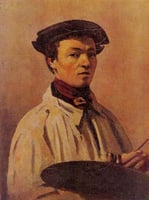
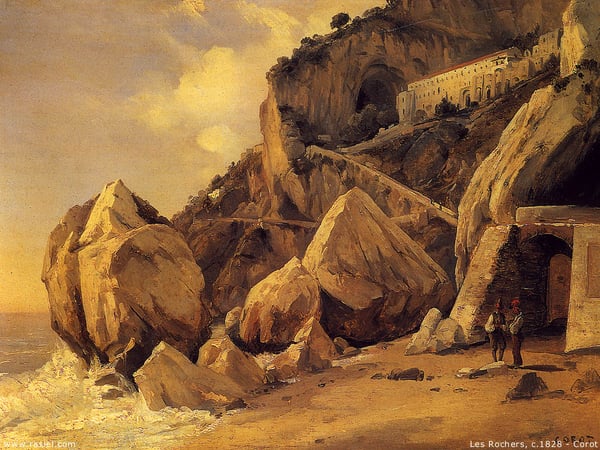
Analisi esperta di Rocks in Amalfi di Camille Corot
Stile: Realism · Genere: landscape
Expert Art Historical Analysis: "Rocks in Amalfi" by Camille Corot
Camille Corot’s "Rocks in Amalfi" stands as a compelling example of Realist landscape painting from the mid‑19th century—a period when artists increasingly turned away from idealized, historical compositions toward direct observation of nature. Within the Realist movement, this work is significant for demonstrating Corot’s masterful balance between topographical accuracy and a subtle, atmospheric sensitivity that elevates the ordinary rock formation into a subject of serious pictorial study.
Significance within Realism and Landscape Tradition:
-
Faithful Depiction of a Specific Locale:
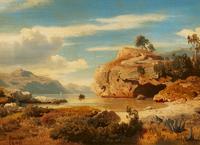
True to Realist principles, Corot presents the rugged cliffs of Amalfi with palpable geological precision. The artist does not soften or dramatize the rocks; instead, he records their texture, weight, and the way they emerge from the Mediterranean terrain. This commitment to empirical observation—recording a specific, unidealized corner of the Italian coast—places the work firmly in the Realist camp, rejecting the romanticized ruins or classical vistas that dominated earlier landscape painting. -
Innovative Treatment of Light and Atmosphere:
While maintaining a Realist foundation, Corot infuses the scene with a delicate, diffused light that anticipates Impressionism. The luminous quality of the sky, the subtle gradations of shadow on the stone surfaces, and the hazy distance reveal his lifelong fascination with valeur (the tonal relationship of colors). This interplay of precise detail and atmospheric unity makes the painting a bridge between strict Realism and the more poetic, plein‑air approaches that would follow. -
Tonal Harmony and Compositional Structure:
Corot organizes the composition with a quiet monumentality: the rock faces anchor the left and foreground, while a diagonal recession leads the eye toward a distant coastline bathed in soft light. His restrained, earthy palette—ochres, grays, muted greens—creates a sense of geological permanence and calm. This emphasis on tonal balance over dramatic contrast was a hallmark of Corot’s mature style, and it allowed him to render a “real” landscape with a meditative, almost classical serenity. -
Influence on Later Landscape Painters:
“Rocks in Amalfi” exemplifies why Corot is often called the “father of modern landscape.” His ability to combine precise naturalism with an airy, atmospheric touch—without succumbing to sentimentality—established a model for subsequent Realists (such as the Barbizon school) and eventually the Impressionists. The painting demonstrates that a simple rock outcrop, observed with patience and humility, could carry the same artistic weight as a historical allegory.
In sum, “Rocks in Amalfi” is significant not only as a faithful record of a specific Italian site but as a manifesto of Realist principles in landscape art: truth to nature, subtlety of light, and a refusal to embellish. Corot’s delicate handling transforms a humble geological subject into a timeless meditation on the quiet power of the natural world.
Museum / Gallery
Visivamente simili
20 opere con composizione e palette affini
An der Küste von Amalfi
Leo von Klenze
Coast, Bay of Naples, possibly Sorrento
William Stanley Haseltine
Sorrento
Nikolai Ge
Vico Equense on the Sorrentine coast with the Cattedrale dell'Annunziata
Oswald Achenbach
Cave in Sorrento
Sylvester Shchedrin
The Coast at Amalfi
Ivan Aivazovsky
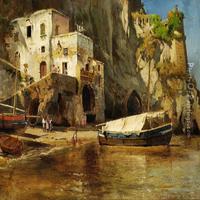
Coastal View With An Old House And A Boat, Sorrento
Carl Frederik Sorensen
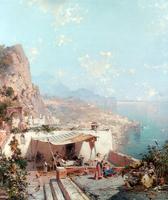
Amalfi, The Gulf Of Salerno
Franz Richard Unterberger
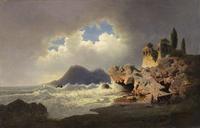
View of the Torre di Badia at Marina di Vietri between Salerno and Amalfi
Albert Flamm
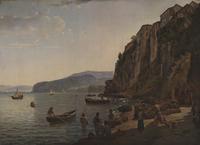
Small harbor in Sorrento
Sylvester Shchedrin
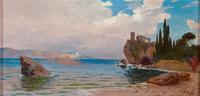
Adrialandschaft
Ferdinand Knab
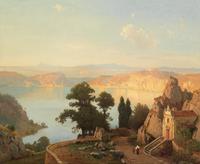
View of the lake of Nemi near Rome
Carl Gustav Rodde
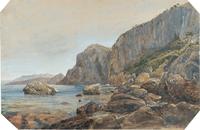
Cliffs near Capri
William Wyld
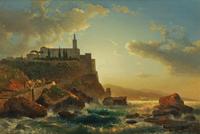
Kloster an der italienischen Küste
Hermann Mevius
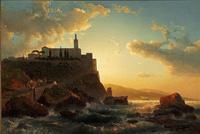
Italian cloister near the the coast
Hermann Mevius
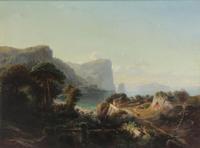
Landscape. Possibly Naple
Johann Hermann Carmiencke
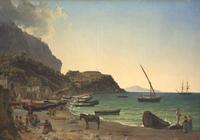
The Large harbor on Capri island
Sylvester Shchedrin
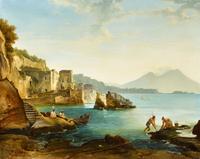
Gulf of Naples with fishermen and mussels gathering
Franz Ludwig Catel
An Italian Landscape
Albert Flamm
Walk of monks to Mount Athos monastery
Hermann David Salomon Corrodi