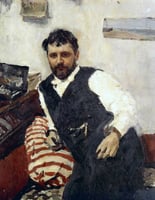
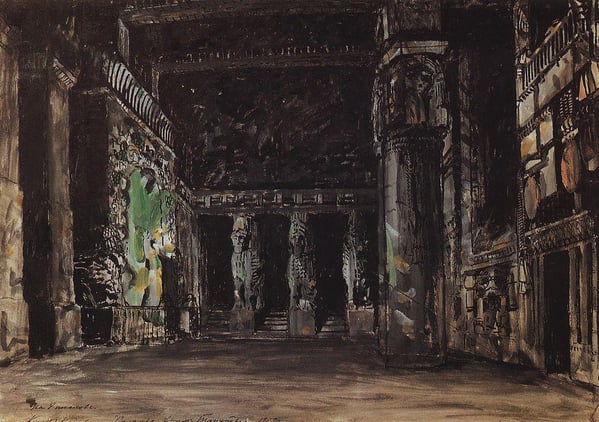
Analisi esperta di Temple of Tanit di Konstantin Korovin
Stile: Art Nouveau (Modern) · Genere: interior
Expert Analysis: "Temple of Tanit" by Konstantin Korovin
Konstantin Korovin’s “Temple of Tanit” stands as a striking example of Art Nouveau’s theatrical synthesis of ornament, symbol, and exoticism. Classified as an interior genre work, it likely depicts a stage or imagined sacred space dedicated to the Phoenician goddess Tanit—a subject that aligns with the period’s fascination with ancient, mystical, and non-Western cultures.
Significance within Art Nouveau:
Korovin transforms the interior into a living, organic environment. The composition would typically rely on sinuous, flowing lines (the hallmark of Art Nouveau) to define architectural elements—columns, archways, and altars—that mimic natural forms such as vines or waves. The palette probably employs opulent jewel tones (deep purples, golds, teals) and iridescent highlights, echoing the movement’s love for stained glass, enamel, and luxurious materials. The “Temple” itself becomes a Gesamtkunstwerk (total work of art), where every surface is decorated with stylized floral or celestial motifs, dissolving the boundary between structure and decoration.
Thematic Importance:
By choosing Tanit—a Carthaginian symbol of fertility, the moon, and the heavens—Korovin taps into Art Nouveau’s obsession with the feminine, the nocturnal, and the spiritual. The interior is not merely a room but a ritual space, evoking mystery and transcendence. This reflects the movement’s broader rejection of industrial rigidity in favor of a dreamed, symbolic world.
Context and Innovation:
Korovin, primarily known for his Impressionist landscapes and stage designs, here adapts his painterly looseness to a more controlled decorative idiom. “Temple of Tanit” likely functioned as a set design for a ballet or opera (e.g., for Diaghilev’s Ballets Russes or a similar production), where art, music, and dance converged. In this, it exemplifies Art Nouveau’s ambition to blur artistic disciplines and transport the viewer into an immersive, stylized realm.
In sum, the work is significant for how it merges the decorative exuberance of Art Nouveau with the symbolic depth of an exotic cult interior, demonstrating Korovin’s ability to infuse a modern, ornamental language with theatrical narrative and emotional atmosphere.
Visivamente simili
20 opere con composizione e palette affini
Temple of Denderah
John Singer Sargent
Babylon Fallen
Gustave Dore
Pharaoh's Palace
Vasily Polenov
Dungeon
Vasily Polenov
Daniel Interpreting the Writing on the Wall
Gustave Dore
Prodigal Son
Vasily Polenov
Pharaoh asked Moses to bring jewish people out of Egypt
Alexander Ivanov
The Temple of Isis on Philae island
Vasily Polenov
Moses and Aaron Before Pharaoh
Gustave Dore
Portico of the Temple of Isis at Philae
David Roberts
The Sword Dance
Jean-Leon Gerome
The Song of Songs
Frantisek Kupka
Theatre
Konstantin Korovin
The Pyrrhic Dance
Jean-Leon Gerome
The Egyptian Widow
Sir Lawrence Alma-Tadema
The palace and the harbor
Konstantin Korovin
The Vintage Festival
Sir Lawrence Alma-Tadema
The Egyptians Ask Moses to Depart
Gustave Dore
Departure of the Israelites
David Roberts
Pastimes in Ancient Egyupe 3 000 Years Ago
Sir Lawrence Alma-Tadema