
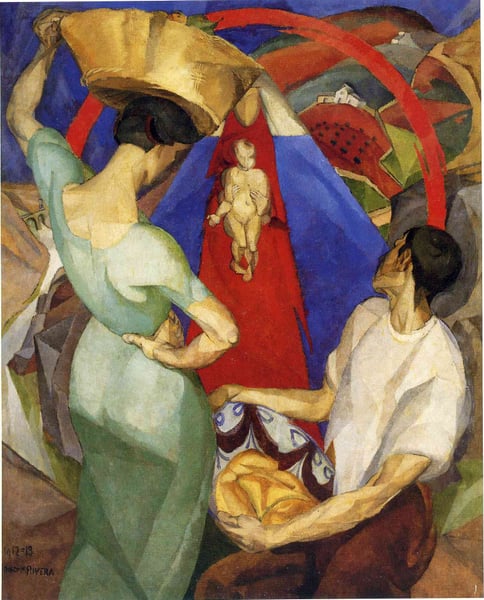
Analisi esperta di The Adoration of the Virgin di Diego Rivera
Stile: Cubism · Genere: religious painting
Expert Analysis: "The Adoration of the Virgin" by Diego Rivera
Diego Rivera’s The Adoration of the Virgin (c. 1913–1917) stands as a pivotal work within the artist’s early Cubist period, marking a bold fusion of avant-garde European modernism with traditional Mexican religious iconography. Painted while Rivera was immersed in the Parisian Cubist circle, this work is significant for several reasons:
1. Rare Subject in Cubism
Cubism, with its emphasis on fractured forms and multiple perspectives, rarely tackled explicitly religious themes. Rivera’s choice to depict the Virgin Mary—a subject steeped in Renaissance and Baroque devotional painting—demonstrates his ambition to reconcile the sacred with the revolutionary visual language of Picasso and Braque. The composition likely retains the hierarchical, centered focus typical of a religious altarpiece, but translates it into angular, overlapping planes and muted earth tones, stripping away naturalistic detail to emphasize spiritual essence over literal representation.
2. Hybrid Cultural Identity
This artwork reveals Rivera’s transitional moment: he was absorbing European avant-garde techniques while still rooted in Mexican Catholic heritage. The Virgin becomes a universal, geometric symbol rather than a sentimental figure, reflecting the Cubist drive to deconstruct form. This hybridity foreshadows Rivera’s later synthesis of modernist form and indigenous Mexican content in his monumental murals.
3. Formal Innovation
As a Cubist religious painting, The Adoration of the Virgin challenges conventional notions of sacred art. The fragmented space suggests a divine realm beyond single-point perspective—viewers are invited to contemplate multiple viewpoints simultaneously, mirroring the mystical, all-seeing nature of the divine. The use of subdued colors (gray, ochre, blue) and faceted shapes evokes a sense of solemnity, while maintaining the intellectual rigor of analytical Cubism.
Significance in Rivera’s Oeuvre
This work marks Rivera’s brief but intense engagement with Cubism before his return to Mexico and subsequent turn toward Social Realism. It demonstrates that Rivera was not merely a derivative follower of European Cubism, but an innovator who infused the style with personal and cultural meaning. By placing the Virgin within a fractured, modern visual vocabulary, Rivera asserted that ancient religious devotion could coexist with contemporary artistic revolution—a theme that would later define his politically charged murals.
In short, The Adoration of the Virgin is significant as a rare, successful marriage of Cubist abstraction and religious narrative, revealing Rivera’s early mastery and his lifelong commitment to making art that speaks to both the sacred and the modern.
Museum / Gallery
Genere
Stile
Visivamente simili
20 opere con composizione e palette affini
Figures in a Landscape at Ampurdan
Salvador Dali
The White Stocking
William Balthazar Rose
Morning: Women Bathing
Kuzma Petrov-Vodkin
Abundance
Henri Le Fauconnier
Czene Bela , Almaszedő, 1942
Czene Béla
Woman at a Well
Diego Rivera

Woman Nursing Her Son
Salvador Dali

The Psychologist
Paul Feeley
Composition with Romanian Motifs
Ion Theodorescu-Sion
Reclining Tahitian Women
Paul Gauguin
L'escale
André Lhote
Couple in the woods
August Macke
Maternite II
Paul Gauguin
Harana
Botong Francisco
La fonte
Ottone Rosai
Lied I
Albert Bloch
The Swimmers
Albert Gleizes
Composition (Mulattos with pitchers)
Arturo Souto
The Survivors. The War Series
Joan Tuset
Gleaners
Rafael Zabaleta