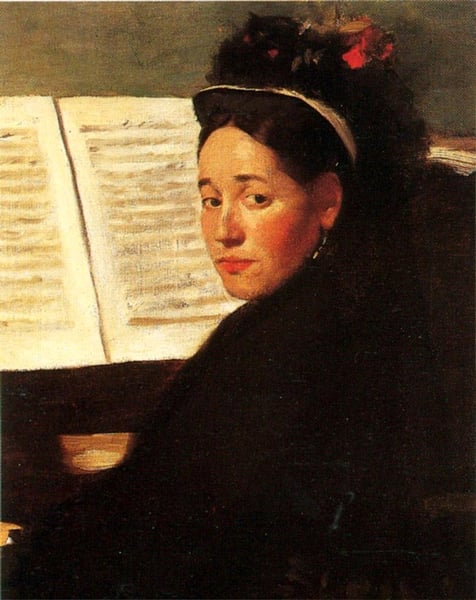
Analisi esperta di Mademoiselle Didau at the Piano di Edgar Degas
Stile: Impressionism · Genere: portrait
Expert Analysis of "Mademoiselle Didau at the Piano" by Edgar Degas
This portrait, firmly rooted in the Impressionist movement, exemplifies Degas’s distinctive approach to capturing modern life. While many Impressionists focused on landscapes and outdoor leisure, Degas specialized in intimate, often unconventional interior scenes—especially those involving music, dance, and the private moments of Parisian society.
Significance within the Impressionist Style
-
Modern Subject and Psychological Intimacy: Degas elevates the portrait genre by focusing on a specific, personal activity—a young woman at the piano. Rather than a formal, staged likeness, he presents a candid, absorbed moment. Mademoiselle Didau is not posed for the viewer; she is shown in the act of playing, her attention directed at the instrument. This captures the Impressionist fascination with the fleeting, unposed instants of contemporary life.
-
Innovative Composition and Cropping: True to Degas’s signature style, the composition likely employs unexpected cropping—perhaps the piano cuts into the frame, or the figure is placed off-center. This echoes the influence of photography and Japanese ukiyo-e prints, which Degas admired. Such asymmetrical framing creates a sense of immediacy, as if we are glimpsing a private rehearsal.
-
Atmospheric Light and Color: Degas uses Impressionist brushwork to dissolve hard outlines, allowing light and color to define form. The interplay of warm lamplight (typical of indoor scenes) against cooler shadows would modulate the whites of the sheet music and the sitter’s dress. This technique emphasizes the atmosphere of the room rather than mere descriptive detail, aligning with Impressionism’s goal of capturing optical sensation.
-
Gesture and the Artist’s Detachment: Unlike the sentimentalized portraits of earlier periods, Degas treats his subject with a certain cool objectivity. The focus on the hands poised over the keys and the tilt of the head conveys a psychological state—concentration, perhaps even melancholy. This detachment, combined with the informal vantage point, makes the work a precursor to modern portraiture, where identity is revealed through action and environment rather than idealized features.
In summary, Mademoiselle Didau at the Piano is significant as a quintessential Degas portrait that merges Impressionist technical innovation—loose brushwork, unconventional framing, and atmospheric light—with a penetrating, modern interest in the private rituals of urban life. It stands as a testament to Degas’s ability to find artistic drama in the quiet, everyday act of making music.
Museum / Gallery
Visivamente simili
20 opere con composizione e palette affini
Emma at the Piano
George Bellows
At the Piano
Julian Alden Weir
Portrait of the unknown woman near piano
Taras Shevchenko

Girl playing the piano
Nikola Martinoski
A Day Dream
Edward Poynter

Mariana Benedita Sequeira
Domingos Sequeira

Josephine Gaujean
Edgar Degas

Portrait of Eric Satie at the harmonium
Santiago Rusinol

The Piano Lesson
Gustave Caillebotte
Elizabeth at the Piano
Thomas Eakins

Portrait of Mariano Goya
Francisco Goya
Czartoryska
Jan Matejko
The Artist`s Mother
Felix Vallotton

A Romance
Santiago Rusinol
At the Piano
Thomas Eakins

Portrait of Frances Eakins
Thomas Eakins

Home scene
Thomas Eakins
The piano. Portrait of S.V. Tarnovskaya
Ilya Repin

Charles Deering
John Singer Sargent

The Black Shawl
Samuel Peploe