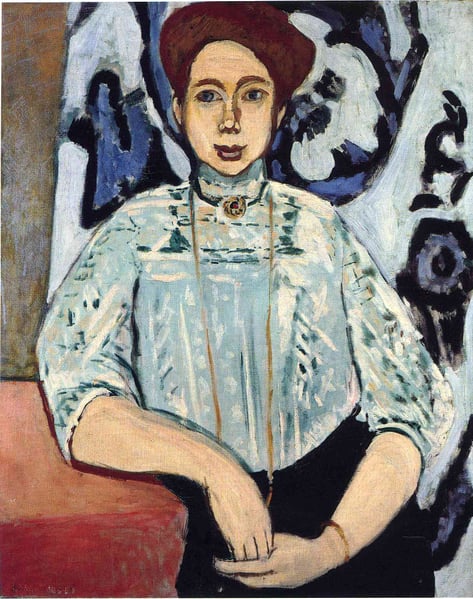
Analisi esperta di Greta Moll di Henri Matisse
Stile: Post-Impressionism · Genere: portrait
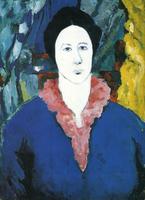
The significance of Henri Matisse’s Greta Moll lies in its embodiment of the transition from Post-Impressionism to Fauvism, a movement Matisse himself pioneered. As a portrait within this period, the work exemplifies a radical departure from naturalistic representation: Matisse prioritizes expressive color, flattened space, and simplified form over mimetic detail. The structured facts provided indicate the style as Post-Impressionism, which situates the painting within the late-19th- to early-20th-century reaction against Impressionism’s optical concerns—here, Matisse pushes further toward emotional and structural autonomy. The genre of portraiture is crucial: rather than capturing a literal likeness, he uses the sitter as a vehicle for rhythmic line and bold, non-local hues, anticipating the liberated palette of Fauvism. This makes Greta Moll significant as a bridge between the subjective intensity of Post-Impressionism (e.g., Gauguin, van Gogh) and the full-blown color revolution that Matisse would soon unleash, redefining what a portrait can convey.
Museum / Gallery
Genere
Stile
Visivamente simili
20 opere con composizione e palette affini
Girl with a Fan
Pyotr Konchalovsky
Portrait of Tyra Hasselblatt
Magnus Enckell
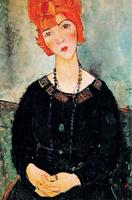
Woman With a Necklace
Amedeo Modigliani
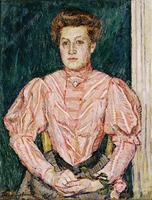
Paris. Innkeeper.
Pyotr Konchalovsky
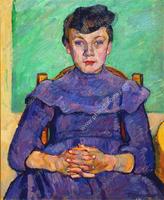
Girl from Arles
Pyotr Konchalovsky
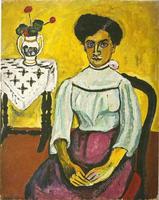
Spanish woman
Pyotr Konchalovsky
Untitled
Nicolae Tonitza
Untitled
Henri Matisse
Portrait of the Artist V. V. Wulf
Konstantin Korovin
Woman Reading with Peaches
Henri Matisse
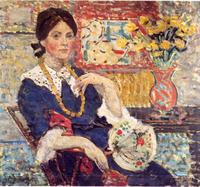
Le Rouge Portrait of Miss Edith King
Maurice Prendergast
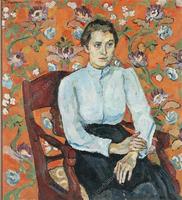
Pasha on flowers
Pyotr Konchalovsky
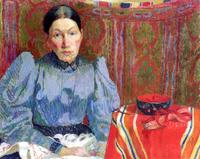
Portrait of Emilie Amiet-Baer
Cuno Amiet
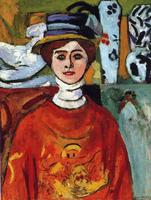
The girl with green eyes
Henri Matisse
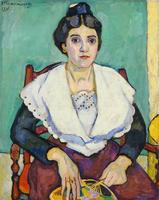
Girl from Arles
Pyotr Konchalovsky
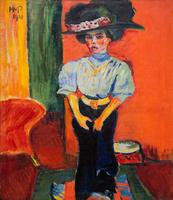
Ein frühes Damenbild
Max Pechstein
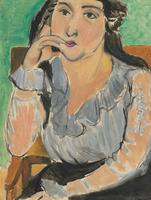
Portrait De Femme (Lorette)
Henri Matisse
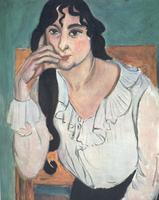
Laurette with a White Blouse
Henri Matisse

Portrait of the Artist's Wife
Bela Kadar
Blue Portrait
Kazimir Malevich