
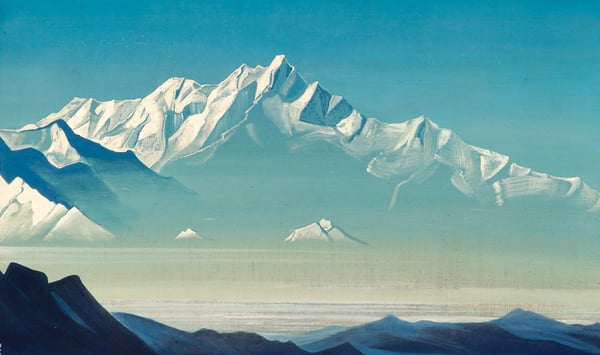
Mount of five treasures (Two worlds)
Dettagli
Analisi esperta di Mount of five treasures (Two worlds) di Nicholas Roerich
Stile: Symbolism · Genere: landscape
Expert Analysis: "Mount of five treasures (Two worlds)" by Nicholas Roerich
Nicholas Roerich’s Mount of five treasures (Two worlds) stands as a quintessential example of Symbolist landscape painting, where the natural world becomes a conduit for spiritual and metaphysical meaning. Executed within the Symbolist movement—which prioritized inner vision, mysticism, and the evocation of ideas over literal representation—this work transforms a seemingly straightforward landscape into a layered meditation on duality and transcendence.
Significance within the Symbolist Style and Period
Roerich’s choice of a mountain as the central subject is profoundly significant. In Symbolist art, mountains frequently symbolize ascension, spiritual striving, and the meeting point between earthly and divine realms. The title Mount of five treasures likely alludes to a sacred peak (possibly Mount Kailash in Tibetan Buddhism or a similar mythical mountain), where “five treasures” correspond to elements, directions, or enlightened qualities—common motifs in Eastern esoteric traditions. The subtitle Two worlds explicitly frames the composition as a boundary or bridge: the physical world (the rugged, tangible landscape) and the spiritual world (the luminous, transcendent light or hidden treasures). This duality is a core Symbolist concern—depicting the invisible through the visible.
Roerich’s technique reinforces this significance. His use of bold, simplified forms and rhythmic, almost musical lines (a hallmark of his mature style) creates a sense of hieratic stillness. The color palette—typically deep blues, purples, and cold whites—evokes a timeless, otherworldly atmosphere, distancing the scene from mere topographic accuracy. The mountain is not a realistic depiction but an icon: it looms as a silent, powerful presence, inviting contemplation rather than observation. This approach aligns perfectly with Symbolism’s rejection of naturalism in favor of subjective, symbolic expression.
Moreover, Roerich’s unique position as both a Russian painter and a deep student of Indian and Tibetan philosophy gave his Symbolism a distinctive cross-cultural dimension. While European Symbolists often drew on Christian, classical, or occult sources, Roerich infused his landscapes with Buddhist and Hindu concepts of sacred geography. Mount of five treasures thus exemplifies how Symbolism could synthesize diverse spiritual traditions into a universal visual language—making the work not only significant within its immediate movement but also as a pioneering example of East-West artistic dialogue.
In summary, this painting’s significance lies in its masterful use of the landscape genre to embody the Symbolist creed: that art should suggest, not describe; that the material world is a veil for eternal truths; and that the viewer is called to experience, not just see. Roerich’s Mount of five treasures remains a luminous testament to Symbolism’s power to transform a mountain into a threshold between two worlds.
Museum / Gallery
Visivamente simili
20 opere con composizione e palette affini

Himalayas
Nicholas Roerich

Land of snow people
Nicholas Roerich

Sacred Himalayas
Nicholas Roerich
Himalayas
Nicholas Roerich
Abode of King Gesar
Nicholas Roerich
Sunset
Nicholas Roerich

Kangchenjunga
Nicholas Roerich
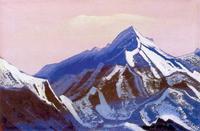
Himalayas
Nicholas Roerich
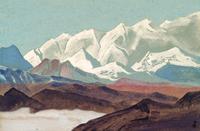
Himalayas. Chain of Kanchenjunga.
Nicholas Roerich
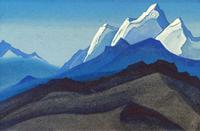
Himalayas
Nicholas Roerich

Kangchenjunga
Nicholas Roerich
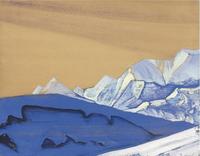
Tibet
Nicholas Roerich
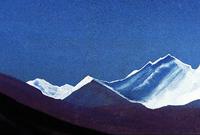
Himalayas
Nicholas Roerich

Himalayas. Sunset.
Nicholas Roerich

Kangchenjunga
Nicholas Roerich

Himalayas
Nicholas Roerich
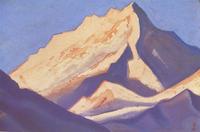
Himalayas
Nicholas Roerich

Himalayas. Everest.
Nicholas Roerich

Himalayas
Nicholas Roerich

Himalayas
Nicholas Roerich